
Prologue: The Contemporary European Paradox
The European Union is currently facing a profound structural tension. On the one hand, it claims a socio-economic model grounded in the protection of human dignity, social cohesion, and quality of working life. On the other, it operates within a geopolitical and economic environment characterized by instability, intensified global competition, and rapid technological acceleration.
This paradox is not merely institutional or macroeconomic in nature. More fundamentally, it raises questions about the place accorded to human beings within European productive systems and about the capacity of the European project to reconcile sustainable economic performance with the psychological integrity of individuals.
I. Psychosocial Risks: A Reality Established by European Data
Work-related psychosocial risks including chronic stress, excessive mental workload, lack of autonomy, and value conflicts, have become a central focus of European social policy analysis.
Successive surveys conducted by the European Agency for Safety and Health at Work (EU-OSHA), particularly the Third European Survey of Enterprises on New and Emerging Risks (ESENER-3, 2019), show that a majority of European companies report exposure to at least one psychosocial risk factor. These risks are widely acknowledged as more complex to prevent than traditional physical risks, due to their organizational, relational, and multifactorial nature.
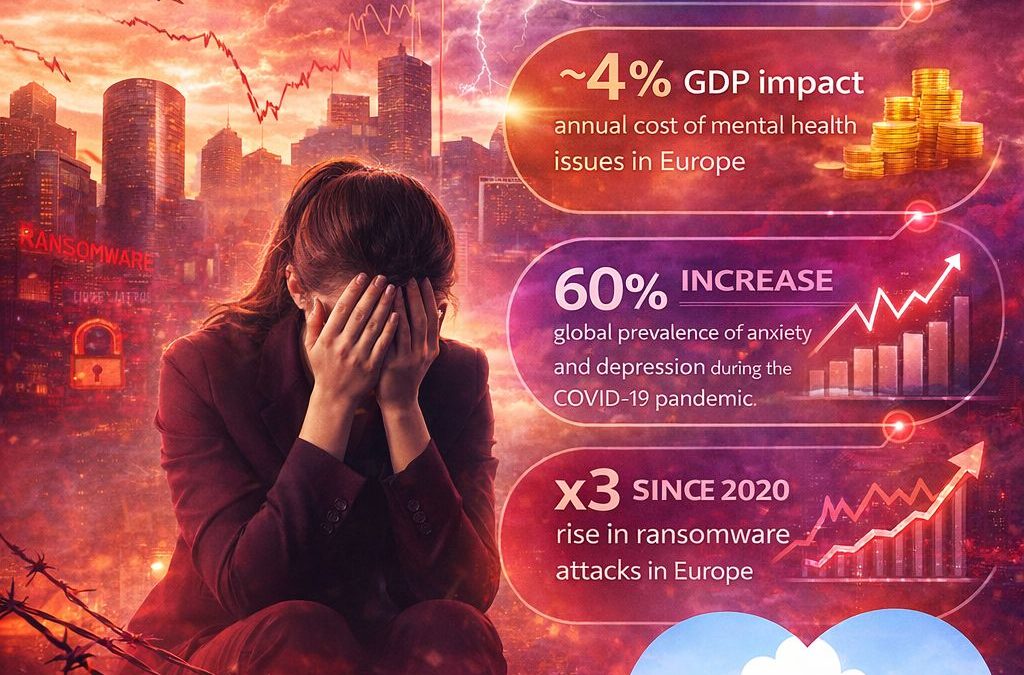
European findings are consistent with those of the World Health Organization. In its World Mental Health Report (2022), the WHO documented a significant global increase in anxiety and depressive disorders during the first year of the COVID-19 pandemic. While global in scope, these findings resonate strongly within the European context, which has experienced profound transformations in work organization, including the expansion of telework, digital intensification, and heightened economic uncertainty.
II. The Measurable Economic Cost of Psychological Distress
The consequences of deteriorating mental health extend far beyond the individual sphere and constitute a well-documented macroeconomic challenge.
The Organisation for Economic Co-operation and Development (OECD) estimates that mental health disorders generate substantial economic losses across member countries, primarily through reduced productivity, absenteeism, presenteeism, and increased social and healthcare expenditures. According to OECD assessments, the overall cost of mental health disorders can amount to several percentage points of gross domestic product, depending on the methodology applied.
Eurofound’s research, notably the European Working Conditions Survey (most recent available edition), corroborates these findings. A significant share of European workers report exposure to working conditions likely to undermine mental health, including high work intensity, insufficient managerial support, and limited decision-making autonomy.
III. A Geopolitical and Technological Context Amplifying Uncertainty
These social dynamics are compounded by an increasingly constraining geopolitical and technological environment.
The European Union Agency for Cybersecurity (ENISA), in its recent threat landscape reports, documents a marked increase in cyberattacks, particularly ransomware attacks, since the early 2020s. This trend places European organizations in a state of sustained vigilance, contributing to heightened organizational pressure and psychological strain.
At the macroeconomic level, the euro area experienced an exceptional inflationary episode in 2022, reaching a historic peak in October of that year, according to European Central Bank data. This inflationary surge, largely driven by energy shocks and geopolitical disruptions, has significantly intensified economic uncertainty for both households and firms.
IV. Demographic Constraints: A Long-Term Structural Pressure
Demographic projections produced by Eurostat highlight a profound structural transformation of the European labour market. The old-age dependency ratio, defined as the proportion of people aged 65 and over relative to the working-age population, is expected to rise sharply between 2050 and 2070.
This demographic shift implies increasing pressure on the active workforce, both in terms of productivity expectations and the sustainability of social protection systems. It mechanically reinforces the importance of mental health and job quality as critical determinants of long-term economic resilience.
V. The European Regulatory Framework: A Progressive but Still Incomplete Response
In response to these challenges, the European Union has progressively strengthened its regulatory framework.
Directive (EU) 2022/2464 on corporate sustainability reporting (CSRD) represents a major milestone by significantly expanding non-financial reporting obligations, including social and governance dimensions. The directive aims to improve the comparability, transparency, and reliability of information related to corporate practices.
In parallel, the European Commission presented in 2023 a comprehensive approach to mental health, explicitly acknowledging psychological well-being as a key determinant of economic prosperity and social cohesion within the Union.
VI. The Central Tension: Economic Competitiveness and Psychological Integrity
Despite these advances, a fundamental tension remains. How can European economies maintain competitiveness in a globalized environment while preserving the psychological integrity of workers? How can performance imperatives be prevented from generating excessive pressure, behavioral standardization, or progressive human disengagement?
Available evidence indicates that measurement tools exist, risks are clearly identified, and normative frameworks are taking shape. The remaining challenge lies in translating these insights into sustainable organizational transformations.
VII. Managerial and Ethical Innovation as a European Lever
In this context, managerial innovation emerges as a strategic lever. The issue is not merely the adoption of preventive mechanisms, but a broader rethinking of leadership models, work organization, and the recognition of individual contribution.
Such an evolution requires a more systematic integration of insights from social sciences, work psychology, and behavioral economics, in order to design organizations capable of reconciling economic efficiency with respect for human dignity.
Conclusion: Towards a European Economic Humanism
Europe today possesses a robust body of evidence, drawn from public and verified sources, highlighting contemporary psychosocial challenges. These data reveal both vulnerabilities and opportunities.
The core issue is no longer diagnostic, but one of coherence between proclaimed values and actual practices. The construction of a European economic humanism is not an abstract ideal; it is a condition for economic, social, and democratic sustainability.
Beyond statistical indicators, the credibility of the European project itself is at stake in the way it protects and values the psychic capital of those who ensure its daily functioning.
Sources
- EU-OSHA, Third European Survey of Enterprises on New and Emerging Risks (ESENER-3), 2019.
- World Health Organization, World Mental Health Report, 2022.
- OECD, Tackling the Mental Health Crisis in the Workplace, 2022.
- Eurofound, European Working Conditions Survey, latest available edition.
- ENISA, Threat Landscape, recent editions.
- European Central Bank, Economic Bulletin, 2022.
- Eurostat, Ageing Europe, 2023.
- Official Journal of the European Union, Directive (EU) 2022/2464 (CSRD).
- European Commission, A Comprehensive Approach to Mental Health, COM(2023) 298 final.