
Surface stability, underlying tensions
As markets enter the week of 19 January 2026, a semblance of calm dominates. Systemic stress indicators remain contained, implied volatility is moderate, and major indices are confined to narrow trading ranges. Yet beneath this measured surface, multiple tensions persist, illustrating that the current equilibrium relies more on expectations than conviction.
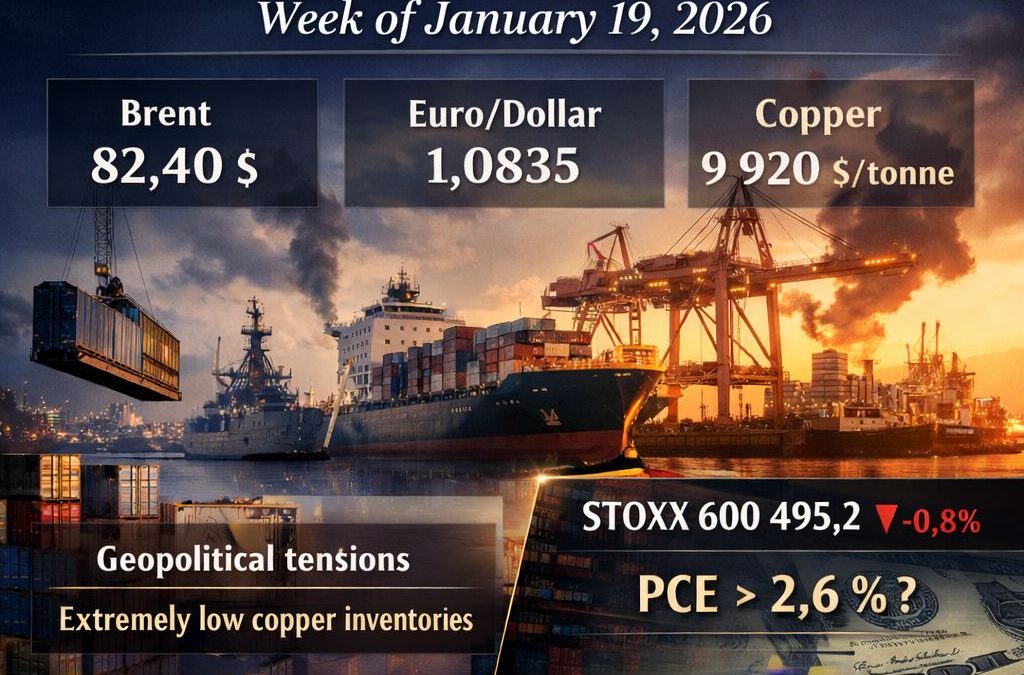
Brent crude hovers around $82 per barrel, the euro trades near $1.08 against the dollar, and European sovereign yields remain within tight bands. Collectively, these movements reflect a cautious stance by investors, attentive to a series of political, macroeconomic, and geopolitical events. None of these factors, in isolation, are likely to destabilize markets significantly, but in combination, they could rapidly alter risk perceptions.
Geopolitics: persistent, diffuse pressures
One of the most structurally significant issues this week remains the Black Sea. As the end-of-January deadline for cereal export mechanisms approaches, the situation extends beyond agricultural trade. It implicates global food security, logistics chains, and regional diplomacy. Satellite data indicates a modest but notable slowdown in Ukrainian port activity, while insurance premiums remain elevated, reflecting a sustained perception of risk.
Further south, partial protection of shipping routes in the Red Sea prevents outright disruption of trade, but logistical costs and rerouting requirements continue to impose burdens on global commerce. These pressures do not trigger immediate market panic but act as a steady background factor, sustaining risk premiums across commodities and shipping.
Financial markets: selective caution
In European equities, hesitancy predominates. The Stoxx Europe 600, slightly lower, signals not a sharp deterioration in economic fundamentals, but prudence in the face of political and fiscal uncertainties, particularly ongoing EU deliberations on budgetary frameworks.
Flows indicate a preference for defensive sectors (healthcare, utilities, and select high-quality equities) at the expense of more cyclical areas. The rotation is gradual rather than dramatic, highlighting a market prioritising visibility over rapid performance.
In the United States, the picture is broadly similar. Indices drift with no clear direction, awaiting clarity from earnings releases and inflation indicators. Attention to the Personal Consumption Expenditures (PCE) index underscores investors’ sensitivity to information that could shift monetary policy expectations, even in the absence of major surprises.
Bond markets exhibit comparable calm. European sovereign yields remain contained, reflecting confidence in monetary authorities’ capacity to maintain a predictable path, with limited scope for sudden shifts in expectations.
Commodities: fragile equilibria
Markets for raw materials arguably reveal the most pronounced structural vulnerabilities. Energy prices fluctuate in response to weekly inventory data and geopolitical signals, without establishing a clear trend. Globally, supply is sufficient, yet regional disruptions immediately affect prices.
Industrial metals, especially copper, warrant attention. Visible inventories remain historically low, leaving the market highly sensitive to supply incidents. This contrasts with more reassuring narratives regarding global demand, underscoring that certain pressures are structural rather than purely cyclical.
Agricultural markets are similarly in a holding pattern. International indicators signal tight global stocks for certain cereals, though not yet a scenario of immediate shortage. Here again, markets operate in a regime of constant vigilance rather than crisis.
Perspective
Unlike prevailing interpretations that emphasize market resilience, data suggest a more nuanced reality. Current stability does not indicate risk disappearance; rather, it reflects the market’s temporary capacity to absorb them. Geopolitical tensions, logistical fragilities, and political uncertainties do not provoke immediate disruption but contribute to a slow recalibration of asset valuations.
In this environment, volatility should not be treated as an anomaly but as a permanent feature. Adjustments occur gradually and subtly, yet their cumulative effect can be profound.
Conclusion
The week of 19 January 2026 is unlikely to see dramatic market swings. It represents a transitional phase, as markets reconcile apparent stability with clearly identifiable structural risks. For observers, it serves as a reminder: in a fragmented global landscape, market “normality” has become a delicate balance, continuously tested by external factors.
Analytical discipline, attention to subtle signals, and understanding the interplay between geopolitics, commodities, and finance are more crucial than ever.
Sources
Geopolitics & Financial Markets
- Reuters: U.S.-EU tariff announcements and market reactions.
- Associated Press: U.S. tariffs and futures market movements.
- The Guardian (Business Live): Global trade tensions and market response.
Energy & Commodities
- Reuters: Oil price fluctuations and Middle East supply context.
- Investing.com: Historical oil price trends and medium-term forecasts.
- BBC / Bermuda Broadcasting: Geopolitical signals affecting crude prices.
- The National: Supply-demand imbalances in 2026 oil market.
Agriculture & Shipping
- MarketMinute / The Pilot News: Black Sea cereal exports and insurance premiums.
Macro & Inflation
- Newsquawk / Barclays / Morgan Stanley: PCE index projections and market expectations.
Important Disclaimer: The content of this article is provided for informational and educational purposes only. It reflects the author’s opinion based on information available at the time of publication, which may become outdated. This content does not constitute personalized investment advice, a recommendation to buy or sell, and does not guarantee future performance. Markets carry a risk of capital loss. The investor is solely responsible for their decisions and should consult an independent professional advisor before any transaction. The publisher disclaims all liability for decisions made based on this information.