
A world economy holding together under structural pressure
Introduction: Stability under strain
March 2026 confirms that the global economy has entered a phase best described as constrained stability. Growth has not collapsed, inflation has moderated, and employment remains relatively resilient across most advanced economies. Yet the system operates with significantly narrower margins of safety than in the previous decade.
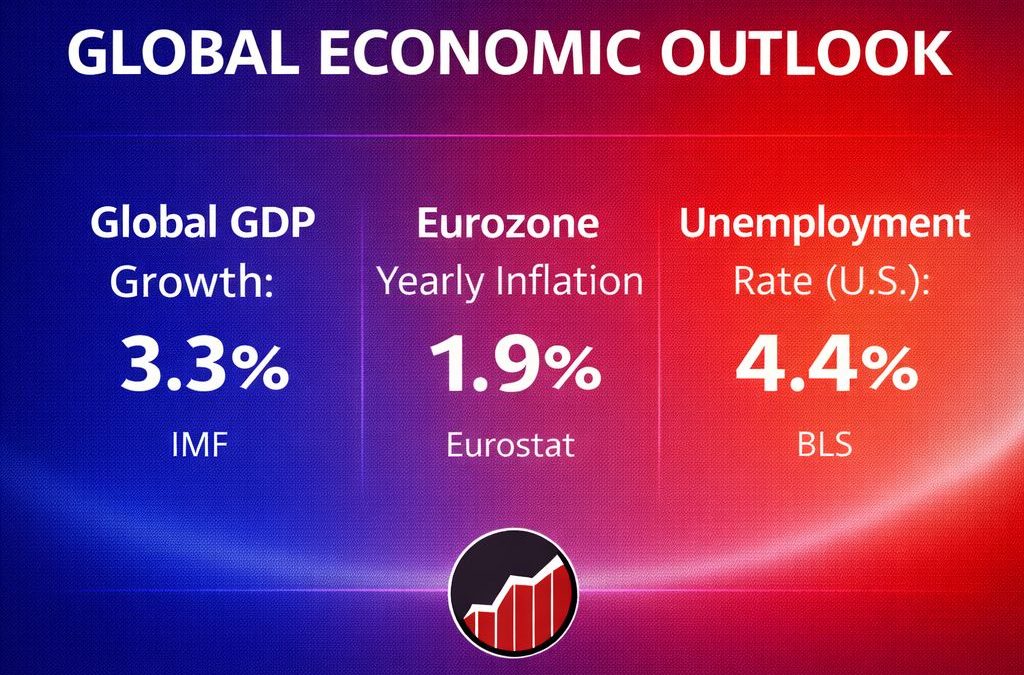
According to the International Monetary Fund’s World Economic Outlook Update (January 2026), global GDP is expected to expand by roughly 3.3% in 2026, broadly in line with the estimated growth rate for 2025. This suggests that the world economy remains resilient, but also that it has settled into a lower-speed equilibrium shaped by higher financing costs, geopolitical uncertainty and structural transitions in energy and technology.
Disinflation has continued but remains incomplete. According to Eurostat, inflation in the euro area stood at approximately 1.9% in February 2026, close to the European Central Bank’s target but still subject to volatility from energy and food markets. In the United States, according to the Bureau of Labor Statistics, the unemployment rate reached about 4.4% in February 2026, indicating a labor market that remains healthy but gradually less tight than during the peak of the post-pandemic expansion.
In this context, the central economic question has shifted. The issue is no longer whether the global economy can grow, but how resilient that growth remains in the face of recurrent shocks.
I. Financial markets: diversification and selective risk
Equities and ETF markets
Global capital markets continue to expand in scale but have become more selective in allocation. According to ETFGI, global assets invested in exchange-traded funds and exchange-traded products reached approximately $20.6 trillion by January 2026, reflecting sustained investor demand for liquid, diversified investment vehicles in a volatile macroeconomic environment.
However, capital flows reveal increasing sectoral differentiation. Technology, digital infrastructure and artificial intelligence continue to attract strong inflows, while capital-intensive industries remain more sensitive to elevated financing costs.
Sustainable finance also remains structurally important. According to ETFGI, ESG-focused ETFs accounted for nearly $800 billion in global assets by the end of 2025, demonstrating that environmental and governance criteria remain embedded in institutional investment strategies, even as regulatory frameworks become more pragmatic.
Crypto assets: a volatile but persistent financial segment
Digital assets remain a visible but volatile component of the global financial ecosystem. According to market data reported by Reuters in early 2026, Bitcoin traded around $68,000, following a period of correction linked to rising risk aversion and macroeconomic uncertainty.
Regulators continue to monitor the sector closely. According to a Federal Reserve research note published in December 2025, the expansion of stablecoins could influence deposit flows within the banking system and alter the channels of financial intermediation. This suggests that crypto markets are no longer viewed solely as speculative instruments but increasingly as elements of the broader financial architecture.
II. Commodities: strategic markets in an uncertain environment
Agriculture and global food markets
Agricultural markets have regained strategic importance for both policymakers and investors. According to the Food and Agriculture Organization of the United Nations (FAO), the FAO Food Price Index reached approximately 125 points in February 2026, rising slightly after several months of decline.
According to the FAO, the increase was driven primarily by higher prices for cereals, vegetable oils and meat products, reflecting climatic disturbances and logistical disruptions affecting major exporting regions.
These developments highlight a structural reality: food markets are no longer only an inflation component; they are increasingly a dimension of economic and geopolitical stability.
Industrial and precious metals
Industrial metals remain central to the global energy transition. According to the International Energy Agency (IEA), demand for critical minerals such as copper, lithium and nickel continues to expand as investments accelerate in renewable energy infrastructure, electrification and battery technologies.
At the same time, precious metals continue to serve as financial hedges against uncertainty. According to market reports cited by Reuters, gold reached historically high levels in early 2026 before stabilizing as the U.S. dollar strengthened and interest-rate expectations adjusted.
This dual movement illustrates the evolving role of commodities: industrial metals reflect structural transformation, while precious metals reflect systemic risk perception.
III. Energy markets: transition and security
Energy markets remain shaped by the interaction between the energy transition and supply security concerns.
According to the International Energy Agency’s Oil Market Report, global oil demand is expected to increase by roughly 850,000 barrels per day in 2026, while global supply could reach approximately 108.6 million barrels per day. Under normal conditions, such figures would suggest a relatively balanced market.
However, geopolitical developments continue to influence price dynamics. According to analyses reported by Reuters in March 2026, tensions in the Middle East temporarily pushed oil prices higher, demonstrating how quickly geopolitical risk can translate into inflationary pressure.
Meanwhile, renewable energy continues to expand rapidly. According to the IEA’s Renewables Market Report, global renewable electricity generation could reach approximately 16,200 TWh by 2030, compared with about 9,900 TWh in 2024, indicating a structural transformation of the global energy system.
IV. Semiconductors: the backbone of the digital economy
Few sectors illustrate the transformation of the global economy more clearly than semiconductors.
According to World Semiconductor Trade Statistics (WSTS), the global semiconductor market reached approximately $796 billion in 2025, and could approach $975 billion in 2026, driven by demand linked to artificial intelligence, cloud computing and digital infrastructure.
This growth reflects more than a traditional technology cycle. Semiconductor supply chains now represent a strategic asset for industrial competitiveness and technological sovereignty, making the sector central to economic policy in the United States, Europe and Asia.
V. Logistics and global trade
Logistics has become a strategic variable of economic performance.
According to the United Nations Conference on Trade and Development (UNCTAD) in its Review of Maritime Transport 2025, global maritime trade grew by roughly 0.5% in 2025, while containerized trade expanded by about 1.4%.
For the period 2026-2030, UNCTAD projects average annual growth of approximately 2% for total maritime trade and 2.3% for containerized shipping, suggesting moderate but sustained expansion.
At the same time, logistics costs remain sensitive to geopolitical disruptions. According to Drewry Shipping Consultants, the World Container Index stood at roughly $1,950 per forty-foot container in early March 2026, reflecting renewed volatility in freight markets.
VI. ESG policy developments
Environmental, social and governance policies continue to shape the regulatory environment for businesses and investors.
In Europe, according to decisions adopted by the Council of the European Union in February 2026, the implementation of the Corporate Sustainability Reporting Directive (CSRD) and the Corporate Sustainability Due Diligence Directive (CSDDD) has been accompanied by regulatory simplification measures aimed at reducing administrative burdens while maintaining transparency requirements.
These developments suggest that ESG policies are entering a phase of institutional consolidation, moving beyond initial expansion toward more operational and economically integrated frameworks.
Conclusion: the rise of resilience economics
The economic landscape of March 2026 is not defined by collapse or exuberance, but by structural tension. The global economy continues to grow, yet the forces shaping that growth (energy security, technological transformation, geopolitical risk and climate transition) are increasingly interconnected.
For policymakers and investors alike, the implication is clear. The next phase of economic performance will not be determined solely by growth rates but by the capacity of systems to remain resilient under pressure.
In such an environment, the most strategic sectors are those that underpin the functioning of the global economy itself: energy systems, semiconductor supply chains, agricultural resilience, logistics infrastructure and reliable data ecosystems.
In a world where shocks travel faster than policy responses, resilience has become the most valuable economic asset.
Sources
International Economic Institutions
International Monetary Fund (IMF), World Economic Outlook Update, January 2026
World Bank, Commodity Markets Outlook, October 2025 and 2026 updates
World Trade Organization (WTO), Global Trade Outlook and Statistics
Bank for International Settlements (BIS), Annual Economic Report and BIS Working Papers
Central Banks and Monetary Authorities
European Central Bank (ECB), Economic Bulletin, monetary policy decisions and macroeconomic projections
Federal Reserve System (United States), FOMC Statements and Summary of Economic Projections
Bank of Japan, Monetary policy statements and economic outlook reports
Official Statistical Agencies
Eurostat, Harmonised Index of Consumer Prices (HICP), GDP and economic statistics for the euro area
U.S. Bureau of Labor Statistics (BLS), Employment Situation Reports
U.S. Census Bureau, international trade and economic statistics
National Bureau of Statistics of China (NBS), PMI indicators, CPI/PPI inflation and industrial production
Ministry of Statistics and Programme Implementation (MOSPI – India), national economic statistics and macroeconomic data
International Sectoral Organizations
Food and Agriculture Organization of the United Nations (FAO), FAO Food Price Index
International Energy Agency (IEA), Oil Market Report, World Energy Outlook, Renewables Market Report
World Semiconductor Trade Statistics (WSTS), global semiconductor market forecasts and industry statistics
U.S. Geological Survey (USGS), Mineral Commodity Summaries
Climate Bonds Initiative, data on sustainable finance and global green bond markets
Logistics and Global Trade
United Nations Conference on Trade and Development (UNCTAD), Review of Maritime Transport 2025
Drewry Shipping Consultants, World Container Index
Financial Market Data
Bloomberg Terminal, financial markets and commodities data
Refinitiv Eikon (LSEG), financial data, analytics and market intelligence
London Metal Exchange (LME), industrial metals prices and market data
Intercontinental Exchange (ICE), energy markets and derivatives trading data
Asset Management and ETF Industry
ETFGI, ETF Global Insights, global ETF and ETP industry statistics
Research Institutes and Analytical Centers
Stanford University, AI Index Report, global data on artificial intelligence development and investment
Potsdam Institute for Climate Impact Research (PIK), climate and economic impact research
McKinsey Global Institute (MGI), research on global productivity, economic transformation and value chains
The Conference Board, productivity statistics and economic indicators
International Economic News Agencies
Reuters
Bloomberg News
Agence France-Presse (AFP)
Important Disclaimer: The content of this article is provided for informational and educational purposes only. It reflects the author’s opinion based on information available at the time of publication, which may become outdated. This content does not constitute personalized investment advice, a recommendation to buy or sell, and does not guarantee future performance. Markets carry a risk of capital loss. The investor is solely responsible for their decisions and should consult an independent professional advisor before any transaction. The publisher disclaims all liability for decisions made based on this information.