
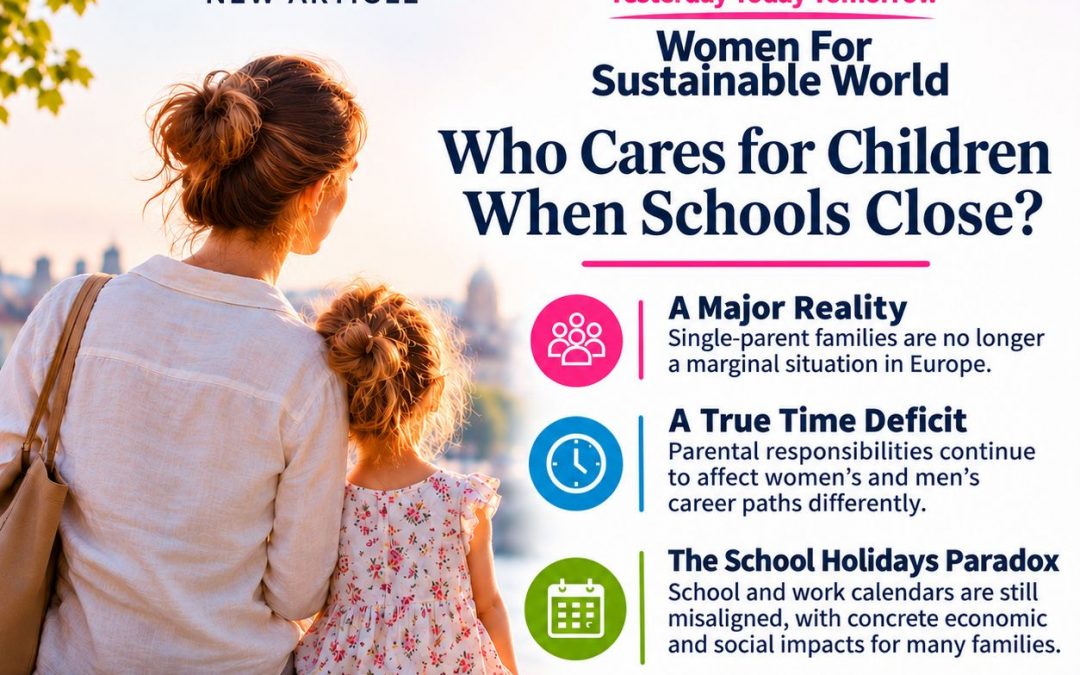
Parental Time and the New Economics of Care in Europe
What if Europe’s next major social investment were not merely financial, but temporal?
By Natalija Riabko
PROLOGUE
This summer, an apparently ordinary scene caught my attention.
A woman was cleaning the staircase of a building. A young child was nearby.
I knew nothing about their family circumstances, their living conditions, or the precise reasons why they happened to be together that day. This observation therefore allows and should allow no individual conclusion about the woman, the child, or their family arrangements.
Nevertheless, it raises a much broader question.
What happens when the calendar of work and the calendar of childhood no longer coincide?
According to the OECD (2024), primary-school pupils receive an average of 805 hours of instruction spread over 38 weeks. School holidays account for approximately fourteen weeks annually, with differences ranging from fewer than eleven weeks in Costa Rica and Denmark to seventeen weeks in Greece, Latvia, and Lithuania. These averages describe the data examined in that publication and should not be interpreted as reflecting a uniform situation across all countries.
Meanwhile, parents continue to work.
Some families can arrange their holidays in alternating periods, turn to grandparents, pay for activities, use out-of-school childcare facilities, or make other arrangements. Others have far more limited possibilities.
When a single adult assumes day-to-day responsibility for a household, time becomes an economic issue as much as a matter of public policy.
I. SINGLE-PARENT HOUSEHOLDS ARE NO LONGER A MARGINAL REALITY
In 2025, the European Union had approximately 6.1 million households consisting of one adult living with one or more children, representing 12.9% of all households with children, almost one in eight. Moreover, 81.6% of these households were headed by women, equivalent to approximately five million households (Eurostat, 2026).
These figures come from the European Labour Force Survey and describe household composition. They do not, in themselves, establish the legal, family, or childcare circumstances of every household member.
Nevertheless, they fundamentally change our understanding of the problem.
In a two-parent household, two adults may, at least in theory, divide annual leave, working hours, and family responsibilities between them. In a household with only one adult, there is no second reserve of time within the home.
Every hour of school closure or childcare unavailability must therefore be accommodated in one of four ways: the parent temporarily interrupts their professional activity; purchases childcare services; relies on a relative or another person; or attempts to work while simultaneously caring for the child.
It is precisely this fourth situation that European statistics still capture inadequately.
II. THE REAL SCARCITY MAY NOT BE MONEY ALONE: IT IS ALSO TIME
A substantial part of family policy has traditionally been designed around income: family allowances, tax credits, social benefits, and childcare fees.
These instruments are essential. Yet they address only imperfectly the scarcity of a resource that can neither be stored nor recovered: time.
European data show that parental responsibilities do not affect women’s and men’s professional trajectories in the same way.
In 2024, among European Union residents aged 25 to 54 living with children, the employment rate reached 91.9% for men, compared with 75.4% for women. For men, the presence of children was associated with a higher employment rate than among men without children; for women, the relationship was reversed (Eurostat, Sustainable Development in the European Union, 2025).
Part-time employment reveals another dimension of this asymmetry. According to the same report, in 2024, 27.9% of employed women aged 20 to 64 worked part-time, compared with 7.7% of men. Among people working part-time, 27.5% of women cited responsibilities for caring for children or dependent adults as their principal reason, compared with 7.1% of men.
It would be misleading to attribute all these differences exclusively to motherhood or school holidays. The most rigorous conclusion is that family responsibilities continue to shape women’s and men’s economic participation differently.
The European Institute for Gender Equality’s CARE Survey 2024, conducted among more than 65,000 people across the twenty-seven Member States and published in 2026, also documents women’s greater participation in childcare and domestic tasks, together with their generally more restricted leisure time.
III. THE SCHOOL-HOLIDAY PARADOX
Here we encounter one of the least examined paradoxes of our economic organisation.
School is designed around children’s development.
Work is organised around production.
These two calendars were constructed separately.
During school terms, educational institutions absorb much of this mismatch: children attend school while their parents work. When schools close, that balance disappears, but parents’ professional obligations remain.
The problem becomes particularly visible during the summer holidays.
In the data examined by the OECD in 2024, school holidays represent an average of approximately fourteen weeks per year, whereas Article 7 of Directive 2003/88/EC establishes four weeks as the minimum annual paid-leave entitlement for workers.
These indicators are not directly comparable: several Member States grant five weeks of leave or more, parents may alternate their absences, and collective services provide childcare. Furthermore, in its 2025 edition of Education at a Glance, the OECD reports an average of approximately thirteen weeks of school holidays for the countries and reporting period covered that year.
Nevertheless, these data reveal a mismatch between institutional calendars that markets and families must compensate for.
And the cost of that adjustment is not the same for everyone.
IV. VULNERABLE FAMILIES CANNOT PURCHASE TIME AS EASILY
Market-based services allow some families to convert money into available time: childcare, holiday clubs, residential camps, babysitting, sports activities, and cultural programmes.
For lower-income households, that conversion is considerably more difficult.
The OECD measures net childcare costs after accounting for fees, allowances, reductions, and tax benefits. Its reference indicator concerns, among other configurations, families with two children aged two and three attending full-time childcare. It therefore does not directly measure the cost of school-holiday care for older children. Nevertheless, it illustrates the financial constraints that childcare services can represent for households, particularly single-parent families.
Economic vulnerability among families with children remains substantial. In 2024, 19.5 million children under the age of eighteen in the European Union, representing 24.2%, were at risk of poverty or social exclusion (Eurostat; European Commission).
In the same year, 13.6% of children under sixteen experienced child-specific material deprivation, according to the corresponding Eurostat indicator.
School holidays are therefore not merely a matter of family logistics.
They are also a question of equality of opportunity.
V. WHEN FINANCIAL POVERTY BECOMES TIME POVERTY
Social economics offers a particularly useful concept here: time poverty.
A person may be employed and yet have virtually no discretionary time remaining after fulfilling professional, domestic, and family obligations.
For a single mother, this process can become circular.
To preserve her income, she works.
Because she works, she must pay for childcare.
Because childcare represents an expense, she must maintain her working hours.
And because she must retain her employment, she has less time available to care for her child herself.
This is not an argument against paid employment or parental presence. Employment constitutes a fundamental source of autonomy, economic security, and social participation for women.
The real question is different:
Can a society expect parents to participate fully in the labour market while continuing to regard childcare during school closures as an exclusively private responsibility?
VI. PARENTAL TIME IS NOT ‘WASTED TIME’
The question becomes even more interesting when we examine what economists call unpaid work.
The System of National Accounts 2025, adopted by the United Nations Statistical Commission, recognises the analytical importance of unpaid household services and care activities.
For the most part, these services remain outside the core production boundary used to calculate gross domestic product. Nevertheless, the revised framework allows them to be represented more effectively through supplementary accounts and statistical extensions, particularly because their exclusion from core aggregates leaves out activities directly connected with health, education, and human well-being.
In other words, preparing a meal for a customer constitutes recorded economic production; preparing the same meal for one’s child generally does not, for the purposes of GDP.
Paid childcare provided to somebody else’s child contributes to GDP; unpaid care provided to one’s own child does not fall within its central production boundary.
This distinction does not necessarily reflect the social usefulness of the activity.
It results from an accounting convention.
And that difference is fundamental.
VII. CAN TIME SPENT WITH A CHILD BE CONSIDERED WORK?
The answer depends on what we mean by the word ‘work’.
In the sense of an employment contract, not automatically.
A parent does not become a government employee simply by raising a child.
However, in the economic and statistical sense of care work, the answer is more nuanced: caring for a child, supervising, accompanying, transporting, feeding, and providing emotional support are productive activities that could, at least in theory, be performed by a paid third party.
The System of National Accounts uses precisely the ‘third-party criterion’ to define unpaid household services that may be included in supplementary measures. These are activities that could be entrusted to an external provider under ordinary circumstances.
The relevant question is therefore not:
‘Should every mother receive a salary?’
Such a formulation would be excessively simplistic from an economic, legal, and political standpoint.
The real question is:
How can social protection systems recognise the economic value of particularly constrained periods of parental care without distancing women from employment or confining motherhood to a domestic role?
That distinction changes almost everything.
VIII. THE OBJECTIVE MUST NOT BE TO SEND MOTHERS BACK HOME
A poorly designed policy could solve one problem while creating another.
Systematically paying a parent to leave employment could reinforce traditional divisions of family roles, permanently reduce women’s professional earnings, and widen pension gaps.
A policy mechanism should therefore rest on three principles: freedom of choice, gender neutrality, and stronger protection for single-parent families.
The objective is not to pay women to remain at home.
It is to recognise that, at certain stages of childhood, parental time possesses a social value that the labour market does not remunerate and that public infrastructure cannot always replace.
IX. AND WHAT ABOUT THE CHILD?
Another consideration prevents this debate from being reduced to mothers’ employment: child development.
OECD research on child well-being considers parental emotional support, together with the material and temporal dimensions of family support, to be important factors in children’s development and well-being.
A study by Berger, Panico, Sheridan, and Thévenon, published in 2024 and based on PISA 2018 data, identifies associations between parental emotional support, subjective well-being, and educational outcomes. It also emphasises the importance of socio-economic circumstances, family background, the school environment, and other contextual characteristics.
It would therefore be scientifically incorrect to claim that the more hours a mother spends with her child, the better that child’s development will necessarily be.
Research findings are more nuanced.
What matters includes the quality of interactions, relational security, the material and emotional environment, and parents’ ability to be available without facing relentless economic pressure.
X. EUROPE ALREADY POSSESSES SOME OF THE NECESSARY INSTRUMENTS
The European Union is not starting from nothing.
Directive (EU) 2019/1158 on work-life balance provides, among other measures, an entitlement to ten working days of paternity leave, an individual entitlement to four months of parental leave, of which two months are non-transferable, five working days of carers’ leave annually, and the right for workers with children up to an age determined by Member States which must be at least eight to request flexible working arrangements.
However, these rights principally concern childbirth, certain caring circumstances, and the organisation of work.
They do not constitute a European mechanism specifically designed to cover school closures throughout the year.
The European Child Guarantee represents another pillar. Established by Council Recommendation (EU) 2021/1004, it calls upon Member States to ensure that children in need have effective access to early childhood education and care, education and school-based activities, healthcare, healthy nutrition, and adequate housing.
Its ambition is considerable.
Nevertheless, parental time during school holidays still does not constitute an autonomous category of European social policy.
XI. SOME COUNTRIES ARE ALREADY EXPERIMENTING WITH ELEMENTS OF A SOLUTION
The schemes examined do not establish the existence of a universal wage specifically paid to parents for spending school holidays with their children.
Several systems nevertheless offer interesting partial responses.
In England, the Holiday Activities and Food Programme finances activities, meals, and safe environments during school holidays for eligible children from disadvantaged families. Official guidance for the 2026–2027 financial year covers, in particular, Easter, summer, and Christmas holidays, with certain possibilities for extending provision to shorter holiday periods. The government explicitly recognises that such services can facilitate employment among lower-income parents (Department for Education, 2026).
In Australia, the Child Care Subsidy may contribute towards the cost of approved childcare services outside school hours (Outside School Hours Care), including programmes offered during school holidays for eligible school-aged children (Australian Government).
In New Zealand, the Out of School Care and Recreation Subsidy (OSCAR) may contribute towards the cost of holiday programmes for up to fifty hours per week for families meeting the relevant income and other eligibility requirements (Work and Income New Zealand).
These approaches share one characteristic: they primarily finance services that substitute for parental time.
Yet another avenue deserves to be explored.
XII. WHAT IF WE SOMETIMES FUNDED TIME RATHER THAN ITS REPLACEMENT?
Europe could experiment with a Parental Time Account, not as a ‘mother’s salary’, but as a hybrid instrument combining family policy, child well-being, and labour-market participation.
Its architecture could be relatively straightforward.
Each child would generate a limited annual entitlement to a defined number of protected parental-time days during school closures.
This entitlement would be attached to the child and could be shared between those exercising parental responsibility.
Where a single parent is the only eligible person able to provide that care, the entire credit would remain available to that parent, subject to the applicable legal arrangements.
The entitlement could take several forms:
- paid parental leave during school holidays;
- a temporary reduction in working hours accompanied by financial compensation;
- a credit paid directly to an accredited childcare provider;
- or a mixed arrangement allowing parents to choose between parental time and childcare funding.
It would be less a new social allowance than a right to choose between time and services.
XIII. ONE EURO FOR CHILDCARE OR ONE EURO FOR THE PARENT?
This question deserves economic examination.
Suppose a public authority were prepared to allocate €60 per day to provide a child with a place in a holiday programme. This is an illustrative assumption, not an average cost measured across the European Union.
Why should we presume, as a matter of principle, that one euro spent purchasing childcare time constitutes productive expenditure, whereas one euro enabling a parent temporarily to reduce their working hours and spend time with their child constitutes passive expenditure?
The answer cannot be ideological.
It must be evaluated.
For some children, particularly those experiencing isolation or deprivation, a high-quality group programme may provide considerable benefits.
In other circumstances, a few additional days spent with a parent may have significant value for family relationships and child development.
Modern public policy should therefore encourage informed choice rather than impose a single model of care.
XIV. HOW COULD SUCH A SYSTEM BE FINANCED WITHOUT GENERATING UNCONTROLLED COSTS?
A credible mechanism should be experimental, targeted, and subject to evaluation.
An initial phase could focus on children under twelve living in single-parent or low-income households.
For example, a Member State could pilot five to ten compensated days per year, usable during school holidays and not convertible into cash if unused. This is a proposed pilot design, not an empirically established optimum.
Compensation could be capped and calculated as a proportion of employment income, with a minimum payment protecting low earners.
Costs would then need to be assessed against several outcomes: parental employment and job retention; involuntary part-time work; unexpected absences; childcare expenditure; parental mental health; child well-being; and, over the longer term, career trajectories and tax revenues.
This would not be a payment made without an obligation to evaluate its results.
It would be a social-investment policy, assessed as such.
XV. PENSION ENTITLEMENTS OFFER A SECOND ROUTE
There is another way to compensate for care without immediately paying a salary: deferred social rights.
A person who substantially reduces paid employment in order to raise children accumulates less income and, often, fewer pension entitlements.
Pension systems can correct part of this imbalance through credits associated with periods devoted to family responsibilities.
The State of Motherhood in Europe 2024 report by Make Mothers Matter recommends, among other measures, introducing care credits in Member States to compensate for career interruptions associated with family responsibilities, improving pension entitlements and transfers for certain parents, particularly single parents, recognising skills acquired through unpaid family care, and improving time-use surveys.
These recommendations are also consistent with OECD research in Pensions at a Glance 2025, which documents pension-credit arrangements linked to periods spent caring for children, as well as European Commission analyses of care credits in occupational pension schemes.
This approach has economic appeal: it recognises the social contribution of care without transforming the relationship between parent and child into an employment relationship.
XVI. THE STATISTICAL BLIND SPOT MUST BECOME A PUBLIC-POLICY PRIORITY
Before creating a new entitlement, Europe could undertake something much simpler: measure the phenomenon.
How many parents interrupt their professional activity during school holidays because childcare is unavailable?
How many take unpaid leave?
How many reduce their working hours?
How many rely on grandparents?
How many pay for childcare that absorbs a substantial proportion of their wages?
How many work from home while simultaneously supervising a young child?
And how many bring their child to their workplace?
The European sources examined do not provide a harmonised and comprehensive answer to all these questions.
What public policy does not measure can easily remain invisible.
EIGE’s CARE Survey 2024 has considerably improved knowledge of unpaid care work, while the European Child Guarantee is also contributing to the development of better indicators. Nevertheless, some areas remain insufficiently documented, and access to services continues to be unequal.
A future European survey could therefore incorporate a specific module devoted to the School Holiday Care Gap.
It would represent a relatively modest statistical innovation.
Its implications could be considerable.
XVII. THE PROPOSAL: A EUROPEAN FAMILY TIME GUARANTEE
The next step could be conceptually more ambitious.
Alongside the European Child Guarantee, the European Union could develop the principle of a Family Time Guarantee, not necessarily as a new binding European competence, but as a common framework enabling Member States to experiment, while respecting their respective powers and the principle of subsidiarity.
Its objective would be straightforward:
No parent should be forced to choose between the economic security of their household and a suitable, safe childcare arrangement for a young child solely because school is closed.
Such a guarantee could rest on three complementary pillars:
- Financially affordable access to high-quality services during school holidays.
- A limited entitlement to compensated parental time.
- Social rights, particularly pension entitlements, recognising significant periods of care.
Funding could draw upon national budgets, family-policy programmes, employers, and, for vulnerable groups where eligibility rules permit, existing European instruments such as the European Social Fund Plus.
This guarantee would not abolish holiday clubs.
It would not prevent mothers from working.
Nor would it turn the state into the employer of parents.
It would recognise that between the market and the family lies an invisible infrastructure: time.
XVIII. THE PARTICULAR ROLE OF EMPLOYERS
Businesses also have an interest in participating in this debate.
An employee who does not know who will look after their child the following week does not arrive at work free from that concern.
Family-related uncertainty may contribute to absences, reduced concentration, reluctance to accept additional working hours, reductions in working time, or departure from an employer.
Family-friendly workplace policies are therefore not merely social measures.
They can also contribute to retaining human capital.
Businesses could participate through family time-saving accounts, dedicated days associated with school closures, seasonal flexibility in working schedules, remote working where professional duties permit, or co-financing holiday programmes.
Nevertheless, these instruments must remain realistic: working remotely while simultaneously caring for a four-year-old child does not, in itself, constitute an adequate childcare solution.
Recognising that distinction would already represent progress.
XIX. MAKE MOTHERS MATTER AND THE PROSPECT OF A NEW EUROPEAN DIALOGUE
The State of Motherhood in Europe 2024 survey, conducted with Kantar among 9,600 mothers across eleven European Union Member States and the United Kingdom, provides valuable insight: 55% of respondents reported having changed their employment situation after having children, while nearly 27% considered that motherhood had negatively affected their careers.
These findings come from a specific survey rather than European administrative statistics. They must therefore be presented as such. Nevertheless, they provide an important indication of mothers’ lived experiences.
Make Mothers Matter’s advocacy for recognising unpaid family care and distributing it more equitably thus forms part of a broader evolution in economic thought: economic life cannot be understood exclusively through monetary transactions.
The 2025 revision of the United Nations System of National Accounts also contributes to improving the statistical visibility of unpaid household services.
Bringing national accounting, family policy, and child development into dialogue opens up a particularly promising field for civil-society organisations.
CONCLUSION: WHAT IF TOMORROW’S ECONOMY BEGINS HERE?
The woman I saw cleaning that staircase is not a statistic.
Neither is the young child who was nearby.
We do not know why they were together that day. Any individual interpretation would therefore be unjustified.
But the question raised by that scene can be measured.
We know that almost one in eight European households with children contains only one adult, and that more than four out of five of these households are headed by women (Eurostat).
We know that children have, on average, considerably more weeks without school than the minimum number of weeks of paid leave guaranteed to European workers (OECD; European legislation).
We know that family responsibilities continue to influence women’s working hours and professional trajectories more strongly (Eurostat).
And we know that parental emotional support and the material and temporal dimensions of family support are associated with children’s well-being and development (OECD).
What we still cannot adequately measure is the human cost of the mismatch between these realities.
For too long, childcare, attention, guidance, and parental availability have been treated as natural family resources, free of charge and almost infinitely available.
They are not.
Parental time is a scarce economic resource.
Recognising it does not mean commercialising love.
It means precisely the opposite: ceasing to assume that what has no price has no economic value.
The children whose time, security, and emotional bonds we protect today will be the adults who, tomorrow, work, create, care for others, innovate, establish businesses, and make decisions.
From this perspective, enabling a parent to be present for their child at certain moments may represent considerably more than family policy.
It may constitute one of the most fundamental forms of long-term investment.
SOURCES
- Eurostat (2026). “1 in 8 EU households with children rely on one adult.” Eurostat News, 1 June. Datasets: lfst_hhnhtyc, lfst_hhnhtych, and lfst_hhindws.
- OECD (2024). “How is the school year organised in OECD countries?” Education Indicators in Focus, No. 86. Paris: OECD Publishing. DOI: 10.1787/a6385722-en.
- Eurostat (2025). Sustainable Development in the European Union: Monitoring Report on Progress towards the SDGs in an EU Context, 2025 Edition. Luxembourg: Publications Office of the European Union.
- Eurostat (2025). “24% of EU children at poverty risk or social exclusion.” Eurostat News, 28 May.
- Eurostat (2025). Children – Material Deprivation. Statistics Explained, data extracted May 2025. Indicator: ilc_chmd03.
- European Institute for Gender Equality (EIGE) (2026). Sharing Care, Closing Gender Gaps: CARE Survey 2024. 25 February. DOI: 10.2839/3368911.
- OECD (n.d.). “Net childcare costs.” OECD Data. Indicator covering net full-time childcare costs.
- Berger, L. M., Panico, L., Sheridan, A., and Thévenon, O. (2024). “Parental emotional support and adolescent well-being: A cross-national examination of socio-economic and gender gaps based on PISA 2018 surveys.” OECD Papers on Well-being and Inequalities, No. 20. DOI: 10.1787/2b7a2ac6-en.
- European Parliament and Council of the European Union (2019). Directive (EU) 2019/1158 of 20 June 2019 on work-life balance for parents and carers. Official Journal of the European Union, L 188.
- European Parliament and Council of the European Union (2003). Directive 2003/88/EC of 4 November 2003 concerning certain aspects of the organisation of working time. Official Journal of the European Union, L 299.
- Council of the European Union (2021). Council Recommendation (EU) 2021/1004 of 14 June 2021 establishing a European Child Guarantee. Official Journal of the European Union, L 223, pp. 14–23.
- United Nations et al. (2025). System of National Accounts 2025. United Nations Statistics Division, pre-edit version. Sections concerning unpaid household services and supplementary accounts.
- UK Department for Education (2026). “Holiday activities and food programme 2026 to 2027 financial year.” UK Government, updated 8 October 2026.
- Australian Government (n.d.). “Outside School Hours Care.” Department of Education; “Outside school hours care.” myGov. Guidance on Child Care Subsidy eligibility.
- New Zealand Ministry of Social Development (n.d.). “Out of School Care and Recreation (OSCAR) Subsidy.” Work and Income.
- Make Mothers Matter and Kantar (2024). State of Motherhood in Europe 2024. Survey report and policy recommendations.
- European Commission (2026). “EU framework for monitoring implementation of the European Child Guarantee updated.” Directorate-General for Employment, Social Affairs and Inclusion, 30 January.
- OECD (2025). Education at a Glance 2025: OECD Indicators. Paris: OECD Publishing. Sections on instruction time and the organisation of the school year.
- OECD (2025). Pensions at a Glance 2025. Paris: OECD Publishing. Analysis of child-related pension credits and gender pension gaps.
- European Commission (2024). Study Supporting the Monitoring of Care Credits in Occupational Pension Schemes – Final Report. Directorate-General for Employment, Social Affairs and Inclusion, 29 July.
- United Nations Economic Commission for Europe (UNECE) (2017). Guide on Valuing Unpaid Household Service Work. Geneva: United Nations.