
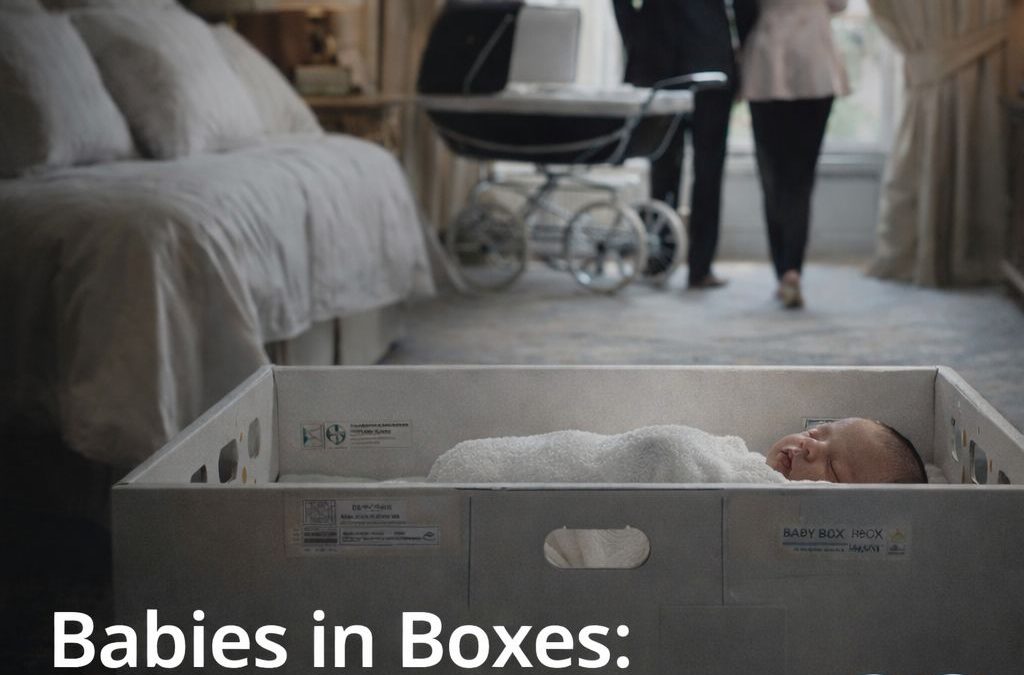
The scene is brief. An opening in a wall. A hand. Then nothing.
Inside: a soft light, controlled temperature, an immediate alert system. Within less than a minute, the newborn is taken into care.
Across more than twenty U.S. states, these installations (between 300 and 400 units today, according to Safe Haven Baby Boxes) operate under a precisely calibrated protocol. Since 2016, between 55 and 150 infants have been placed in them, based on data reported by local authorities and program operators. On a broader scale, more than 5,000 infants have been legally relinquished under Safe Haven laws since 1999, according to the U.S. Department of Health and Human Services.
These are precise figures, controlled, almost reassuring. They suggest a system that works.
What is visible and what is not
Over longer timeframes, certain movements emerge.
Between 2008 and 2017, a study relayed notably by the University of North Carolina indicates a 66.7% decline in infanticide rates in the United States as Safe Haven laws expanded. In 2021, 73 infants were safely relinquished, compared to 31 illegal abandonments, according to reports from the Health Resources and Services Administration. Over a longer period, more than 4,500 infants have been legally surrendered, while 915 infants died following unsafe abandonment, based on aggregated public health and research data.
At this level, the interpretation appears straightforward: a technological solution, a legal framework, a measurable reduction in extreme outcomes.
Yet the background resists clarity.
There is no consolidated national database in the United States tracking infant abandonment comprehensively, as highlighted in multiple academic studies published in peer-reviewed outlets, including ScienceDirect.
What is observed is real. What remains unseen is no less so.
A broader geography, converging logics
The phenomenon is not uniquely American.
Across Europe, comparable mechanisms have developed, often with deeper historical roots.
In Germany, where confidential birth is regulated, estimates suggest several hundred anonymous births per year, according to the Federal Ministry for Family Affairs (Bundesministerium für Familie). In France, the system of accouchement sous X accounts for approximately 600 to 700 births annually, based on consolidated data from the Ministry of Solidarity and Health and the National Council for Access to Personal Origins (CNAOP). In Italy, close to 300 anonymous births per year are estimated, according to the Ministry of Health.
Alongside this, another reality persists: across Europe, several hundred cases of infanticide or fatal abandonment are still recorded annually, according to various public health analyses and academic studies, with significant methodological variation.
Further east, in countries such as Poland, the Czech Republic, and Switzerland, “baby hatches” have received several hundred infants since the early 2000s, based on hospital and non-governmental organization data. In Japan, where a similar system operates in Kumamoto, a few dozen cases have been documented since 2007, according to local authorities and academic research.
Volumes differ. The underlying logics do not.
Broader movements, barely visible
Expanding the lens further reveals additional indicators, less directly connected, yet difficult to separate.
In the United States, the average cost of a hospital birth can exceed $10,000 to $18,000, according to the Health Care Cost Institute. In several states, maternity-related costs remain among the highest in the OECD, as confirmed by comparative analyses from the Organisation for Economic Co-operation and Development.
At the same time, data from the Centers for Disease Control and Prevention indicate that maternal mortality exceeds 20 deaths per 100,000 births, a level significantly higher than in many European countries.
In Europe, pressures manifest differently. According to Eurostat, nearly 95 million people were at risk of poverty or social exclusion in 2023, including a substantial proportion of single-parent households.
Across OECD countries, the data converge on a consistent observation: situations of rupture surrounding childbirth are disproportionately concentrated in contexts of economic and social vulnerability, as shown in cross-analyses by the OECD and national statistical institutes.
Even when they do not fully appear in headline indicators.
A frictionless mechanism
Inside the baby box, everything is designed to eliminate friction.
The door closes. The signal is triggered. The child is retrieved.
Nothing moves in the opposite direction.
No medical history is transmitted. No trajectory is recorded. No continuity is preserved.
In some cases, healthcare professionals and child welfare experts point to complex situations: total absence of pregnancy-related data, inability to reconstruct medical conditions, difficulty anticipating the child’s needs—issues documented in bioethics research from institutions such as Yale University and in specialized media reporting.
In others, weak signals emerge out-of-scope use, atypical cases, documented through local investigations and regional reporting in the United States.
The mechanism functions. But it says nothing about what precedes it.
A contemporary form of regulation
As these systems expand, a broader interpretation becomes unavoidable.
In the environments where they emerge, recurring patterns documented by international institutions, can be observed:
- direct and indirect costs associated with childbirth (OECD, HCCI)
- inequalities in access to healthcare (CDC, WHO)
- increased exposure of households to economic risk (Eurostat, OECD)
Within such a framework, childbirth is no longer solely a biological event.
It becomes a point of tension. And at its most fragile margins, a point of rupture. Baby boxes appear precisely at that threshold.
Shifting trajectories
International comparisons suggest subtle but meaningful dynamics.
In countries where upstream support is structured (accessible healthcare, confidential birth systems, social assistance) levels of anonymous abandonment remain contained, as reflected in French and German data.
Conversely, a number of international studies indicate that the absence of such frameworks increases the likelihood of critical situations, including unsafe abandonment.
Nothing is linear. Yet certain correlations are now consistently documented.
What might change quietly
The instruments already exist.
Comparative analyses from the OECD, WHO, and national systems show that:
- medically supervised confidential birth reduces high-risk abandonment
- targeted economic support lowers early-stage ruptures
- psychological support improves prevention outcomes
These mechanisms, already implemented in several European systems, produce measurable effects on child protection indicators.
They are not visible. They do not occupy walls or infrastructure. But where they are deployed, the data shift.
Breaking the silence without forcing it
There is another threshold, less visible than the opening in the wall.
It does not involve metal, sensors, or alarms. It begins often much earlier, at the moment when a woman hesitates to speak.
Across OECD countries, policy analyses consistently show that confidential birth frameworks, protected access to healthcare, and legally guaranteed anonymity when combined with non-judgmental counselling significantly reduce high-risk abandonment scenarios. In France, the long-standing system of accouchement sous X, supported by the Conseil national pour l’accès aux origines personnelles, has demonstrated that anonymity, when embedded in a medical and legal continuum, can coexist with later rights of access to origins. In Germany, reforms introduced under the Gesetz zum Ausbau der Hilfen für Schwangere have created structured pathways for confidential births with delayed identity disclosure, ensuring both protection and traceability. Similar approaches, documented by the World Health Organization, emphasize that early, stigma-free contact points (midwives, social workers, confidential hotlines) are decisive in preventing rupture before it occurs.
Yet the effectiveness of these instruments depends less on their existence than on their accessibility. Reports from OECD and European social agencies indicate that support structures for vulnerable mothers (shelters, counselling centers, community-based services) remain unevenly funded and territorially fragmented, even in advanced economies. Many operate at the edge of capacity, reliant on mixed public-private financing and short-term grants.
This is where another layer quietly emerges.
Within ESG frameworks, particularly the “S” pillar, maternal protection, access to care, and early childhood stability are increasingly recognized as material indicators of social resilience, as reflected in evolving corporate reporting standards and impact investment criteria. Some institutional investors and foundations have begun to channel funding toward maternal health programs and community support systems, aligning social risk mitigation with long-term economic stability.
But the scale remains limited. The silence, in many cases, is not chosen. It is structured.
And where silence persists, unaddressed, unsupported, unprotected, the need for last-resort mechanisms does not disappear. It reorganizes itself. Sometimes, into a discreet opening in a wall.
Beyond economic constraint
Research from the INED and European social history shows that child abandonment has never been exclusively tied to poverty. As early as the Ancien Régime, hospice archives reveal that children from socially established backgrounds were also relinquished when their birth conflicted with norms of lineage, status, or reputation.
Today, although anonymity mechanisms prevent precise quantification, qualitative analyses highlighted in particular by the World Health Organization, confirm the persistence of situations in which abandonment does not stem from material constraint, but from a difficulty of social inscription: preserving a trajectory, avoiding a rupture in image, maintaining a fragile sense of coherence.
In such configurations, the child does not disappear for lack of resources, but for lack of an immediately acceptable place within the social order. Abandonment is neither purely necessity nor accident, but a silent adjustment, a mechanism through which a society, at times, privileges the continuity of its norms over that of its bonds.
This is where the question shifts. No longer one of survival, but of value.
As long as certain births remain conditioned by social perception, reputation, or conformity, their recognition remains partial.
Reducing such situations cannot rely solely on economic instruments. It requires a deeper transformation: making speech possible without fear, weakening the structures of stigma, and shifting the center of gravity of norms from image to existence itself.
But it also requires a more demanding, more uncomfortable choice: to stop looking away.
For what persists at the margins never does so alone. It endures also within the blind spots that societies accept or choose not to see.
Conclusion: what an opening in a wall reveals
The baby box is a discreet device. It generates neither spectacle nor sustained public debate. It operates in silence.
And yet, it concentrates several structural dynamics, documented across international data:
- a technical capacity to intervene at the last possible moment
- a persistent difficulty in acting earlier
- a gradual transformation of the relationship between birth and its economic environment
It saves lives, the data confirm it. But it appears precisely where other mechanisms have failed to operate. In this sense, it is not only a solution. It is an indicator. A discreet, measurable indicator
of a balance that has become more fragile than it appears.
Sources
- U.S. Department of Health and Human Services, Safe Haven Laws data
- Health Resources and Services Administration (HRSA), Infant abandonment reports
- University of North Carolina, Media Hub research on infanticide trends
- Safe Haven Baby Boxes, official installation and usage data
- ScienceDirect, academic publications on data gaps in infant abandonment
- Bundesministerium für Familie (Germany), confidential birth statistics
- Ministry of Solidarity and Health (France) + CNAOP
- Italian Ministry of Health, anonymous birth data
- Health Care Cost Institute (HCCI), childbirth cost analysis
- Centers for Disease Control and Prevention (CDC), maternal mortality statistics
- Eurostat, poverty and social exclusion data
- OECD, comparative social and healthcare indicators
- Yale University, bioethics research on baby boxes
- European hospital and NGO reports on “baby hatches”