
In the early years of the decade, ESG (Environmental, Social and Governance) carried the tone of a moral awakening. Capital, long accused of indifference to social and ecological cost, appeared ready to reform itself. Sustainability was no longer the vocabulary of activists alone; it entered earnings calls, boardrooms, and sovereign policy frameworks.
Yet reform, once financialised, changes character.
Today ESG stands at a crossroads, not because it has failed, but because it has succeeded in becoming systemic. And systemic tools reshape power.
The question is no longer whether ESG matters. It does. The question is who ultimately governs it and to whose benefit.
I. The Scale of the Transformation
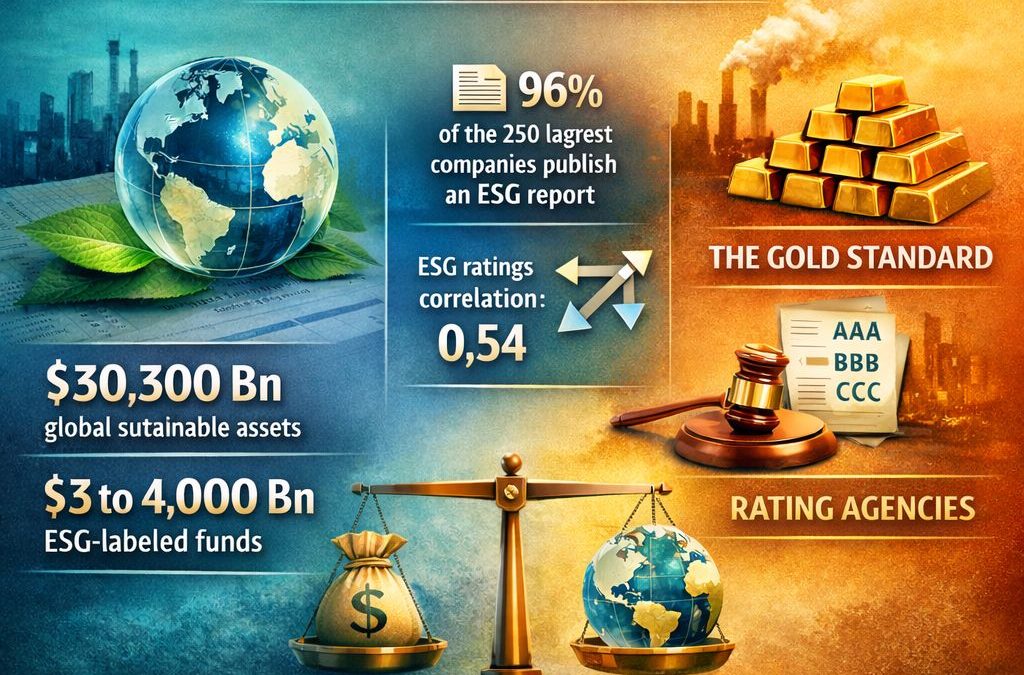
The Global Sustainable Investment Alliance (GSIA) reports that sustainable investment assets reached USD 30.3 trillion in 2022, down from USD 35.3 trillion in 2020, largely due to methodological revisions and market conditions rather than ideological retreat.
This figure includes assets applying various sustainable investment strategies (exclusions, screening, ESG integration).
By contrast, Morningstar’s Global Sustainable Fund reports (2024–2025) estimate that sustainable-labelled open-end funds and ETFs manage approximately USD 3–4 trillion globally.
The distinction matters.
One reflects broad integration into investment processes. The other reflects capital explicitly marketed as sustainable.
Even the lower figure is not marginal. At several trillion dollars, ESG-labelled capital represents a structural force in financial markets capable of influencing corporate financing costs, bond spreads, equity valuations and capital allocation decisions.
But scale alone does not guarantee impact.
II. The Reporting Revolution
If capital flows show ambition, corporate disclosure confirms entrenchment.
According to the KPMG Survey of Sustainability Reporting (2022):
- 96% of the world’s 250 largest companies now report on sustainability.
- 79% of the top 100 companies in each surveyed country publish sustainability reports.
In Europe, disclosure is no longer voluntary aspiration but legal architecture. The Corporate Sustainability Reporting Directive (CSRD) adopted by the European Commission expands mandatory sustainability reporting to nearly 50,000 companies.
What was once corporate signalling has become regulated reporting infrastructure.
This shift is historic. Financial accounting took centuries to standardise. ESG reporting has reached near-universal adoption among major firms within two decades.
And yet measurement remains contested.
III. The Measurement Problem
A foundational academic study by Florian Berg, Julian Koelbel and Roberto Rigobon (MIT Sloan, 2022) examined divergence among major ESG rating agencies.
Their finding is striking:
- The average correlation between ESG ratings is approximately 0.54.
- For credit ratings, correlation historically approaches 0.99.
In practice, this means the same company may appear highly sustainable according to one provider and mediocre according to another.
The divergence does not imply bad faith. It reflects differing methodologies, weighting environmental emissions versus labour standards versus governance structures. But for investors, policymakers and regulators, the consequence is ambiguity.
Markets depend on comparability. Ambiguity redistributes influence to those who design the metrics.
IV. Financial Performance: What Evidence Actually Shows
The debate over whether ESG “outperforms” conventional investment often obscures nuance.
The most comprehensive meta-analysis remains Friede, Busch and Bassen (2015), reviewing over 2,000 empirical studies. Approximately 90% found a non-negative relationship between ESG and financial performance; a majority found positive correlation.
More recent academic reviews suggest ESG integration is more consistently associated with risk mitigation than with systematic excess returns. In other words ESG appears to reduce downside volatility and reputational risk more reliably than it guarantees alpha.
For fiduciaries, this distinction is critical. It positions ESG less as moral luxury and more as prudential governance.
V. Enforcement and the Limits of Label
As ESG expanded, regulators began testing its credibility.
In 2022, the U.S. Securities and Exchange Commission (SEC) fined BNY Mellon Investment Adviser USD 1.5 million for misleading ESG disclosures.
In 2023, DWS, the asset management arm of Deutsche Bank, agreed to pay USD 25 million to settle SEC charges related to ESG misstatements.
In France, the Autorité des marchés financiers (AMF) has tightened scrutiny over sustainability labels under European disclosure rules.
These cases are not evidence of systemic fraud. They are evidence of enforcement maturing. But they also reveal a structural tension: once sustainability becomes marketable, it becomes tradable, and therefore vulnerable to exaggeration.
VI. Political Friction and Institutional Uncertainty
ESG has not only entered financial markets; it has entered constitutional debate.
Several U.S. states, including Texas and Florida, adopted measures restricting public pension funds from incorporating ESG criteria in certain contexts. These initiatives were widely reported by Reuters, the Financial Times, and other mainstream outlets.
The underlying argument varies from concerns about fiduciary duty to accusations of politicised capital allocation.
Regardless of ideological position, the legal contestation underscores a reality: ESG is no longer merely technical governance. It is a site of political negotiation.
For multinational investors, this creates cross-jurisdictional complexity.
VII. Historical Echoes
Economic history offers perspective.
The gold standard once promised monetary stability but constrained sovereign flexibility during crises. Credit rating agencies, before post-2008 reforms, operated with immense market power and limited oversight.
In each case, measurement frameworks (originally designed for coordination and trust) evolved into structural levers of influence.
The lesson is not that ESG will inevitably follow this trajectory. It is that measurement systems require governance proportional to their power.
VIII. The Real Risk: Concentration Without Accountability
ESG has created an ecosystem:
- Rating agencies
- Index providers
- Data aggregators
- Compliance consultancies
- Asset managers wielding engagement influence
None of these actors is illegitimate. All perform necessary functions.
Yet when sustainability metrics determine access to capital, influence voting rights, and shape corporate strategy, governance of the measurement process itself becomes a matter of public interest.
Without transparent methodology, consistent standards and independent oversight, ESG risks amplifying the influence of those who control data architecture.
This is not a moral accusation. It is a structural observation.
IX. Preserving the Promise
The evidence does not support abandoning ESG.
- Disclosure has increased transparency.
- Risk management has improved in many sectors.
- Investor awareness of climate exposure is materially higher than a decade ago.
But preservation requires discipline:
- Harmonised core metrics.
- Clear separation between marketing claims and measurable outcomes.
- Public oversight proportionate to market influence.
ESG began as a promise to align capital with sustainability.
Whether it becomes a durable instrument of collective benefit or a sophisticated layer of market signalling, will depend less on ideology than on governance design.
Reform is rarely defeated by its enemies. It is more often diluted by its success.
Sources
• Global Sustainable Investment Alliance (GSIA), Global Sustainable Investment Review 2022
• Morningstar Direct, Global Sustainable Fund Flows Reports (2024-2025)
• KPMG, Survey of Sustainability Reporting 2022
• European Commission, Corporate Sustainability Reporting Directive (CSRD)
• Berg, Koelbel & Rigobon (2022), “Aggregate Confusion: The Divergence of ESG Ratings,” MIT Sloan
• Friede, Busch & Bassen (2015), Journal of Sustainable Finance & Investment
• U.S. Securities and Exchange Commission enforcement releases (2022-2023)
• Autorité des marchés financiers (France) ESG communications
• Reuters reporting on U.S. state ESG legislation (2022-2024)
Important Disclaimer: The content of this article is provided for informational and educational purposes only. It reflects the author’s opinion based on information available at the time of publication, which may become outdated. This content does not constitute personalized investment advice, a recommendation to buy or sell, and does not guarantee future performance. Markets carry a risk of capital loss. The investor is solely responsible for their decisions and should consult an independent professional advisor before any transaction. The publisher disclaims all liability for decisions made based on this information.