
Preamble: A global economy entering the age of conscious constraints
The global economy in early 2026 is neither recovering nor booming. It is lucid.
The great cycles of economic illusion like monetary abundance, frictionless globalization, cheap energy, geopolitically neutral arbitrage, have given way to a regime in which every economic decision now carries strategic, social, and political implications.
The most recent macroeconomic data converge toward a central conclusion: stability is returning, but it is costly, conditional, and selective.
This note offers a rigorous, global, and systemic assessment, based exclusively on recent institutional data (IMF, OECD, FAO, World Bank, IEA, central banks), with no speculative projections.
I. Global growth: contained resilience, structurally differentiated
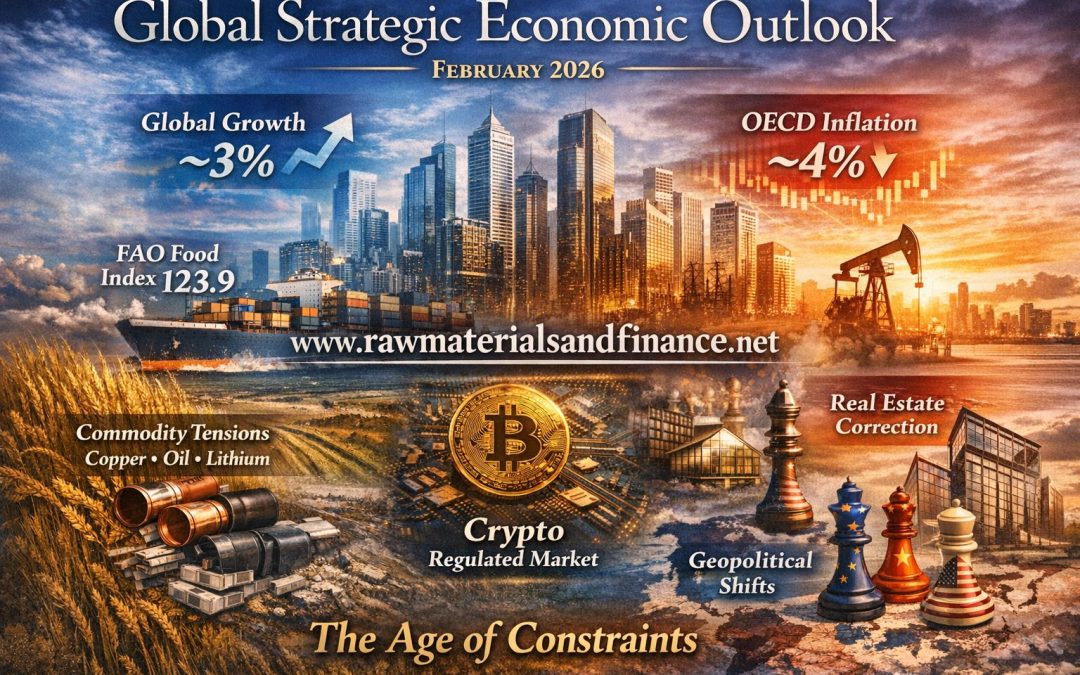
International institutions place global growth in 2026 within a narrow range, around 3%, reflecting an economy that continues to expand without acceleration.
This average, however, conceals deeply heterogeneous dynamics:
- Advanced economies are growing at a moderate pace, constrained by demographic aging, monetary normalization, and rising regulatory adjustment costs.
- Emerging economies remain the primary contributors to global growth, but face tighter financing conditions, currency volatility, and geopolitical pressures.
Global growth is no longer driven by a single engine. It now results from a fragile balance between productive investment, social stability, and economic sovereignty. For decision-makers, this marks the end of uniform strategies and the return of granular, country-by-country and sector-by-sector analysis.
II. Inflation: measured disinflation, persistent underlying pressures
Global inflation continues its gradual deceleration. Across the OECD area, inflation stands around 4%, while several European economies, including France, are converging toward levels close to 1.7%.
This disinflation is primarily driven by:
- normalization of energy prices,
- partial easing of food prices,
- adjustment of global supply chains.
However, several structural pressures remain:
- sustained increases in skilled labor costs,
- services inflation,
- costs associated with energy and digital transitions,
- tighter regulatory constraints.
Price stability is therefore real, but it does not signal a return to abundance.
III. Food and agriculture: the quiet return of sovereignty
The FAO global food price index stood at 123.9 points in January 2026, down moderately year-on-year, reflecting a gradual rebalancing of global agricultural markets after several years of tension.
This apparent normalization masks significant vulnerabilities:
- growing dependence on extreme climate conditions,
- geographic concentration of key productions,
- sensitivity to logistical and geopolitical disruptions.
Agriculture is once again a strategic pillar of political and social stability, far beyond its purely economic role. States and major private actors increasingly treat food security as a core component of sovereignty.
IV. Global industry: reconfiguration rather than recovery
Leading indicators of manufacturing activity point to slow and uneven expansion. Global industry is not rebounding in a synchronized manner:
- Asia shows sharp contrasts between economies undergoing structural adjustment and dynamic technology hubs.
- Europe maintains constrained but resilient industrial activity, particularly in essential sectors, under persistent energy constraints.
- North America benefits from a strengthened industrial base supported by investment incentives and reshoring policies.
This phase reflects less a cyclical recovery than a reconfiguration of global value chains, driven by proximity, supply security, and technological control.
V. Financial markets: discipline, dispersion, discernment
Equity markets
Global equity markets trade at elevated levels, but with increased sectoral dispersion. Performance is concentrated in:
- sectors with strong and predictable cash flows,
- companies exposed to real or strategic assets,
- firms capable of absorbing regulatory and compliance costs.
Market dynamics now favor balance sheet quality and revenue visibility over purely narrative-driven valuations.
Fixed income markets
Bond markets reflect a world in which the cost of capital remains structurally higher than pre-2020 levels, yet broadly stabilized. Sovereign bonds continue to serve as liquidity benchmarks, while private credit requires granular risk assessment.
VI. Commodities and energy: the return of fundamentals
Commodity markets operate within an intermediate pricing regime, without speculative excess. Hydrocarbon prices remain relatively stable, while strategic industrial metals (copper, aluminum, lithium) face structural tension between transition-driven demand and constrained supply capacity.
Energy is no longer merely a cost factor; it has become a lever of sovereignty, competitiveness, and industrial policy.
VII. Real estate: an orderly adjustment
Real estate markets are undergoing a controlled correction across several advanced economies. Residential segments show relative resilience, while commercial real estate (particularly office space) continues to adjust to structurally altered usage patterns.
This adjustment contributes to capital reallocation rather than systemic value destruction.
VIII. ETFs, index finance, and global asset allocation
The continued rise of ETFs reflects investor demand for transparency, liquidity, and controlled diversification. Flows are primarily directed toward:
- broad market indices,
- commodity-linked ETFs,
- strategies focused on energy and infrastructure.
This evolution strengthens the link between financial markets and the real economy.
IX. Crypto-assets: a regulated, non-systemic market
Crypto-assets remain part of the global financial ecosystem, but within an increasingly regulated framework. Their role is largely confined to that of alternative financial assets, without systemic monetary function.
Institutional interest focuses primarily on underlying technologies and payment infrastructures rather than speculative use cases.
X. Geoeconomic dynamics: managed fragmentation
Geopolitical tensions now shape trade, energy, and financial flows. Data point to gradual fragmentation rather than a collapse of global exchanges.
Economic blocs are being redefined without abrupt rupture, but with increasingly selective and hierarchical strategic partnerships.
Conclusion: Governing complexity
The year 2026 marks neither a rupture nor a golden age. It confirms entry into an economy of constrained choices, lucid trade-offs, and systemic responsibility.
For leaders and decision-makers, performance will no longer stem from perfect foresight, but from the ability to:
- understand interdependencies,
- secure economic fundamentals,
- invest with discipline,
- preserve social cohesion.
This environment demands fewer promises and stronger, more enlightened governance.
SOURCES:
International macroeconomic institutions
- International Monetary Fund (IMF), World Economic Outlook, Global Financial Stability Report
- OECD, Economic Outlook, Inflation Outlook
- World Bank, Global Economic Prospects, Commodity Markets Outlook
- Bank for International Settlements (BIS), Quarterly Review
Central banks and monetary authorities
- European Central Bank (ECB)
- Federal Reserve (FOMC statements, projections)
- National central banks (Banque de France, Bundesbank, Bank of England)
National statistical offices
- Eurostat, INSEE, Destatis, ISTAT
- U.S. BEA, U.S. BLS
- National Bureau of Statistics of China
Agriculture and commodities
- FAO, Food Price Index, AMIS
- International Grains Council (IGC)
Energy
- International Energy Agency (IEA)
- U.S. Energy Information Administration (EIA)
- ENTSO-E
Industry and metals
- London Metal Exchange (LME)
- World Bureau of Metal Statistics (WBMS)
Financial markets
- Bloomberg, Refinitiv (LSEG), S&P Global, ICE BofA
Real estate
- ECB Financial Stability reports
- National statistical institutes
- Case-Shiller Home Price Index
Trade and geoeconomics
- WTO, World Trade Statistical Review
- UNCTAD, Global Trade Update, World Investment Report
- U.S. Census Bureau
Crypto-assets
- BIS
- Central banks’ financial stability reports
- CoinMetrics
Important Disclaimer: The content of this article is provided for informational and educational purposes only. It reflects the author’s opinion based on information available at the time of publication, which may become outdated. This content does not constitute personalized investment advice, a recommendation to buy or sell, and does not guarantee future performance. Markets carry a risk of capital loss. The investor is solely responsible for their decisions and should consult an independent professional advisor before any transaction. The publisher disclaims all liability for decisions made based on this information.