
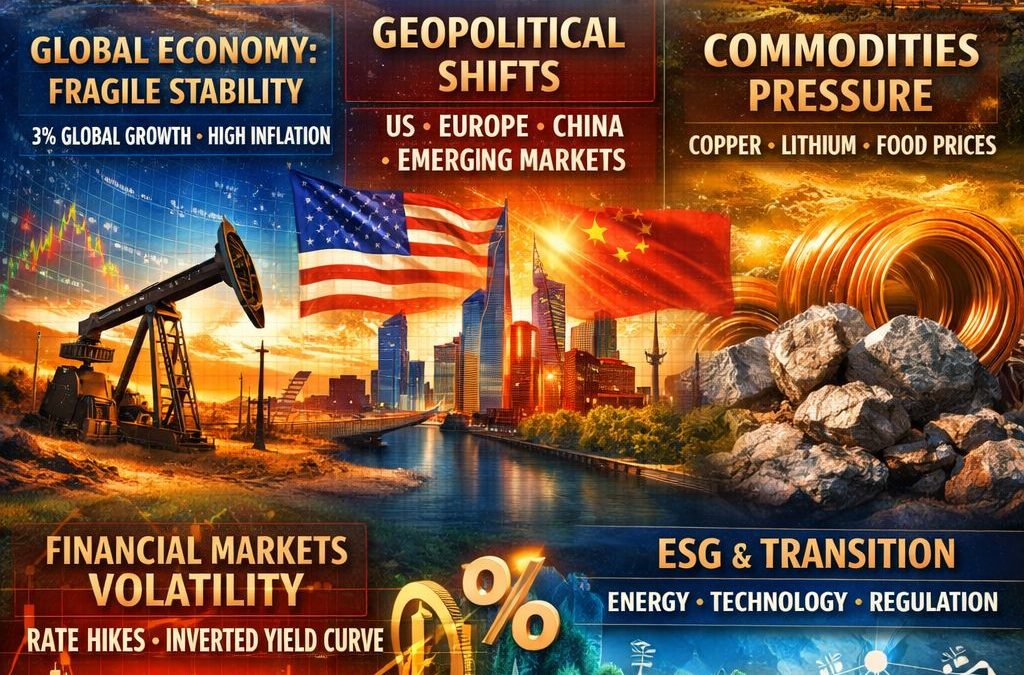
FOREWORD: THE ERA OF COMPLEX SYSTEMS
We are now navigating a global economy in which traditional analytical categories are reaching their limits. This outlook synthesizes three complementary levels of analysis: market dynamics (trading data and financial flows), structural transformations (long-term trends reshaping production and trade), and geo-economic reconfiguration (new power balances and interdependencies).
Based exclusively on recent primary data (December 2025 – January 2026) and recognized analytical frameworks, it provides a comprehensive mapping of the forces currently at play.
Global Economy: Apparent Stability, Structural Fragilities
The year 2026 opens with a global economy that is proving more resilient than dynamic. After several years marked by successive shocks (inflation, monetary tightening, geopolitical tensions, and climate disruptions) global growth remains positive but constrained. The International Monetary Fund anticipates global expansion close to 3%, a historically moderate level that reflects less a catch-up phase than a cruising regime under pressure.
Disinflation has taken hold across most advanced economies, without restoring an accommodative monetary environment. Energy prices have stabilized, yet services, wages, and transition-related costs continue to sustain underlying inflation above long-term averages. This environment durably anchors the global economy in a phase of compressed nominal growth, where policy missteps become increasingly costly.
For investors and public decision-makers alike, the reading is clear: this is neither a phase of acute crisis nor one of robust expansion, but rather a period of managed vulnerability, requiring discipline, selectivity, and a long-term perspective.
Economic Geography: A Fragmented World
In the United States, activity is slowing without tipping into contraction. The labor market remains resilient, although job creation shows signs of normalization. Policy rates, maintained in restrictive territory by the Federal Reserve, continue to weigh on both residential and commercial real estate. Consumption remains supported by slightly positive real incomes, while industrial policy (semiconductors, clean energy, infrastructure) acts as a structural buffer.
In the euro area, the trajectory is more fragile. Growth remains weak, constrained by subdued domestic demand and the persistent contraction of certain energy-intensive industrial sectors. Nevertheless, the region benefits from an increasingly structuring regulatory framework, particularly in ESG matters, which supports long-term investment in energy efficiency, low-carbon infrastructure, and industrial modernization.
China continues to navigate a delicate transition. Leading indicators point to broadly stable activity, but without genuine momentum. The real estate sector remains a source of vulnerability, while massive investment in strategic technologies (electric vehicles, batteries, industrial artificial intelligence) reinforces the country’s influence over global critical metals markets.
Emerging economies, particularly in Africa and Latin America, occupy a central position in the global resource equation. They concentrate a decisive share of copper, lithium, and agricultural production, while remaining exposed to political, climatic, and currency risks. Their growth potential is real, but intrinsically conditional on institutional stability.
Commodities: Structural Tensions Under Apparent Control
Agricultural markets remain characterized by persistently elevated prices. The FAO Food Price Index continues to stand above its long-term average, reflecting the combined effects of global demand, biofuel policies, and recurrent climate shocks. This situation heightens social and fiscal risks in net-importing countries, while creating targeted opportunities in agritech, logistics, and hedging instruments.
In critical metals markets, the energy transition exerts sustained structural pressure. Demand for copper, lithium, and nickel is growing faster than supply, which remains constrained by long investment cycles and rising environmental requirements. Historically low visible inventories amplify volatility, underscoring that the low-carbon transition still rests on fragile material foundations.
Monetary Policy and Financial Markets: Durable Normalization
Major central banks continue to adopt a cautious stance. Both the Federal Reserve and the European Central Bank have clearly signaled that price stability and institutional credibility remain the overriding priorities. Interest rates are therefore expected to remain higher for longer than in previous cycles, establishing a new financial regime.
This configuration penalizes assets most sensitive to the cost of capital, while restoring appeal to short-duration bonds, cash-generative companies, and defensive infrastructure assets. Volatility is no longer cyclical; it has become structural, requiring active management and rigorously diversified allocation strategies.
ESG and Transition: From Regulatory Constraint to Competitive Advantage
The gradual entry into force of the CSRD and the implementation of the CSDDD are profoundly reshaping the European economic environment. ESG is no longer merely a declarative framework; it is becoming a full-fledged market infrastructure. In the short term, compliance costs are rising; in the medium term, the quality of extra-financial information improves, facilitating more efficient capital allocation.
Opportunities are increasingly concentrated in traceability technologies, ESG auditing, green bonds indexed to measurable performance indicators, and financing solutions aligned with the transition.
PART ONE: THE STATE OF MARKETS, THE GREAT DISLOCATION
1.1 Financial Markets: The Breakdown of Historical Correlations
Financial markets are experiencing an unprecedented dislocation since the post-2020 monetary normalization.
- Equities: The S&P 500 closed 2025 up 8.2%, masking record sectoral dispersion. Valuations for companies linked to generative AI infrastructure (specialized chips, data centers, networks) have reached average P/E ratios of 28x (Bloomberg), compared with 17x for traditional industrial sectors. Europe shows a similar pattern, with the Stoxx Europe 600 Technology index outperforming the broader index by 24%.
- Fixed Income: The U.S. yield curve remains inverted (2-year at 4.1% vs. 10-year at 3.9%, Federal Reserve, January 2026), a persistent signal of slowdown expectations. A notable innovation is the rapid growth of transition bonds (financing the conversion of carbon-intensive industries) whose issuance increased by 35% year-on-year, reaching USD 85 billion (Climate Bonds Initiative).
- Currencies: The DXY dollar index exhibits heightened volatility (quarterly amplitude of +8%). Currencies of critical-metals-producing countries (Australian dollar, Chilean peso, Canadian dollar) are developing newfound resilience, becoming less correlated with global risk cycles.
- Materials: Copper (LME) trades around USD 9,800 per tonne, but the real tension lies in physical inventories, which cover only 2.3 weeks of global consumption, a historically low level (LME warehouse reports). Lithium (battery-grade carbonate) has stabilized at USD 18,500 per tonne following the 2024 correction (Benchmark Mineral Intelligence).
1.2 Real Markets: The Paradox of Selective Abundance
- Energy: Brent crude fluctuates between USD 78–85 per barrel (ICE). The strategic indicator has become stock coverage ratios: Europe (87%), United States (89%), China (91%) according to the IEA. A silent revolution is underway in liquefied natural gas (LNG): 78% of new contracts signed in 2025 include destination flexibility clauses, compared with 45% in 2020 (GIIGNL).
- Agriculture: The FAO Food Price Index stood at 118.7 in December 2025. Cereals benefited from exceptional harvests in the Northern Hemisphere (+5% vs. 2024, FAO), while oilseeds and cocoa suffered localized climate stress. Parametric futures contracts based on satellite data tripled in volume in 2025.
PART TWO: THE FIVE MAJOR STRUCTURAL SHIFTS
2.1 The Asymmetric Productivity Revolution
Conference Board data reveal a profound divergence: labor productivity grows at 1.9% annually in the digital sector (software, cloud, IT services), compared with just 0.4% in physical services (hospitality, healthcare, construction). This gap explains differentiated inflation dynamics: relative deflation in digital goods, persistent inflation in proximity services.
2.2 Reconfiguring Value Chains: Beyond “Reshoring”
- United States: For the first time, U.S. imports from Mexico exceeded those from China (U.S. Census Bureau, December 2025).
- Europe: Germany reduced its dependence on Russian gas to 12%, while tripling imports of blue ammonia from Qatar for fertilizer production.
- Asia: Intra-Asian trade now accounts for 58% of the region’s total trade, up from 52% in 2020 (Asian Development Bank).
2.3 The Financialization of the Ecological Transition
For every dollar invested in renewable energy in 2025, USD 2.3 were invested in grid and storage infrastructure (IEA). Sovereign green bonds with environmental performance clauses (Italy, United Kingdom) benefit from a greenium of 15-20 basis points.
2.4 The Emergence of Alternative Economic Systems
Payments in local currencies (excluding USD/EUR) in bilateral trade reached 28% in 2025, up from 12% in 2020 (BIS). Instant payment systems (India’s UPI, Brazil’s Pix) now process more transactions than credit cards in their domestic markets.
2.5 “Shared Economic Sovereignty”
Critical minerals partnerships (US-Japan-EU, EU-Canada) are creating new spheres of economic influence based on resource complementarity. The US-Japan partnership on advanced semiconductors has already mobilized USD 25 billion in joint investments.
PART THREE: NEW REGIMES OF SYSTEMIC RISK
3.1 Critical Nodes of the Global System
- Data Centers: They consume up to 4% of global electricity (IEA) and are concentrated in regions exposed to water stress (Virginia, Taiwan, Singapore).
- Maritime Chokepoints: Twelve straits account for 40% of global trade, yet only three are covered by multilateral security agreements (IMO).
- Payment Systems: SWIFT remains dominant, but 47 countries are developing parallel systems (Russia’s SPFS, China’s CIPS), increasing payment fragmentation risks.
3.2 Non-linear and Cascading Risks
- Financial Cyclones: The private credit market (USD 3.5 trillion) presents vulnerabilities in the event of a severe recession (FSB, Risk Assessment).
- Ecological Tipping Points: Accelerated permafrost thaw could release massive quantities of methane, invalidating current climate risk models.
- Systemic Cyber Risk: A major attack on a dominant cloud provider could simultaneously paralyze the financial, energy, and logistics sectors.
PART FOUR: GEOECONOMIC RECOMPOSITION (“FUNCTIONAL NEO-MULTIPOLARITY”)
4.1 Economic Pragmatism as the New Doctrine
Alliances increasingly form around concrete objectives rather than ideological affinity. “Minilateralisms” (groups of 3-10 countries) are multiplying on specific issues: food security (India-UAE-Israel), critical metals (US-Canada-Japan), artificial intelligence (EU-UK-Singapore).
4.2 Partial Sovereignty and Selective Interdependencies
States accept interdependence in certain domains (public health, technological standards) while preserving autonomy in others (defense, sensitive data). China, for example, remains dependent on Taiwanese semiconductors while developing autonomy in batteries and electric vehicles.
4.3 Competition Through Cooperation
The United States and China cooperate on responsible AI standards (UNESCO-OECD forum) while competing fiercely over advanced chips and industrial subsidies. This duality defines the new geo-economic normal.
PART FIVE: SCENARIOS AND STRATEGIC OPPORTUNITIES FOR 2026-2027
5.1 Three Probabilistic Scenarios
- Central scenario (60%): Global growth at 2.8%, inflation at 3.2%, with 3-4 medium-intensity crises (emerging sovereign default, localized food shortages).
- Optimistic scenario (25%): Technological breakthrough in long-duration energy storage (>100 hours), accelerated productivity gains from AI.
- Downside scenario (15%): Liquidity crisis in emerging markets, proliferation of protectionist measures “below the WTO radar.”
5.2 Opportunities by Actor Category
- States: Develop strategic reserves of critical metals (modeled on oil reserves), create cross-border economic zones for transition industries.
- Companies: Adopt intelligent diversification (presence across complementary economic blocs), invest in operational resilience (dual sourcing, modular capacity).
- Investors: Focus on three themes: connectivity infrastructure (fiber optics, smart ports), sobriety technologies (lightweight materials, heat recovery), and services to economic ecosystems (supply-chain finance).
CONCLUSION: TOWARDS A NEW “DYNAMIC EQUILIBRIUM”
January 2026 marks neither a rupture nor a return to abundance. The global economy holds, but under constraint. Geopolitical tensions, the energy transition, the cost of capital, and the physical limits of resources define a demanding environment where value creation depends less on speed than on robustness.
In a world where margins for error are shrinking, stability becomes a strategic asset.
January 2026 marks entry into a phase in which the global economy must manage five simultaneous transitions:
- Energy transition (from fossil fuels to renewables)
- Digital transition (from physical to digital economies)
- Geopolitical transition (from a unipolar to a multipolar world)
- Demographic transition (aging in advanced economies, youth in emerging societies)
- Climate transition (adaptation to new planetary conditions)
Success will not come from choosing among these transitions, but from orchestrating them coherently. Data show that the most resilient actors combine long-term vision (investment in foundational capacities) with short-term agility (adaptation to shocks and opportunities).
Twenty-first-century economic intelligence no longer consists in predicting the future, but in preparing for multiple possible futures by developing robust capabilities in a fundamentally uncertain world.
The challenge is no longer growth for growth’s sake, but the construction of prosperity compatible with planetary limits.
SOURCES
- Market Data: Bloomberg, Refinitiv Eikon, London Metal Exchange, Intercontinental Exchange
- International Institutions: IMF (World Economic Outlook, January 2026), IEA (World Energy Outlook 2025), BIS (Working Papers), WTO (Trade Monitoring Report)
- Sectoral Organizations: The Conference Board (Productivity Data), USGS (Mineral Commodity Summaries), FAO (Food Price Index), Climate Bonds Initiative
- Central Banks: Federal Reserve, European Central Bank (ECB), Bank of Japan (policy decisions and projections)
- National Statistical Agencies: U.S. Census Bureau, Eurostat, National Bureau of Statistics of China (NBS), Ministry of Statistics and Programme Implementation of India (MOSPI)
- Research Centers: Stanford AI Index, Potsdam Institute for Climate Impact Research (PIK), McKinsey Global Institute
SOURCES AND BASIS FOR ECONOMIC PROJECTIONS
- International Monetary Fund (IMF), World Economic Outlook and Update, late 2025
- World Trade Organization (WTO), Global Trade Outlook, 2025
- European Central Bank (ECB), Macroeconomic Projections and monetary policy decisions, 2025
- U.S. Federal Reserve, FOMC Statements and Summary of Economic Projections, 2025
- Eurostat, HICP, Flash Estimates, 2025
- Bureau of Labor Statistics (BLS), Employment Situation, 2025
- National Bureau of Statistics of China (NBS), PMI indicators, 2025
- FAO, Food Price Index, 2025
- International Energy Agency (IEA), World Energy Outlook, Oil Market Report, Critical Minerals Outlook, 2025
- Bank for International Settlements (BIS), Annual Economic Report, 2025
- Bloomberg, Reuters, AFP, economic and commodities newswires, 2025
Important Disclaimer: The content of this article is provided for informational and educational purposes only. It reflects the author’s opinion based on information available at the time of publication, which may become outdated. This content does not constitute personalized investment advice, a recommendation to buy or sell, and does not guarantee future performance. Markets carry a risk of capital loss. The investor is solely responsible for their decisions and should consult an independent professional advisor before any transaction. The publisher disclaims all liability for decisions made based on this information.