
Executive Overview
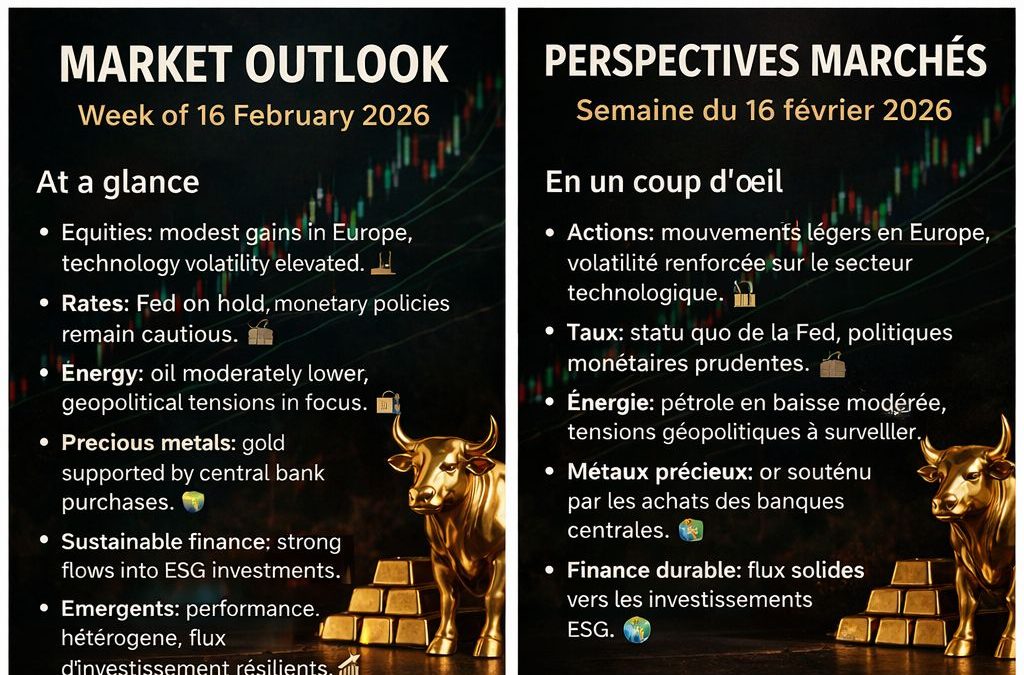
Global financial markets enter mid-February in a phase characterised by relative stability in policy expectations, selective equity leadership, and persistent geopolitical sensitivity. Cross-asset signals suggest neither systemic stress nor broad-based exuberance, but rather a period of recalibration following the disinflationary trend observed across advanced economies.
This document provides macroeconomic context and market observations based on publicly available information. It is intended to support strategic awareness, not prescribe portfolio action.
Macroeconomic Environment & Monetary Policy Context
In both the United States and the United Kingdom, inflation has moderated materially from prior peaks, though services inflation and wage dynamics continue to influence central bank communication.
The Federal Reserve maintains a data-dependent stance. Forward guidance reflects caution rather than directional commitment. Similarly, the Bank of England faces a complex domestic backdrop balancing residual inflation pressures with signs of moderating demand.
Current cross-market pricing reflects expectations of gradual policy normalisation, though timing and magnitude remain subject to incoming data.
Observational note:
Fixed income markets appear particularly sensitive to incremental shifts in inflation expectations and central bank language, rather than to absolute macro deterioration.
Developed Equity Markets: Structure and Dispersion
United States
U.S. equity indices continue to demonstrate resilience, though performance dispersion remains pronounced. A concentrated group of large-cap issuers accounts for a significant share of index-level gains. Earnings stability and capital expenditure in digital infrastructure remain central themes in valuation discussions.
However, breadth indicators suggest that performance leadership is not uniformly distributed across sectors.
United Kingdom & Europe
European equities exhibit comparatively balanced sector participation, with financials, industrial exporters, and energy-linked firms contributing to index stability. UK-listed companies continue to reflect valuation metrics below long-term global averages, while dividend yields remain comparatively elevated.
Domestic economic sensitivity in the UK, particularly in housing and consumer sectors, remains an observable variable.
Structural observation:
Market performance at the index level may obscure internal rotation dynamics. Sector dispersion remains a defining characteristic of the current cycle.
Energy & Commodities: Policy Sensitivity and Structural Themes
Energy Markets
Oil prices remain influenced by geopolitical developments and supply coordination mechanisms. Recent trading patterns indicate responsiveness to diplomatic developments and inventory data rather than purely demand-driven shifts.
European gas markets remain more stable than in prior years, reducing systemic energy volatility relative to earlier phases of the cycle.
Gold
Gold continues to function primarily as a macro-risk hedge within institutional allocation frameworks. Central bank purchasing activity and geopolitical uncertainty remain relevant supporting factors.
Movements in real yields continue to influence price sensitivity.
Industrial Metals
Industrial metals, particularly copper, remain linked to long-term electrification and infrastructure narratives. At the same time, short-term price action reflects variability in global industrial production data.
Agricultural Commodities
Agricultural markets display relative equilibrium at present, though weather conditions, export flows, and logistical factors remain material drivers of short-term volatility.
Cross-asset observation:
Commodities currently reflect a combination of structural demand themes and tactical macro positioning, rather than uniform cyclical acceleration.
Sustainable Finance & ESG Developments
Sustainable finance continues to evolve from thematic positioning to regulatory and reporting discipline.
In the UK and Europe, enhanced disclosure requirements are reinforcing scrutiny around emissions reporting, governance standards, and transition credibility. In the United States, investor differentiation increasingly focuses on measurable sustainability metrics rather than narrative positioning.
Capital allocation decisions appear progressively influenced by transparency, reporting quality, and long-term transition clarity.
This development is structural rather than cyclical.
Emerging Markets: Heterogeneity and Policy Sensitivity
Emerging markets continue to demonstrate differentiated performance across regions.
Asia remains closely tied to semiconductor production, advanced manufacturing, and digital infrastructure ecosystems. Latin American markets remain sensitive to commodity cycles and fiscal discipline trajectories.
Currency dynamics remain a central variable, particularly in relation to U.S. rate expectations.
Broad index-level interpretations may not fully capture country-specific divergence.
Near-Term Risk Considerations
The following variables warrant close observation:
- Inflation releases in major developed economies
- Corporate earnings guidance revisions
- Geopolitical developments affecting trade or energy corridors
- Central bank communications and fiscal policy signals
At present, these risks appear incremental rather than systemic; however, market reaction functions remain sensitive to data surprises.
Structural Themes Worth Monitoring
- Concentration risk within major equity indices
- The interaction between disinflation and corporate margin stability
- Capital allocation discipline in AI-related expenditure cycles
- ESG reporting quality as a determinant of institutional capital access
A notable dynamic in the current environment is that index-level stability may coexist with internal fragility if leadership narrows excessively. Market breadth therefore remains an analytical priority.
Concluding Perspective
The current phase of the cycle is characterised less by directional conviction and more by balance-sheet resilience, earnings durability, and policy calibration.
Cross-asset signals do not currently indicate systemic dislocation. However, valuation sensitivity, concentration risk, and geopolitical unpredictability reinforce the importance of disciplined capital oversight and diversified exposure frameworks.
This environment favours analytical rigour over bold forecasts.
Sources
Central Banks & Monetary Policy
- Federal Reserve, FOMC statements, Summary of Economic Projections
- Bank of England, Monetary Policy Reports
- European Central Bank, Economic Bulletin
- Bank for International Settlements, Quarterly Review
Inflation, Labour & Growth Data
- U.S. Bureau of Labor Statistics, CPI, PPI, Employment Situation
- U.S. Bureau of Economic Analysis, GDP, PCE
- Office for National Statistics, CPIH, labour market
- Eurostat, HICP, euro area macro data
Equity & Capital Markets
- S&P Dow Jones Indices, Index concentration & sector weight
- FTSE Russell, UK market analytics
- MSCI, Developed & Emerging Markets data
- London Stock Exchange Group, Market statistics
Fixed Income & Sovereign Markets
- U.S. Department of the Treasury, Yield curve data
- UK Debt Management Office, Gilt issuance & yields
Commodities & Energy
- U.S. Energy Information Administration, Oil inventories
- International Energy Agency, Oil Market Report
- World Gold Council, Gold demand trends
- London Metal Exchange, Industrial metals pricing
- Food and Agriculture Organization, FAO Food Price Index
Sustainable Finance & ESG
- Financial Conduct Authority, Sustainability Disclosure Requirements
- U.S. Securities and Exchange Commission, Climate disclosure framework
- International Sustainability Standards Board, Reporting standards
- UN Principles for Responsible Investment, Responsible investment framework
Emerging Markets & Global Outlook
- International Monetary Fund, World Economic Outlook
- World Bank, Global Economic Prospects
- Institute of International Finance, Capital flows tracker
Important Disclaimer: The content of this article is provided for informational and educational purposes only. It reflects the author’s opinion based on information available at the time of publication, which may become outdated. This content does not constitute personalized investment advice, a recommendation to buy or sell, and does not guarantee future performance. Markets carry a risk of capital loss. The investor is solely responsible for their decisions and should consult an independent professional advisor before any transaction. The publisher disclaims all liability for decisions made based on this information.