
After more than twenty-five years of negotiations, the trade agreement between the European Union and the Mercosur bloc comprising Brazil, Argentina, Paraguay and Uruguay, stands as one of the most consequential trade initiatives in modern EU commercial policy. As the agreement moves toward phased implementation, its economic implications deserve careful examination, not only for the European Union itself, but also for neighbouring economies whose trade structures and competitive positioning will inevitably be affected.
I. A Trade Relationship Already Substantial Before the Agreement
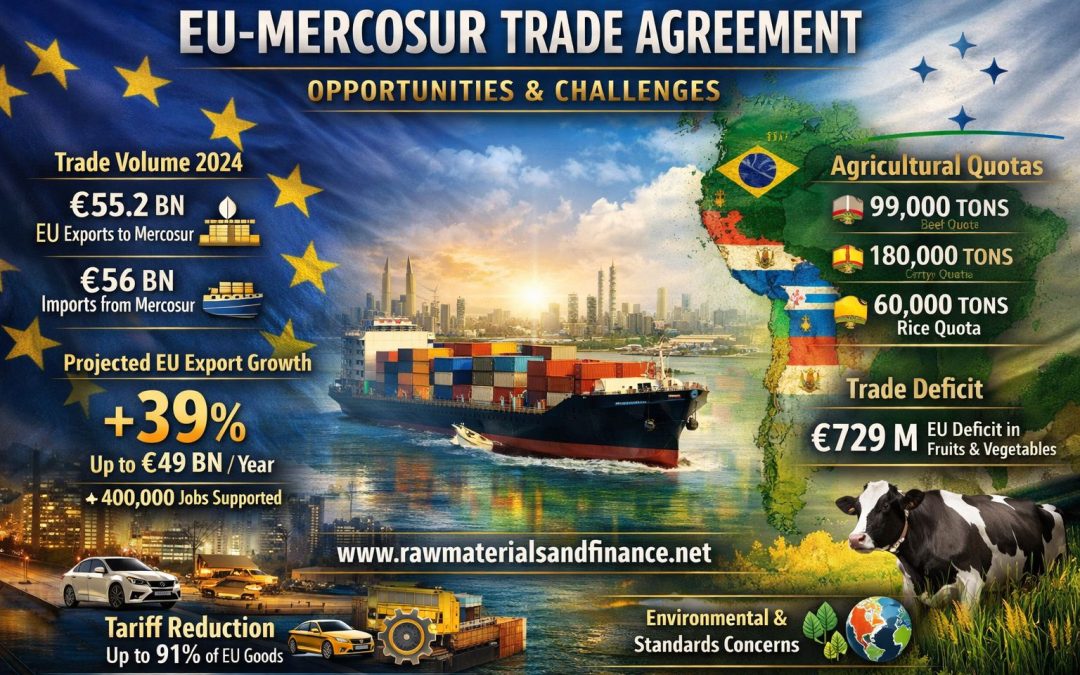
Even prior to ratification, trade relations between the EU and Mercosur rested on a significant economic foundation. In 2024, total bilateral trade in goods exceeded €111 billion, with €55.2 billion in EU exports to Mercosur and €56 billion in imports from the bloc. Over the past decade, imports from Mercosur have increased by more than 50%, while EU exports rose by approximately 25% between 2014 and 2024, reflecting both structural demand and growing integration into global supply chains.
The composition of this trade highlights a marked structural complementarity. More than 80% of EU imports from Mercosur consist of agricultural products and raw materials, while 86% of EU exports are manufactured goods, notably industrial machinery, transport equipment and pharmaceuticals. This asymmetry underscores the strategic nature of the agreement: it reinforces Europe’s industrial export base while securing access to essential primary inputs.
Trade in services, often overlooked in public debate, is also substantial. In 2023, the EU exported approximately €29 billion in services to Mercosur, compared with €13.4 billion in services imports, confirming Europe’s strong comparative advantage in high-value service sectors.
II. Expected Structural Benefits for the European Economy
1. Export Growth in Manufacturing and Services
According to consolidated institutional projections, the progressive elimination of trade barriers including the removal of over 91% of customs duties on EU exports to Mercosur, phased in over 10 to 15 years, could result in a nearly 39% increase in EU goods exports to the region by 2040. In absolute terms, this would represent close to €49 billion in additional trade flows, potentially supporting over 440,000 jobs across the EU economy.
These gains are expected to be concentrated in automotive manufacturing, mechanical engineering, chemicals, pharmaceuticals and advanced industrial equipment, sectors where EU firms currently face tariffs of up to 35% in Mercosur markets. Their gradual removal is likely to significantly enhance European competitiveness across South America’s 270-million-strong consumer base.
Services liberalisation constitutes a parallel growth channel. Financial services, transport, digital services and professional consulting are expected to benefit from improved market access, regulatory cooperation and greater legal certainty.
2. Targeted Opportunities for European Agri-Food Exports
While agricultural sensitivities dominate political debate, the agreement also creates tangible opportunities for selected European agri-food producers. In 2024, EU agri-food exports to Mercosur totalled approximately €3.3 billion. The phased elimination of high tariffs on products such as olive oil (€600 million), wine (€238 million), spirits and beverages (€259 million), and chocolate (€109 million) is expected to support further export growth, particularly for high-quality, value-added European products.
Dairy products including cheese and milk powders will also benefit from tariff elimination within defined quota limits, offering incremental market access without abrupt competitive shocks.
III. Sectoral Risks and Internal Vulnerabilities
1. Increased Competition in Sensitive Agricultural Sectors
The most contentious dimension of the agreement concerns agriculture. The deal allows for a quota of 99,000 tonnes of beef imported into the EU under preferential tariff conditions. While politically sensitive, this volume represents only around 1.5% of total EU beef production, and less than half of current beef imports from Mercosur countries.
Additional quotas apply to poultry (180,000 tonnes), rice (60,000 tonnes) and honey (45,000 tonnes), each corresponding to a limited share of EU consumption. Nonetheless, for certain regions and farm structures, the pressure on prices and margins may be significant.
Structural imbalances already exist. In 2024, the EU recorded a €729 million trade deficit in fruit and vegetables with Mercosur, driven by €984 million in imports versus €255 million in exports, illustrating vulnerabilities that pre-date the agreement.
2. Standards, Sustainability and Competitive Fairness
Concerns regarding environmental, sanitary and animal-welfare standards remain central to public discourse. While all imports must comply with EU food safety regulations, critics argue that production cost differentials linked to environmental and social standards may distort competition.
In response, the European Council and Parliament adopted strengthened bilateral safeguard mechanisms in December 2025, lowering thresholds for intervention and enabling faster protective measures should import surges threaten EU agricultural markets. These safeguards aim to reconcile market openness with domestic stability.
IV. Spillover Effects on the EU’s Neighbouring Economies
The agreement’s implications extend beyond EU borders. Neighbouring economies, including those in the Western Balkans, Eastern Partnership countries and Turkey, may experience indirect effects as trade flows and supply chains adjust.
Preferential EU-Mercosur trade could prompt these economies to reposition production, specialise in niche segments or deepen regulatory alignment with EU standards. Conversely, sectors lacking competitiveness may face marginalisation unless supported by targeted industrial or trade policies.
V. Safeguards, Governance and Strategic Leverage
The agreement is not a simple tariff-cutting exercise. It establishes safeguard clauses, transition periods, regulatory cooperation frameworks and protections for geographical indications, reinforcing legal certainty and market predictability.
The EU’s position as the largest foreign investor in Mercosur, with a stock of approximately €390 billion in foreign direct investment in 2023, further strengthens its capacity to shape standards, promote sustainability and anchor long-term economic cooperation.
VI. Medium- and Long-Term Outlook
According to European Commission estimates, the agreement could generate a net GDP gain of around 0.05% for the EU by 2040. This is modest in aggregate terms, but meaningful when combined with industrial competitiveness, export diversification and strategic resilience.
The benefits are expected to materialise gradually, reflecting the agreement’s phased implementation and the current scale of bilateral trade. Short-term macroeconomic effects will likely remain limited, while structural gains accrue over time.
VII. The Quiet yet Structural Role of Multinational Corporations in the EU-Mercosur Equation
Beyond the signatory states themselves, the EU-Mercosur agreement is part of a broader dynamic in which large multinational corporations, including American ones, play a structuring role that is often indirect yet decisive. Many global groups, active in agribusiness, energy, logistics, chemicals or the automotive industry, maintain deep industrial and financial footprints both within the European Union and across Mercosur countries, positioning them as potential beneficiaries of enhanced trade fluidity, regardless of their formal nationality. For these actors, the agreement represents not merely a trade framework, but a tool for securing value chains, reducing regulatory frictions and optimising long-term investment flows. This perspective warrants close attention: it suggests that a portion of the agreement’s tangible effects may be captured by firms already embedded in globalised production networks, capable of arbitrating between jurisdictions, regulatory environments and cost structures. Without calling into question the sovereignty of European trade policy, this reality underscores a central governance challenge: ensuring that the benefits of trade liberalisation translate into value creation, employment and productive resilience within the European economic space, rather than being confined to the global balance-sheet optimisation of transnational corporations.
Conclusion: A Demanding but Structurally Sound European Opportunity
The EU–Mercosur agreement represents a major step in Europe’s long-term trade strategy. It offers clear opportunities for industrial exports, services and selected agri-food sectors, while simultaneously exposing vulnerabilities in sensitive agricultural markets.
Its success will depend less on headline figures than on effective implementation, safeguard activation, and accompanying policies to support affected sectors and regions. More broadly, the agreement underscores the EU’s ambition to combine openness with standards, competitiveness with sustainability, and trade liberalisation with social responsibility.
Rather than a disruptive shock, the EU-Mercosur agreement should be understood as a long-cycle structural adjustment, testing Europe’s capacity to manage global integration while preserving economic cohesion and strategic autonomy.
Sources
- Eurostat, EU-Mercosur trade data (goods) 2024
- Conseil de l’Union européenne, EU-Mercosur trade infographic
- European Commission, Policy on EU-Mercosur relations
- Commission factsheet on export duties removal (agroalimentaire)
- Quota and safeguard provisions, EU-Mercosur partnership factsheet.
- EU-Mercosur Council & Parliament bilateral safeguards rules (Dec 2025)
- The Week, Overview of deal history and projections
- Le Monde, Industrial sector gains and GDP projection
- EU trade and investment context, Policy
- Fruit & vegetable trade deficit stats (EU-Mercosur)
Important Disclaimer: The content of this article is provided for informational and educational purposes only. It reflects the author’s opinion based on information available at the time of publication, which may become outdated. This content does not constitute personalized investment advice, a recommendation to buy or sell, and does not guarantee future performance. Markets carry a risk of capital loss. The investor is solely responsible for their decisions and should consult an independent professional advisor before any transaction. The publisher disclaims all liability for decisions made based on this information.