
1. The Invisible Frontiers of Power
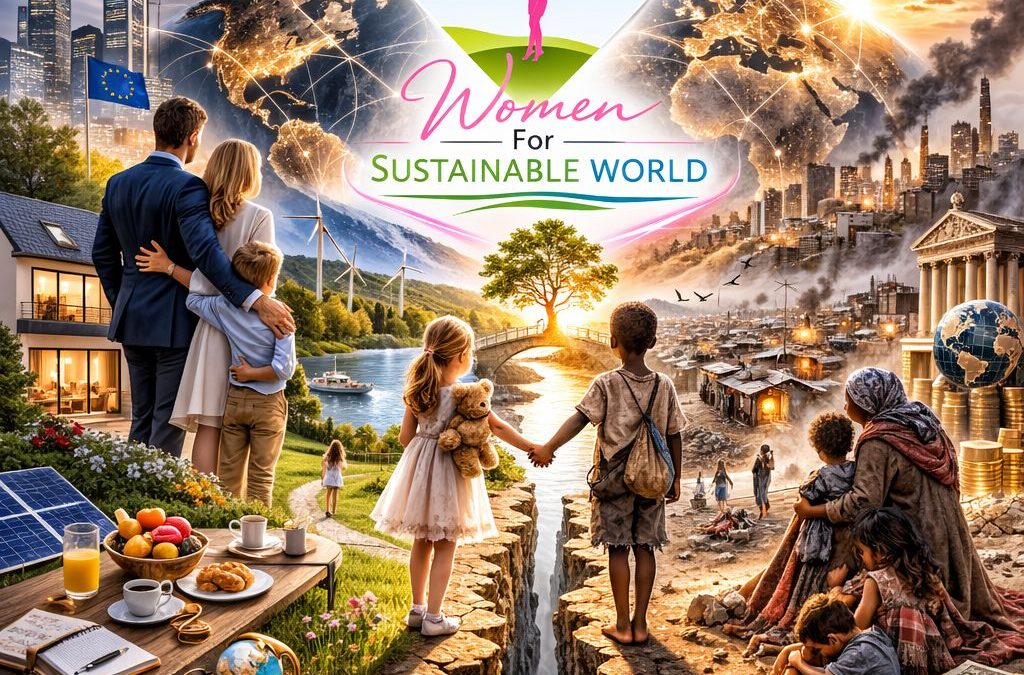
There exist borders that no customs officer guards and no treaty mentions. They do not separate territories, but destinies. They are neither geographical nor cultural in nature. They are patrimonial. At the heart of this invisible line, one of the most significant economic phenomena of the century is now unfolding: the intergenerational transfer of wealth on a scale unseen for a hundred years. This is not merely a matter of private succession, but a silent reconfiguration of global economic power.
Imagine a planet where a handful of individuals hold not only assets, but the very capacity for choice, mobility, and hope. This is not a metaphor; it is a quantified fact. Globally, less than 0.001% of the population holds a share of wealth comparable to that of several billion human beings; approximately 60,000 individuals concentrate a considerable fraction of the world’s assets, while the richest 10% possess nearly 75-76% of total wealth, and the poorest 50% control only about 2%.
These figures, established by the World Inequality Lab in the World Inequality Report 2022, are neither hyperbole nor ideological manifesto: they describe the current structure of global capitalism. This concentration becomes tangible when translated into the real capacity to live, to move, to access healthcare, to invest, or to bequeath. A silent fracture is forming, not between countries, but within societies themselves, between those who possess transferable capital and those who have only their labour. We are witnessing the emergence of a new form of segregation: no longer based on explicit legal discrimination, but on the cumulative concentration of patrimony, inheritance, and differential access to the fundamental resources of existence.
2. The Transfer Reshaping the World
This concentration is not static; it is poised to be transmitted. According to the Billionaire Ambitions Report published by UBS, approximately $6.9 trillion held by billionaires is expected to change hands by 2040. This figure concerns only the apex of the wealth pyramid. Broadening the view to global high-net-worth individuals, the Capgemini World Wealth Report 2024 refers to a “Great Wealth Transfer” amounting to several tens of trillions of dollars over the next two decades.
- In the United States, Cerulli Associates estimates intergenerational transfers will exceed $70 trillion by the mid-2040s.
- In Europe, Eurostat data and OECD research show a marked resurgence in the weight of inheritances in the formation of private wealth since the 1980s, returning to levels observed at the beginning of the 20th century.
- In France, long-term series from INSEE and analyses by France Stratégie indicate that annual inheritance flows now represent over 15% of national income, compared to approximately 5% in the 1950s, with cumulative projections nearing €8,000 to €9,000 billion transferred by 2040.
- According to the Observatoire des inégalités, the richest 10% in France receive on average more than three times the income of the poorest 10%, while the share of wealth originating from inheritances has risen sharply since the 1970s.
Recent Oxfam reports confirm an accelerated global dynamic of concentration, highlighting that between 2000 and 2024, the richest 1% captured a disproportionate share of newly created wealth. Inheritance, therefore, is not merely a transfer of financial assets: it is a transfer of power, security, investment capacity, networks, and influence. It provides access to capital without debt, enables strategic equity stakes, allows for risk anticipation, and ensures lasting membership in decision-making circles. In a world where certain multinational corporations wield economic weight comparable to that of medium-sized states, this concentration of patrimony becomes an issue of global governance.
3. Governing Wealth-Based Segregation
Data from the World Bank and the International Monetary Fund show that within many advanced economies, the share of capital in value added has increased since the 1980s while the share of labour has declined, mechanically reinforcing the role of wealth in income formation.
Concurrently, the work of the European Commission and the OECD on Base Erosion and Profit Shifting (BEPS) documents the effects of transnational tax optimisation on the redistributive capacity of states. The OECD also notes that intergenerational mobility is lower in countries where wealth inequality is high: when the return on capital sustainably outstrips growth, concentration tends to become self-reinforcing.
Within the next twenty to forty years, demographic ageing in Europe and North America, the rise of wealth in Asia highlighted by UBS global wealth reports, and the progressive hardening of wealth gaps could transform this dynamic into a durable architecture. However, data is not fate; it constitutes a diagnosis. The European Union already possesses concrete instruments (enhanced tax cooperation, transparency of beneficial owners, an international minimum tax rate) capable of altering the trajectory.
The issue is neither ideological nor moral, but systemic: preserving an open and innovative economy without allowing inheritance to become the central determinant of economic trajectories. For if nothing is adjusted, wealth-based segregation risks transforming into birth-based segregation, fragmenting societies into nearly inviolable patrimonial enclaves and persistently marginalised social peripheries. What is at stake by 2040 is not merely the redistribution of private fortunes, but the very structure of global economic power. And the figures, for their part, do not speculate.
Conclusion
Wealth-based segregation is not an accusation. It is an observation.
Global data converge:
- wealth is concentrating,
- capital appreciates faster than labour,
- and social mobility is slowing.
We stand at a pivotal moment. Either patrimonial concentration becomes humanity’s new invisible frontier. Or institutions (national and European) adapt their instruments to the reality of globalised capitalism.
The great wealth transfer, far from being a simple transfer of assets, is a process that shapes generations, opportunities, and social trajectories in the 21st century. If wealth-based segregation was initially a diagnosis, the addition of inheritance projections up to 2040 renders it a durable historical fracture.
What we call equality of opportunity is now being tested. It is no longer merely a question of income or wealth. It is a question of human destinies, of chance, of liberty, and of social equity.
Sources
- World Inequality Lab, World Inequality Report 2022.
- UBS, Billionaire Ambitions Report (2023-2024); Global Wealth Report 2023.
- Capgemini, World Wealth Report 2024.
- Cerulli Associates, estimates on intergenerational wealth transfers in the United States (2022-2023).
- OECD, Inheritance Taxation in OECD Countries (2021); data on social mobility and taxation.
- INSEE, national wealth accounts.
- France Stratégie, analyses on inheritance flows in France.
- Observatoire des inégalités, data on income and wealth gaps.
- Oxfam, global reports on wealth concentration (2023-2024).
- World Bank, World Development Indicators.
- International Monetary Fund, work on the share of capital and inequality.
- European Commission, reports on tax base erosion and international tax cooperation.