
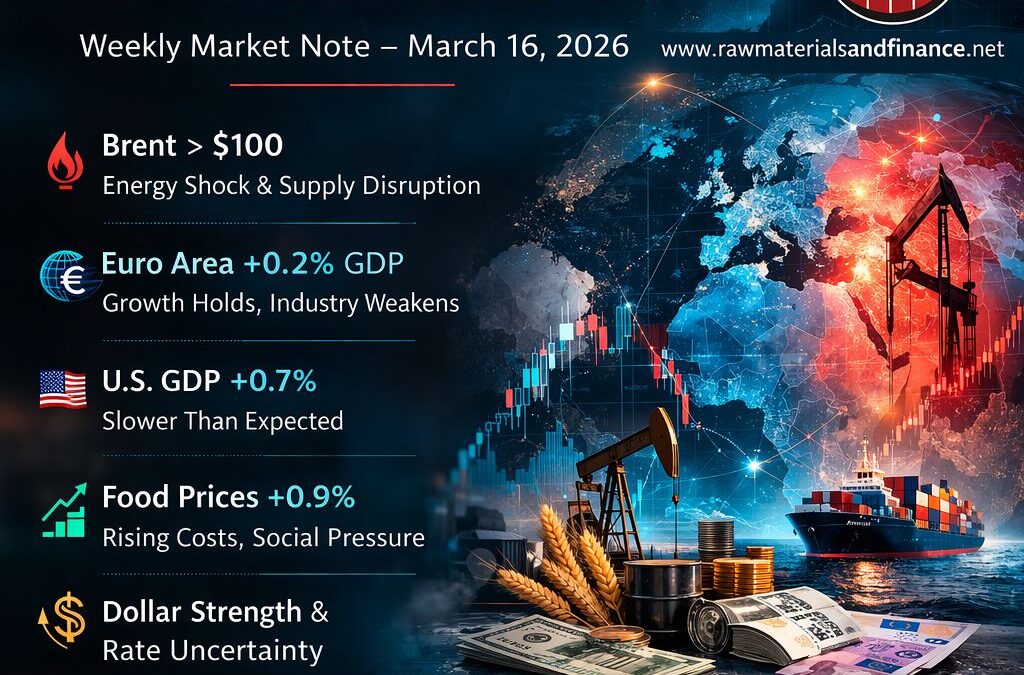
Week of 16 March 2026
This is not merely another week in the markets. It is a week in which global risk is being repriced in real time. The immediate catalyst lies in the Gulf: tensions around the Strait of Hormuz, Brent crude rising above $100 a barrel, and the abrupt return of a word investors had hoped to leave behind stagflation. According to Reuters, Brent reached $106.30 on 16 March, as markets absorbed the implications of an energy shock arriving precisely when the world economy was entering an incomplete and uneven disinflation phase.
The more consequential message for decision-makers is this: headline growth remains positive across several major economies, but the quality of that growth is deteriorating. Growth is being sustained less by broad-based private demand than by selective public support, concentrated investment, labour-market resilience, and statistical carryover. In the euro area, for instance, GDP still expanded by 0.2% in the fourth quarter of 2025 and by 1.4% for the year as a whole, according to Eurostat. Yet those figures coexist with signs of industrial weakness and fragile underlying momentum.
1. Equities, ETFs and allocation: markets are no longer rewarding expansion, but shock-absorption capacity
Investor positioning has turned noticeably more defensive. According to Reuters, global equity funds recorded their largest weekly outflow since December, reflecting a shift toward cash, short-duration fixed income, and selective exposure rather than broad risk appetite.
The underlying issue is not simply whether growth persists, but whether that growth remains earnings-supportive. In earlier cycles, modestly positive growth was often sufficient to underpin equity markets. That is less clearly the case now, because the present shock is hitting non-discretionary cost structures: energy, transport, financing conditions and, for many jurisdictions, currency exposure. In this environment, equity indices and large ETFs may appear superficially stable while internal market leadership narrows sharply. Resilience is migrating toward energy, defence and select defensive sectors; vulnerability is gathering in European consumer-facing businesses, energy-intensive industry, and segments that require cheap financing to sustain valuations. According to Reuters, European defence and energy-linked stocks have already outperformed broader benchmarks.
In other words, markets are no longer paying primarily for growth. They are paying for the ability to absorb a cost shock without a material collapse in margins.
2. Rates, currencies and central banks: energy has re-entered the monetary equation
The policy calendar is unusually consequential. The Federal Reserve meets on 17–18 March, while other major central banks are also in focus. According to Reuters, the broad market expectation is for policy rates to remain unchanged, not because inflation has been definitively defeated, but because the energy shock has made the path to monetary easing far less straightforward.
This distinction matters. An energy shock is not inflation in the classical demand-driven sense. It pushes prices upward without necessarily generating stronger end-demand. It therefore forces central banks into a far less comfortable trade-off: either tolerate imported inflation for longer, or maintain restrictive settings in economies already losing momentum. The apparent freedom central banks seemed to be regaining in recent months was more conditional than many assumed. It depended, to a significant degree, on a benign energy backdrop. That condition no longer holds.
On currencies, the dollar remains firm. That firmness is not only a conventional safe-haven dynamic; it is also a reminder that in periods of geopolitical and energy stress, the dollar reasserts itself as the core liquidity axis of the international system. For many energy-importing economies, the problem is therefore not merely higher oil prices, but higher oil prices in a stronger dollar environment.
3. Crypto: less an anti-system asset than a liquidity-sensitive macro instrument
Crypto-assets continue to be framed rhetorically as alternatives to the traditional financial system. Yet their recent behaviour points in a different direction. What matters now is not the mythology of detachment, but the reality of correlation. Bitcoin and other major digital assets are increasingly responsive to global liquidity conditions, real-rate expectations, and the broader macro regime.
That makes crypto less a standalone ideological hedge than a barometer of confidence in future monetary relaxation. If rate cuts are delayed by a renewed energy inflation impulse, digital assets are not insulated by design. They are exposed, like other risk assets, to a world in which liquidity remains more constrained than hoped. The implication for serious investors is straightforward: crypto now reveals less about escape from the system than about the market’s expectations for the future cost of money. This is an inference grounded in the same macro drivers currently reshaping broader asset allocation.
4. Energy: oil is signalling more than inflation, it is signalling a redistribution of economic power
Brent’s move above $100 a barrel is not simply an inflation story. It is also a story about relative economic power. According to Reuters, the current disruption linked to the closure of the Strait of Hormuz has materially reduced oil flows, while emergency measures, including a historically large IEA reserve release, have only partially offset the pressure.
What this means in practice is that the shock is not symmetrical. Economies and corporations with secure access to energy, fiscal room to cushion prices, strong domestic balance sheets or sophisticated hedging capacity are in a very different position from those that must absorb higher import costs immediately. In that sense, oil is functioning this week as a diagnostic of global fragmentation. It is revealing which systems can manage stress and which are far more exposed to it.
A further point deserves emphasis. Strategic reserve releases may moderate spot prices temporarily, but they do not repair the strategic signal being sent to industrial planners: energy security has once again become a first-order competitiveness issue. For Europe in particular, this reinforces a deeper truth—future industrial strength will be determined not only by labour costs, tax frameworks or capital access, but also by the physical and geopolitical reliability of energy supply.
5. Gold and industrial metals: refuge for gold, but a test of sincerity for copper
Gold continues to benefit from its defensive role, though not in an indiscriminate panic-driven fashion. According to Reuters, safe-haven demand is evident, but measured. That is itself revealing. Markets are not yet in full crisis mode; they are in a phase of disciplined caution.
Copper, by contrast, requires a more nuanced reading. A firm copper price might traditionally be read as a sign of healthy global industrial demand. That interpretation is now incomplete. Structural support for copper comes increasingly from energy transition investment, supply constraints and regionally concentrated industrial policy rather than from synchronised global expansion. In other words, industrial metals can remain well supported even when large parts of the real economy (particularly European manufacturing) remain weak. This is one of the more important analytical shifts of the current cycle: some commodity prices no longer reflect broad prosperity; they reflect scarcity, strategic policy and geographically uneven demand.
6. Agriculture: a rise in prices is not reassurance, it is a stress signal
According to the FAO, its food price index reached 125.3 points in February, up 0.9% month-on-month after several months of decline. Euro-area and U.S. policymakers should not read that merely as a sectoral fluctuation. It is a reminder that food systems are once again becoming sensitive to exogenous shocks.
The critical analytical point is that the absence of an immediate global shortage does not imply the absence of systemic risk. In agriculture, end-prices increasingly depend on the cost architecture of the system itself: energy, fertilisers, freight, inventory financing and geopolitical reliability. A crop year can appear balanced in aggregate terms while becoming economically more fragile for producers and more inflationary for households. That distinction matters greatly for public policy. When energy rises, agriculture is no longer just a food-sector question; it becomes a transmission channel into consumer inflation, household sentiment and social stability. This is precisely why agricultural volatility deserves to be treated as macroeconomically significant rather than merely seasonal. The logic here is an inference from FAO price data and the broader energy shock now moving through costs.
7. Euro area: growth is being upheld by employment while productive capacity remains under strain
According to Eurostat, euro-area GDP rose by 0.2% in the fourth quarter of 2025, with employment also rising by 0.2%; the unemployment rate fell to 6.1% in January 2026. On the surface, that appears reassuring.
Yet the more important observation lies in the relationship between employment and output. When labour-market resilience outpaces productive momentum, this can imply not only social stability but also deteriorating apparent productivity. In practical terms, economies continue to preserve or add jobs without a proportional expansion in output. That may be politically valuable in the short term, but it is not economically neutral. It can compress margins, dampen private investment and make growth more dependent on state support and service-sector cushioning. Europe’s paradox, then, is not the absence of growth. It is the presence of growth that is more labour-preserving than productivity-enhancing.
This is why the latest GDP data, while real, should not be over-romanticised. The illusion is not that growth is fictitious; it is that it is already structurally healthy.
8. United States: growth slowed before the full energy shock was felt
According to the U.S. Bureau of Economic Analysis, real GDP grew at an annualised rate of just 0.7% in the fourth quarter of 2025, down sharply from 4.4% in the previous quarter.
The significance is not simply that growth slowed. It is that it slowed before the full consequences of the latest oil shock were reflected in domestic activity. Even where nominal spending remains resilient, the composition matters. A rise in expenditure driven disproportionately by prices rather than real volumes is less supportive of broad-based prosperity than the headline number suggests. That distinction is central for the Federal Reserve and for any serious reading of U.S. consumer strength. If households are spending more largely because essentials cost more, the macro aggregate may remain positive while the social and political economy beneath it becomes far less comfortable.
This is one reason why the U.S. outlook remains more delicate than the headline resilience narrative implies. Growth has not collapsed, but its quality is becoming less reassuring.
9. China: stronger data, but still too state-directed and supply-led
China’s early-2026 data have surprised on the upside in several areas. Yet the issue is not whether the numbers are better; it is what kind of growth they represent. According to Reuters, industrial output and retail activity have improved, but the broader macro picture remains uneven, with the property sector still under pressure and domestic demand not yet fully convincing.
The deeper reading is that China’s growth still appears more robust in its productive apparatus and policy-led sectors than in organically confident household demand. This distinction is crucial for global markets. China can continue to support selected commodity chains, industrial demand pockets and strategic manufacturing ecosystems without returning to its former role as the uniformly expansive engine of global cyclical demand. That means investors should be careful not to mistake better Chinese data for the return of the old global growth template.
10. ESG and the European Union: ESG is not disappearing; it is becoming more material
According to the European Commission, the Omnibus package launched in February 2025 is designed to simplify sustainability and investment rules, with the stated aim of delivering more than €6 billion in administrative relief. Meanwhile, the Carbon Border Adjustment Mechanism entered its next operational phase on 1 January 2026.
The more useful interpretation is not that Europe is retreating from ESG, but that ESG is changing function. It is moving away from a primarily declaratory and reporting-centred logic toward one that is more industrial, geopolitical and commercially operative. Simplification responds to real regulatory fatigue. Yet at the same time, CBAM makes carbon exposure more tangible at the border and therefore more material to procurement, treasury, compliance and pricing decisions. ESG is losing some of its bureaucratic rhetoric, but gaining harder economic consequences.
For firms, this means the immediate cost of the transition is no longer only environmental or reputational. It is operational and financial: traceability, compliance architecture, working capital and supplier adaptation. The relevant question is no longer whether decarbonisation matters. It is who can absorb its administrative and capital burden faster than others.
11. Fragmentation: the underlying risk is not only war, but the widening inequality of adjustment capacity
Headline global growth figures can still create a false sense of collective stability. Yet averages increasingly conceal divergence. The world economy is becoming more fragmented not only commercially and geopolitically, but also fiscally, energetically, institutionally and statistically.
Some states have fiscal headroom, domestic energy resources, deep financial markets and policy agility. Others face imported inflation, weaker currencies, tighter financing conditions and much less room to cushion households or industry. That is why aggregate growth can remain positive while lived economic reality becomes more uneven and politically sensitive. The issue is no longer only whether the world grows, but under what conditions—and for whom. The current oil shock is sharpening precisely that divide.
This may be the week’s most important policy conclusion: the global economy is not necessarily collapsing, but the capacity to absorb shocks is becoming the defining measure of economic power.
Conclusion
The week of 16 March 2026 is more than a week of market volatility. It is revealing a more uncomfortable truth: a meaningful part of the recent growth story in major economies was more fragile than the aggregates suggested. In Europe, labour markets are holding up better than the productive base. In the United States, spending looks firmer than real purchasing power. In China, industrial capacity looks stronger than private domestic confidence. In agriculture, balance in quantities does not mean security in costs. And in Europe’s ESG framework, the centre of gravity is shifting from disclosure to competitiveness and sovereign economic design.
Growth, then, is not fictitious. It is something more subtle and more problematic: less diffuse, less productive, more dependent on protection and more vulnerable to energy. That is why it can look credible in macro tables while still leaving households, firms and policymakers with a persistent sense of fragility. For senior decision-makers, that is now the central question, not whether growth exists, but whether it is resilient enough to survive a harsher geopolitical and monetary environment.
Sources
- Reuters, Stock markets cautious, oil gains on Hormuz doubts; traders await central banks, 16 March 2026.
- Reuters, US is quickly exhausting tools to absorb Iran war oil shock, 16 March 2026.
- Eurostat, GDP and employment both up by 0.2% in the euro area, 6 March 2026.
- Eurostat, Euro area unemployment at 6.1%, March 2026.
- U.S. Bureau of Economic Analysis, GDP (Second Estimate), 4th Quarter and Year 2025, 13 March 2026.
- European Commission, Commission simplifies rules on sustainability and EU investments, delivering over €6 billion in administrative relief, 25 February 2025.
- European Commission, Q&A on simplification Omnibus I and II, 25 February 2025.
- Reuters, Crude futures turn positive on continued Hormuz closure, 13 March 2026.
Important Disclaimer: The content of this article is provided for informational and educational purposes only. It reflects the author’s opinion based on information available at the time of publication, which may become outdated. This content does not constitute personalized investment advice, a recommendation to buy or sell, and does not guarantee future performance. Markets carry a risk of capital loss. The investor is solely responsible for their decisions and should consult an independent professional advisor before any transaction. The publisher disclaims all liability for decisions made based on this information.