
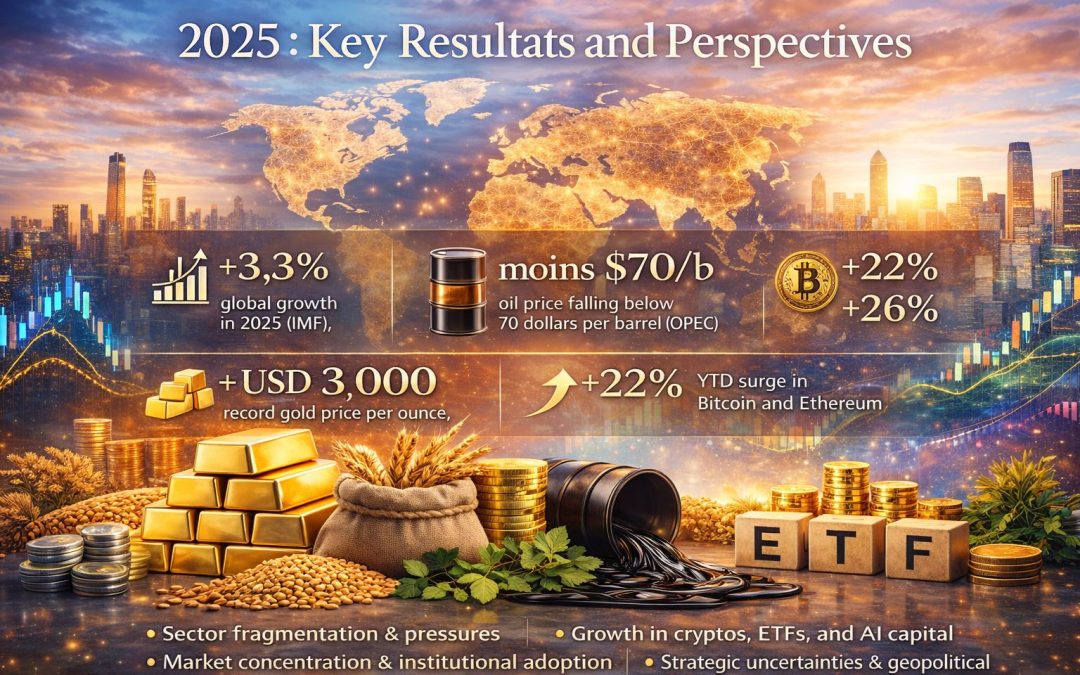
Year-end Chronicle : A European and Global Perspective
There are years that merely extend cycles, and others that expose them. 2025 did not overturn the global economic order; it revealed its fatigue, its fault lines, and its blind spots. Beneath the apparent continuity of indices and capital flows, markets ceased to produce a consensual narrative. They spoke more quietly but more truthfully.
As 2026 approaches, one conviction stands out: markets are no longer simply arenas of financial valuation. They have once again become spaces of sovereignty, social arbitration, and technological power, without ever declaring themselves as such.
The European Union: Nominal Stability, Structural Tensions
In 2025, the European Union moved through the year without a systemic shock. Growth remained weak but positive, inflation contained, and monetary policy restrictive yet legible. And yet, this apparent calm concealed a profound reconfiguration.
European bond markets have now fully priced in a world of persistently positive real rates, reshaping capital hierarchies and the sustainability of certain economic models. Public debt continues to be absorbed by markets, but at a cost that is increasingly visible in fiscal trade-offs.
On equity markets, Europe was not absent, it was selective. Sectors tied to infrastructure, energy, economic security, water, and essential services proved more resilient than those dependent on frictionless global growth. Visibility has commanded a higher premium than rapid expansion.
The European question is therefore no longer one of short-term competitiveness, but of how to finance transition, security, and innovation without eroding social cohesion.
United States and Global Markets: Concentration and Asymmetry
Globally, 2025 confirmed a defining trend: the concentration of performance. A substantial share of global equity gains accrued to a narrow group of firms, primarily exposed to advanced technologies, artificial intelligence, and digital infrastructure.
This dynamic is not irrational; it is underpinned by capital flows, investment spending, and observable productivity gains. Yet it raises a systemic question: what becomes of diversification when value concentrates structurally?
Across emerging economies, the picture has been uneven. Some regions benefited from resilient commodity demand and strengthening South–South trade, while others faced the weight of a strong dollar, higher financing costs, and climate-related vulnerabilities.
Energy: The End of Linear Illusions
Energy markets delivered a clear message in 2025: the transition is neither orderly nor synchronised. Oil prices remained within ranges consistent with moderate global demand, while gas reaffirmed its status as a strategic asset both energy commodity and geopolitical lever.
In Europe, supply diversification improved resilience without eliminating exposure to global markets. Worldwide, upstream energy investment remained substantial, including in fossil fuels, even as renewables continued their steady ascent.
The reality of 2025 is unambiguous: the global energy system operates under a dual constraint (short-term security of supply and long-term transition) without a perfect coordination mechanism.
Commodities: The Return of Material Reality
Industrial and strategic metals reminded markets in 2025 that material constraints matter. Copper, lithium, nickel, and rare earths are facing rising demand driven by electrification, networks, and digitalisation, while supply remains bound by geological, environmental, and legal limits.
Gold, meanwhile, reached historically elevated levels, reflecting less an acute fear than a durable uncertainty surrounding the international monetary and financial order.
These markets have ceased to be cyclical in the classical sense; they have become structural, shaped by long-term political and industrial choices.
Agriculture: A Vital Market, a Financial Market
In 2025, global agriculture illustrated a fundamental paradox: generally high levels of production combined with heightened vulnerability to climatic, logistical, and geopolitical shocks. Prices were unstable without becoming explosive, revealing a permanent tension between statistical abundance and local fragility.
For the European Union as for many regions worldwide, agriculture has once again become a strategic issue, economic, social, and political at once.
Crypto-assets and ETFs: The Institutionalisation of the Alternative
For crypto-assets, 2025 was not a year of rupture but of methodical integration. Their growing presence in regulated vehicles, particularly ETFs, enhanced financial visibility while reducing marginality.
This shift has profoundly altered their role: from instruments of contestation to objects of allocation, subject to the same risk, liquidity, and correlation assessments as traditional assets.
Artificial Intelligence: Economic Engine, Systemic Challenge
Artificial intelligence dominated the economic imagination in 2025, but market focus gradually shifted from innovation to infrastructure. Value accrued to those controlling access to data, energy, computing capacity, and legal frameworks.
International economic institutions increasingly point to a widening gap between technological potential and its measurable translation into aggregate productivity. This gap is not an anomaly; it is the core economic debate heading into 2026.
2026: The Year of Silent Trade-offs
Available data converge on a clear outlook: global growth is expected to remain moderate, interest rates durably higher than in the previous decade, and climate constraints increasingly visible in prices and capital flows.
Against this backdrop, 2026 is unlikely to be a year of dramatic rupture, but rather a year of structural decisions between resilience and return, sovereignty and openness, innovation and sustainability.
And perhaps one final, deliberately uncomfortable question must be faced:
What if the true risk for global markets is no longer volatility, but the collective inability to recognise that yesterday’s normality will not return?
Sources
- International Monetary Fund (World Economic Outlook (2025-2026))
- European Central Bank (Monetary and Financial Statistics)
- Bank for International Settlements (Annual Economic Reports)
- World Bank (Global Economic Prospects)
- International Energy Agency (World Energy Outlook)
- FAO (Global Food Price Indices)
- OECD (Economic Outlook)
- European Statistical Authorities (Eurostat)
- Financial market data: equities, commodities, metals, energy
Important Disclaimer: The content of this article is provided for informational and educational purposes only. It reflects the author’s opinion based on information available at the time of publication, which may become outdated. This content does not constitute personalized investment advice, a recommendation to buy or sell, and does not guarantee future performance. Markets carry a risk of capital loss. The investor is solely responsible for their decisions and should consult an independent professional advisor before any transaction. The publisher disclaims all liability for decisions made based on this information.