
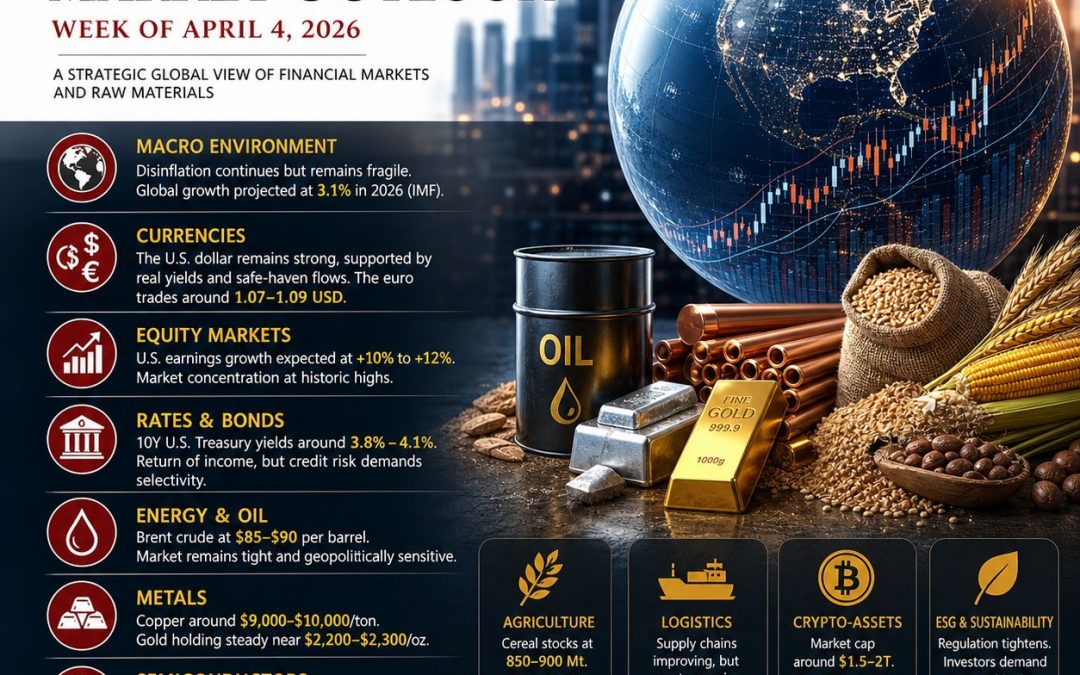
An Environment in Transition: Fragile Disinflation and the Return of Real Economy Factors
A Strategic Global Reading of Financial Markets and Commodities
As the week of April 4, 2026, commences, global financial markets are operating under a regime that can no longer be analysed through a purely monetary lens. While the inflationary cycle that commenced in 2021-2022 has unquestionably moderated, the most recent data confirms that this disinflation is now incomplete, heterogeneous, and structurally constrained. In the United States, the Consumer Price Index (CPI) published in early April stands at approximately 3.2%-3.3% year-over-year, with core inflationary pressures driven by services, notably housing and insurance. Within the euro area, consolidated data from Eurostat indicates inflation nearing 2.5%-2.6%, though with pronounced divergences between member states, particularly between industrial and service-based economies.
In this context, the International Monetary Fund’s projections maintain global growth at approximately 3.1% for 2026, yet this figure belies a profound recomposition of underlying economic drivers. Growth is no longer propelled solely by demand but is increasingly constrained by supply-side factors: energy costs, availability of industrial inputs, and logistical tensions. Manufacturing PMIs in Europe remain proximate to contraction territory (approximately 47-49 according to the latest estimates), while services retain a modestly expansionary bias, illustrating a persistent sectoral imbalance.
Central banks, most notably the Federal Reserve and the European Central Bank, have enacted a definitive pause in their tightening cycles. Policy rates reside at approximately 3.50%-3.75% in the United States and 2.00% in the euro area. However, the determinative element is no longer the level of rates but their anticipated trajectory. Money markets are discounting scenarios of gradual easing, yet these expectations remain exquisitely sensitive to monthly inflation data and energy prices.
A factor persistently underestimated in contemporary analysis is the growing role of physical constraints in price formation. For instance, maritime transport costs, while below the peaks of 2021–2022, remain materially above their historical averages. Similarly, industrial electricity prices in Europe remain structurally elevated relative to the United States, thereby exerting downward pressure on manufacturing competitiveness.
Consequently, the genuine regime change is as follows: markets are no longer dictated by a purely monetary logic, but by an interaction between financial disinflation and real-economy constraints. This hybridisation renders expectations more complex and explains the heightened sensitivity of markets to data that would previously have been considered secondary.
Currencies: A Rebalancing Under Energy and Financial Constraints
The foreign exchange market has regained prominence as a central macroeconomic adjustment variable. This phenomenon is explicable by the confluence of three factors: real interest rate differentials, capital flow dynamics, and the structural role of the dollar in global commodity trade.
The US dollar remains securely anchored, supported by positive real yields estimated at approximately 1.5% to 2% on Treasury Inflation-Protected Securities (TIPS). This level, historically elevated in a post-financial crisis context, mechanically attracts international capital flows, particularly within an uncertain environment. The US Dollar Index (DXY) trades in an elevated range, reflecting this structural demand.
The euro, by comparison, remains constrained. Its trajectory around 1.07-1.09 reflects a European economy characterised by moderate growth (1%-1.3% ) and substantial exposure to energy imports. The productivity and energy cost differential between the United States and Europe continues to exert implicit downward pressure on the single currency.
Emerging markets are the most exposed to this configuration. According to World Bank data, over 60% of emerging economy external debt is denominated in dollars, which amplifies the foreign exchange effect. Any dollar appreciation mechanically increases debt service costs, reducing fiscal headroom and weighing on local currencies.
A particularly strategic element resides in the correlation between currencies and commodities. Exporting countries (Brazil, Indonesia) benefit from a supportive effect, while net importers suffer a dual constraint: elevated prices and a weakened currency.
Thus, the foreign exchange market no longer merely reflects fundamentals; it has become an amplifier of global economic imbalances.
Equity Markets: Concentration, Valuation, and the Illusion of Stability
Equity markets continue to exhibit notable resilience, yet this robustness rests upon an increasingly narrow foundation. In the United States, large-cap technology firms now account for a substantial portion of overall performance. Earnings growth estimates for the S&P 500 reside at approximately +10% to +12% for 2026, yet a significant proportion of this growth is concentrated within a limited number of companies.
This concentration phenomenon is not without consequence. The ten largest market capitalisations now represent over 30% of total index capitalisation, a historically elevated level. This implies that overall market performance is disproportionately dependent upon a handful of participants.
In Europe, the situation is more balanced yet also more fragile. Indices benefit from the support of energy and financial sectors in an environment of still-elevated rates. However, moderate economic growth limits the scope for multiple expansion.
ETF flows, which now exceed $14 trillion in assets under management, illustrate a profound transformation in investor behaviour. Passive management captures a growing share of flows, which tends to reinforce existing trends rather than correct them. This mechanism creates a self-reinforcing dynamic: outperforming assets continue to attract flows, accentuating concentration and relative decoupling from underlying fundamentals.
Rates and Bonds: The Return of Income but the Rise of Latent Risk
Bond markets are progressively recovering their role in asset allocation after a decade characterised by exceptionally low rates. Sovereign yields are stabilising at historically significant levels: approximately 3.8%-4.1% for the 10-year US Treasury and 2.2%-2.5% for the German Bund.
This return of nominal yield restores the asset class’s appeal, particularly for institutional investors. However, this normalisation is accompanied by a set of underlying risks.
First, fiscal sustainability becomes a determinative factor. The debt-to-GDP ratio exceeds 120% in the United States and remains above 90% in the euro area, implying substantial and ongoing funding requirements.
Second, bond market sensitivity to inflation variations remains elevated. Even a modest uptick in inflation expectations can precipitate rapid yield adjustments.
Finally, credit remains under surveillance. Investment-grade spreads remain contained, but high-yield segments show increased sensitivity to the economic outlook.
Thus, bonds are becoming attractive once more, but within a framework where risk management has regained centrality.
Energy and Oil: A Market Driven by Geopolitical Constraints
The oil market operates within an unstable equilibrium, characterised by persistent tension between controlled supply and moderate demand. Brent crude resides within a range of 85-90 per barrel, reflecting a fragile balance.
Global demand, according to International Energy Agency estimates, continues to grow, albeit at a decelerated pace near +1 million barrels per day. This growth remains supported by emerging economies, particularly in Asia.
On the supply side, OPEC+ decisions continue to play a determinative role. Production limitation policies maintain implicit upward pressure on prices.
A key element resides in the relative weakness of exploration and production investment. Despite global energy requirements, investment remains below levels observed prior to 2014, thereby limiting supply adjustment capacity.
Consequently, the oil market is becoming increasingly sensitive to exogenous shocks, notably geopolitical, which reduces medium-term visibility.
Metals: Structural Tension Between the Energy Transition and Supply Constraints
Industrial metals occupy a central position in the current economic transformation. Copper, often regarded as a leading indicator of industrial activity, maintains a range of 9,000t to 10,000 per tonne.
Demand is supported by structural factors: electrification, infrastructure, and renewable energy development. According to the World Bank, the energy transition could multiply demand for certain critical metals by a factor of two to three by 2030.
However, supply remains constrained. Mine development lead times, combined with elevated energy costs, limit production expansion capacity.
Gold, meanwhile, trades around 2,200-2,300 per ounce, supported by central bank purchases, which have exceeded 1,000 tonnes annually in recent years according to the World Gold Council.
Thus, metals are no longer merely cyclical assets; they are becoming strategic assets linked to the structural transformation of the global economy.
Semiconductors: A Cyclical Industry Become a Strategic Pillar of the Global Economy
The semiconductor sector confirms its dual nature in 2026: cyclical in the near term, yet structurally indispensable over the medium and long term. Consolidated data from the World Semiconductor Trade Statistics (WSTS) indicates that the global market has surpassed the $600 billion threshold, with expected growth exceeding +10% in 2026, following an adjustment phase in 2023-2024.
This growth is primarily driven by three segments: artificial intelligence-related infrastructure, data centres, and advanced industrial applications. Demand for high-performance chips (GPUs, ASICs) is expanding particularly rapidly, driven by increased computing capacity requirements for AI models. By way of example, hyperscale data centre investment has progressed at over +20% on an annualised basis in certain regions, directly translating into increased demand for advanced semiconductors.
However, this dynamic is accompanied by major structural risks. Production remains heavily concentrated: over 70% of global advanced manufacturing capacity is located in East Asia, notably Taiwan and South Korea. This concentration exposes the entire global economy to significant geopolitical risk.
Furthermore, production costs are rising sharply. Development of a state-of-the-art semiconductor fabrication facility now represents an investment exceeding 10 to 20 billion, limiting new entrant access and reinforcing industry concentration.
Thus, semiconductors must no longer be analysed as a mere technology segment, but as critical infrastructure for the global economy, on a par with energy or transport.
Agriculture: Statistical Stability Masking Rising Structural Tensions
At first reading, global agricultural markets enter the week of April 4, 2026, in a relatively stable configuration. Global production balances published in the latest estimates from the United States Department of Agriculture and the Food and Agriculture Organization’s indicators confirm satisfactory overall availability across several major product categories.
Global cereal stocks remain estimated between 850 and 900 million tonnes, a historically compatible level for reasonable supply security. This relative abundance explains why markets have not experienced a generalised price surge comparable to that observed in 2022.
Yet, beneath this aggregate stability, several signals merit particular attention.
The FAO Food Price Index, published on April 3, 2026, stands at 128.5 points, a 2.4% increase month-over-month , marking a second consecutive advance. This movement remains moderate but reflects a gradual build-up of tensions, primarily driven by energy and agricultural input costs.
Cereals: A Still Robust but Vulnerable Balance
Wheat: The global wheat market remains adequately supplied. Exportable availabilities stay solid due to generally satisfactory harvests across several major producing regions. However, several factors introduce increasing fragility: localised deterioration of growing conditions in certain North American zones, rising fertiliser costs, and logistical uncertainties on certain trade routes. International prices are advancing moderately, with a recent increase near 4.3% according to consolidated FAO indicators. The market thus remains fundamentally balanced but is becoming more sensitive to climatic revisions.
Corn: Corn displays a slightly more relaxed configuration. Availabilities remain substantial, notably due to robust US and South American production. The recent price advance remains limited to approximately 0.9%, reflecting relative abundance. However, an often-underestimated element merits attention: rising oil prices are gradually increasing the economic attractiveness of ethanol, which could redirect a growing share of supply toward energy uses. This phenomenon creates a direct interaction between the energy market and the grain market.
Rice: Rice is currently among the most stable segments. International prices are declining by approximately 3%, due to satisfactory harvests and more measured import demand. This easing helps absorb global food tensions.
Oilseeds and Rapeseed: A Market Increasingly Dependent on Energy
Oilseed dynamics constitute one of the most strategic points of the week. The latest USDA analyses show progressive tension in vegetable oils, particularly soy, rapeseed, and sunflower. The FAO Vegetable Oil Index advanced 5.1% month-over-month.
European rapeseed stands at the intersection of three forces: food demand, industrial demand, and energy demand via biofuels. The recent rise in oil prices mechanically enhances biofuel competitiveness, creating structural pressure on oilseed crops. This is a particularly important market signal for commodity investors.
Sugar: The Return of the Energy Variable
Sugar is currently experiencing one of the most significant increases among agricultural commodities. The FAO Sugar Index advanced 7.2% month-over-month. The primary driver is not food-related but energy-related. The rise in crude oil increases the appeal of sugarcane destined for ethanol production, notably in Brazil. This arbitrage between food and energy use reduces exportable supply. Sugar thus becomes a hybrid asset once more, influenced as much by energy as by agricultural fundamentals.
Cocoa: Persistent Structural Tension
Cocoa remains one of the most sensitive agricultural markets. Imbalances remain linked to climatic constraints, plantation aging, yield pressure, and insufficient investment. Even if recent volatility has moderated slightly, the market remains structurally tight. Any further climatic deterioration could rekindle significant nervousness.
Meats: Moderate but Persistent Tension
April WASDE data shows several important adjustments. Pork production is revised modestly downward. Beef remains constrained by limited herd availability. The FAO Meat Index advanced 1% month-over-month. Demand remains supported, notably in certain Asian markets, creating measured but real tension.
Dairy: First Signs of Rebalancing
The FAO Dairy Index advanced 1.2% , marking an inflection after several months of weakness. Drivers include more dynamic international demand, improved export competitiveness, and gradual supply adjustment. Nonetheless, milk remains strongly dependent on energy costs and animal feed.
Logistics: Partial Normalisation, Persistent Fragility
Global supply chains have experienced gradual improvement since the major disruptions of the 2020-2022 period. However, this normalisation remains incomplete and masks persistent fragilities.
Global logistics pressure indices, tracked notably by international institutions, show significant easing relative to extreme levels observed during the pandemic. Nevertheless, transport costs remain 20% to 40% above pre-2020 levels on certain strategic routes.
This situation is explicable by several factors. On one hand, logistics capacity has not fully regained its initial efficiency level due to structural constraints: port congestion, labour availability, and insufficient investment in certain infrastructures.
On the other hand, energy costs continue to strongly influence maritime and land transport. Fuel prices remain a key determinant of overall supply chain cost.
An often-underestimated element resides in the reconfiguration of trade flows. Nearshoring and supply chain diversification strategies, implemented to reduce geopolitical risk, are resulting in increased structural costs.
Thus, logistics is no longer merely an adjustment factor but is becoming a structuring element of price formation, with a direct impact on headline inflation.
Crypto-Assets: Toward Relative Maturity Under Regulatory Oversight
The crypto-asset market is progressively entering a structuring phase, marked by increased regulation and stronger integration into the traditional financial system.
Total market capitalisation oscillates around 1.5 to 2.0 trillion , with persistent dominance of the principal assets. Volatility, while still present, is materially below levels observed in previous cycles.
A key factor in this evolution is the strengthening of the regulatory framework. In the United States, the Securities and Exchange Commission is intensifying its supervision of platforms and financial products linked to crypto-assets. In Europe, the implementation of the Markets in Crypto-Assets (MiCA) regulation marks an important step toward legal framework harmonisation.
Furthermore, the correlation between crypto-assets and traditional financial markets remains elevated, particularly with risk assets. This correlation is partly explicable by common sensitivity to liquidity conditions and real rates.
Thus, crypto-assets are no longer an isolated market; they are becoming an integrated segment of the global financial system, with their own dynamics but also their interdependencies.
ESG: From Intention to Measurable Constraint
Sustainable finance is entering a maturity phase characterised by a shift from a declarative logic to an evidence-based logic. Investors are no longer satisfied with general commitments; they demand precise, comparable, and verifiable data.
In Europe, the regulatory framework is strengthening under the impetus of the European Securities and Markets Authority (ESMA) and associated directives. ESG reporting requirements are becoming stricter, notably regarding carbon emissions, transition trajectories, and governance.
Investment flows remain significant. Assets under management integrating ESG criteria now represent several tens of trillions of dollars globally. However, selectivity is increasing.
A notable phenomenon is the challenge to greenwashing. Companies unable to concretely demonstrate their commitments see their appeal diminish among institutional investors.
Thus, ESG is becoming a structuring criterion for capital allocation, with direct implications for the cost of financing.
Conclusion: An Observable Structural Shift
With the developments presented, a deeper reading of markets is imperative. What characterises the current period is not merely a cyclical transition but a progressive recomposition of the fundamental determinants of the global economy.
For over a decade, market dynamics were largely dominated by accommodative monetary policies, which shaped valuations, directed capital flows, and artificially reduced the cost of risk. That phase now appears to be over. Current rate levels of approximately 3.5%-3.75% in the US and around 2% in the euro area reflect a return to more normal, yet also more demanding, financial conditions.
In this new environment, markets are no longer guided solely by liquidity but by tangible constraints: energy availability, access to natural resources, robustness of logistics chains, and genuine industrial capacity. Observed tensions in critical metals, energy costs, and production infrastructure illustrate this transformation.
Furthermore, the rise of cross-cutting factors (artificial intelligence, energy transition, industrial sovereignty) is redefining sectoral hierarchies and market structures. The concentration of equity performance, the centrality of semiconductors, and the strategic importance of commodities are concrete manifestations of this shift.
In this context, potential volatility no longer resides solely in monetary shocks but in the economic system’s capacity to absorb growing physical constraints. This evolution implies a finer, more multidimensional reading of markets, integrating both financial variables and industrial realities.
Thus, the paradigm shift is already underway: financial markets are progressively becoming the reflection of a world where scarcity, material transformation, and geopolitics are reclaiming a central place.
Sources
Macroeconomics & Monetary Policy
- International Monetary Fund, World Economic Outlook (2025-2026)
- World Bank, Global Economic Prospects & Commodity Markets Outlook
- Federal Reserve, FOMC statements, Summary of Economic Projections
- European Central Bank, Monetary policy decisions & staff projections
- Eurostat, Inflation (HICP), GDP, industrial data
Energy & Oil
- International Energy Agency, Oil Market Report
- Organization of the Petroleum Exporting Countries, Monthly Oil Market Report
- U.S. Energy Information Administration, Petroleum data & forecasts
Metals & Commodities
- World Bank, Metals & Minerals Outlook
- London Metal Exchange, Copper, aluminium pricing data
- World Gold Council, Gold Demand Trends
Agriculture
- Food and Agriculture Organization, FAOSTAT, Food Price Index
- United States Department of Agriculture, WASDE reports, Grain data
Semiconductors & Industry
- World Semiconductor Trade Statistics, Global semiconductor market data
- Semiconductor Industry Association, Industry reports
Financial Markets & ETFs
- BlackRock, ETF flows & global assets
- Bank for International Settlements, Global liquidity & financial system data
Logistics & Supply Chains
- Federal Reserve Bank of New York, Global Supply Chain Pressure Index
- World Trade Organization, Trade flows & logistics
Crypto & Regulation
- Securities and Exchange Commission, Regulatory actions & crypto oversight
- European Securities and Markets Authority, MiCA & digital asset regulation
ESG & Sustainable Finance
- European Securities and Markets Authority, ESG disclosure rules
- International Energy Agency, Energy transition investment data
United Nations, Sustainable finance frameworks
Important Disclaimer: The content of this article is provided for informational and educational purposes only. It reflects the author’s opinion based on information available at the time of publication, which may become outdated. This content does not constitute personalized investment advice, a recommendation to buy or sell, and does not guarantee future performance. Markets carry a risk of capital loss. The investor is solely responsible for their decisions and should consult an independent professional advisor before any transaction. The publisher disclaims all liability for decisions made based on this information.