
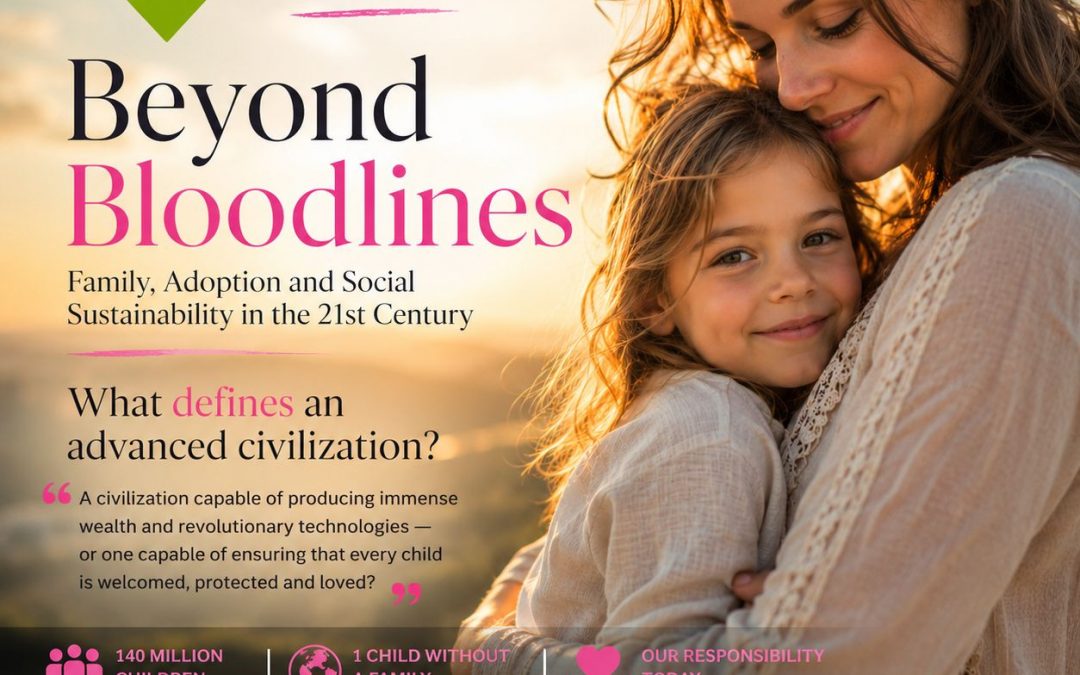
Family, Adoption and Social Sustainability in the 21st Century
In the impeccably illuminated corridors of palaces, economic forums, and the social media landscapes of global elites, the family is still presented as the ultimate sanctuary of human success. Perfectly choreographed Christmas portraits, smiling heirs, and dynastic continuity elevated almost into an art form: the family remains one of the last sacred narratives of modern civilization. Yet behind this nearly liturgical staging of continuity, another deeply disturbing reality unfolds.
According to UNICEF, approximately 140 million children worldwide have lost at least one parent, including nearly 15 million who have lost both their mother and father. Figures vary depending on methodologies and regions, but the scale remains staggering. Sub-Saharan Africa remains the most affected region, notably due to the combined effects of conflict, structural poverty, and health crises. In Asia, absolute numbers are also considerable because of demographic density. Even Europe and North America, despite greater economic stability, are witnessing a growing number of children deprived of stable family environments.
Official orphanhood statistics primarily measure the biological loss of one or both parents. Yet many researchers and organizations emphasize that contemporary family vulnerability extends far beyond this administrative definition and remains difficult to quantify globally.
At the same time, the world has never been wealthier. Global private wealth has surpassed hundreds of trillions of dollars. Technology now allows humanity to send satellites into space, produce generative artificial intelligence, and increase global food production to historically unprecedented levels. Yet despite this material power, millions of children continue to grow up without a lasting family, without emotional stability, and sometimes without even the certainty of being truly wanted by someone.
This contradiction may represent one of the great moral paradoxes of the twenty-first century.
Our era celebrates innovation, yet seems hesitant before one of civilization’s oldest ideas: welcoming a child who is not biologically one’s own.
Adoption remains relatively marginal on a global scale. In many developed countries, international adoptions have even sharply declined over the last two decades. The reasons are complex: stronger legal oversight, legitimate efforts to combat trafficking, and the priority given to maintaining children within their original environments. But beyond administrative explanations, a more uncomfortable question emerges: does modern civilization still truly value parenthood itself?
It is striking that the most visible public figures associated with adoption are often unconventional personalities: artists, actors, singers, celebrities sometimes perceived as eccentric or marginal. By contrast, major institutional families (economic dynasties, hereditary aristocracies, royal households) speak endlessly about legacy and continuity, yet very rarely about adoption. The vulnerable child remains largely absent from the official narrative of social continuity.
This is not an attempt to condemn anyone individually. No one has a moral obligation to adopt. Yet the collective question remains: why do societies that are so sophisticated in economic organization seem incapable of creating a genuine culture of welcome?
Why are there almost no global campaigns comparable to climate, health, or technological campaigns aimed at encouraging adoption, long-term sponsorship, or the integration of isolated children into stable family environments?
Why does modern success continue to be represented almost exclusively through biological transmission?
The philosopher Hannah Arendt viewed each birth as the possibility of a new beginning for the human world. Yet contemporary society appears increasingly to reduce birth to lineage, genetic inheritance, or narcissistic continuity. It is as though transmitting biological heritage has gradually acquired greater symbolic value than transmitting education, culture, affection, or stability to a child already alive.
This evolution may reflect a deeper transformation. Contemporary individualism, reinforced by certain forms of hyper-capitalism, appears to weaken the intermediary structures that once gave meaning to human solidarity. Extended families fade away. Local communities weaken. Human bonds become increasingly contractual, reversible, and at times profoundly solitary.
In this context, the child without a family and the abandoned elderly person become almost mirror figures of our age: one enters life without roots, the other leaves it without transmission.
And yet humanity has never possessed so many material resources capable of reducing such suffering.
The question is therefore no longer merely economic. It becomes philosophical.
What defines an advanced civilization? A civilization capable of producing immense fortunes and revolutionary technologies or one capable of guaranteeing every child the fundamental experience of being awaited, protected, and loved?
The answer belongs neither to governments alone, nor NGOs alone, nor celebrities alone. It may depend upon a deeper redefinition of human success itself.
For it is possible that in the twenty-first century, true modernity no longer resides in what we own, but in what we remain capable of transmitting to those who do not biologically resemble us, yet whose human dignity remains absolutely identical to our own.
We have created extraordinarily sophisticated systems to protect children legally, administratively, and materially. But do we still possess the same ambition when it comes to symbolically offering them a family?
Modern states devote considerable resources to social protection. According to the OECD, member countries spend on average more than 2% of GDP on family- and child-related policies. Yet only a very small portion of these investments is truly directed toward building a collective culture of long-term welcome (adoption, family sponsorship, emotional integration) and social inclusion for children deprived of stable family environments. The contemporary paradox may lie precisely here: we have developed remarkably sophisticated mechanisms for legally managing vulnerability, but far more timidly for rebuilding durable human bonds.
This issue could gradually become a major dimension of the social pillar of ESG. Until now, the social dimension of ESG policies has focused primarily on diversity, working conditions, inclusion, or professional equality. Yet a sustainable society cannot be evaluated solely through economic or environmental performance. A civilization’s ability to protect human continuity like transmission, parenthood, emotional stability, the dignity of childhood and ageing, may become one of the true indicators of social sustainability in the twenty-first century.
Over time, new mechanisms could emerge internationally: fiscal or institutional incentives for adoption and long-term sponsorship, integration of family-support indicators into public and private ESG policies, development of European programs favoring family integration over prolonged institutionalization, or even the creation of “family resilience” indices within national social strategies. The objective would not be to transform adoption into a moral obligation or ideological instrument, but rather to restore the notion of human responsibility to the very heart of modernity.
For a technologically advanced society incapable of durably reducing the loneliness of children and elderly people alike may ultimately discover that true progress is measured not only by economic power, but also by the quality of the human bonds it remains capable of transmitting.
Sources
Eurostat
- Eurostat, Fertility statistics
https://ec.europa.eu/eurostat/statistics-explained/index.php?title=Fertility_statistics - Eurostat, Population structure and ageing
https://ec.europa.eu/eurostat/statistics-explained/index.php?title=Population_structure_and_ageing - Eurostat, Household composition statistics
https://ec.europa.eu/eurostat/statistics-explained/index.php?title=Household_composition_statistics
Hannah ArendtThe Human Condition (1958)