
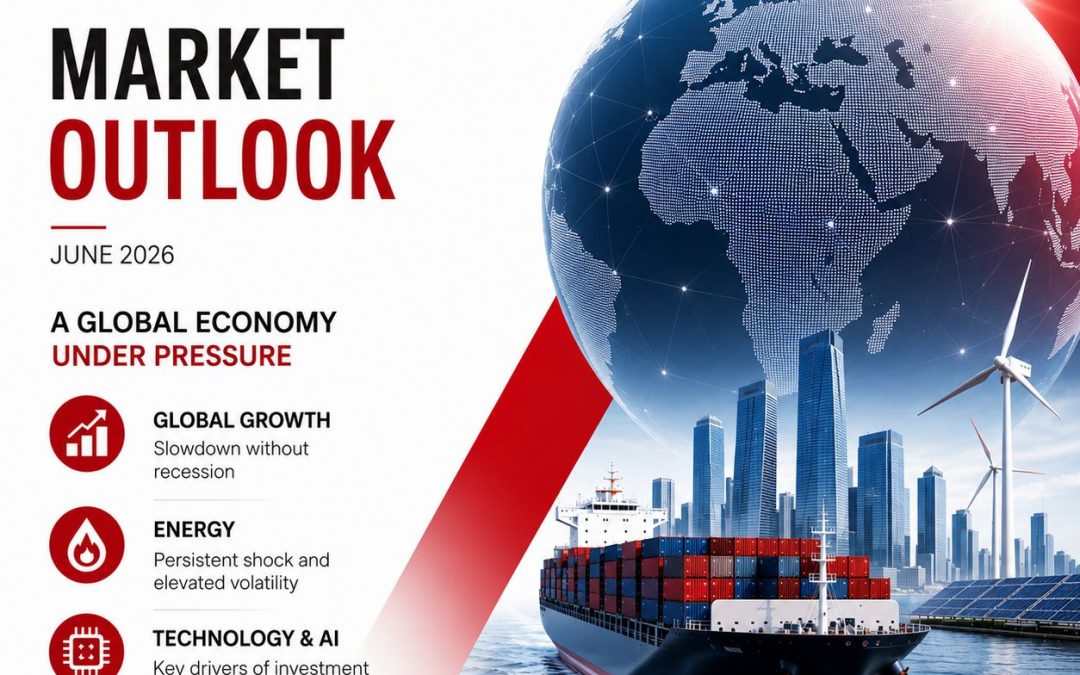
EXECUTIVE SUMMARY
Key trends to watch for summer 2026
Global Macroeconomy: Positive Growth, Increased Fragility
- A slowdown without global recession
- New IMF, OECD, and central bank forecasts
- Inflation, productivity, and new growth drivers
- Systemic risks to monitor in the second half of the year
United States: Economic Resilience, Artificial Intelligence, and the Debt Challenge
- Growth holding up despite high rates
- The AI revolution as an investment driver
- The labour market under surveillance
- Public deficits and US debt sustainability
- Outlook for summer 2026
Euro Area: Energy Shock, Imported Inflation, and Fragilised Competitiveness
- Growth sustainably below that of the United States
- Energy cost as a strategic challenge
- Reindustrialisation, defence, and the green transition
- Divergences among member states
- Outlook for summer 2026
China: Industrial Power, Clean Technologies, and the Redefinition of the Economic Model
- Beyond the property crisis
- Exports, artificial intelligence, and industrial upgrading
- Dominance in batteries and green technologies
- The Chinese model of sustainability and economic sovereignty
- Outlook for summer 2026
Emerging Countries: Food Vulnerability, Debt, and New Opportunities
- India: the demographic and technological locomotive
- Latin America: raw materials and energy transition
- Africa: growth, debt, and food security
- Middle East: economic diversification under geopolitical pressure
- Winners and losers of the new global cycle
Energy: Oil, Gas, Renewables, Grids, and Storage
- The new global energy shock
- The strategic role of the Strait of Hormuz
- Natural gas and energy security
- The rise of renewables
- The challenge of electricity grids
- Storage, batteries, and critical infrastructure
Industrial and Strategic Raw Materials: The New Infrastructure of Power
- Copper: the metal of global electrification
- Lithium, nickel, cobalt, graphite, and rare earths
- Semiconductors and critical materials
- Aluminium and energy competitiveness
- Gold and reserve assets
- Defence, strategic metals, and industrial sovereignty
- The new geographies of mineral power
Agriculture, Fertilisers, and Global Food Security
- Cereals: wheat, corn, and rice
- Oilseeds: soy, rapeseed, and palm oil
- Sugar, coffee, and cocoa
- Dairy products
- Meats and animal proteins
- Fruits and vegetables
- The strategic role of fertilisers
- Climate risks for summer 2026
- Agriculture, energy, and food geopolitics
Financial Markets: Rates, Currencies, Equities, Credit, and Safe-Haven Assets
- Central banks facing the new cycle
- Sovereign bonds and public debt
- Dollar, euro, and major currencies
- Equities: AI, energy, defence, and infrastructure
- Credit and financing of the real economy
- Gold and safe-haven assets
Global ESG: Regulatory Fragmentation, Return of Pragmatism, and Green Sovereignty
- Europe: simplification and competitiveness
- The United States: federal retreat and rise of local initiatives
- China: ESG and industrial policy
- Japan, Singapore, and Australia: the rise of the ISSB model
- New ESG issues for investors
- ESG trends to watch by the end of 2026
Geopolitics: Energy, Technologies, Defence, and Strategic Routes
- Middle East: a global shock from a regional conflict
- China-United States: the technological war
- Europe: strategic autonomy and economic security
- Defence and global rearmament
- Straits, cables, logistics, and new vulnerabilities
- Geopolitical risks for summer 2026
Scenarios for Summer 2026
- Progressive stabilisation of the global economy
- Prolonged energy tensions
- Food stress and persistent inflation
- Indicators to monitor week by week
Investor Conclusion: What to Watch Now
The key variables likely to determine the second half of 2026 and the main implications for businesses, investors, and policymakers.
GLOBAL MACROECONOMY: POSITIVE GROWTH, INCREASED FRAGILITY
Apparent resilience masking a deterioration in the quality of growth
At first glance, the global economy continues to display remarkable resilience. The IMF maintains its global growth forecast at 3.1% for 2026 and 3.2% for 2027, levels below the pre-pandemic average but sufficiently high to rule out a global recession scenario. Emerging and developing economies are expected to grow by 3.9%, while advanced economies would progress by 1.8%. This aggregate snapshot might suggest that the global economy is simply continuing its normalisation after the turbulence of the first half of the decade. Yet a deeper analysis reveals a progressive deterioration in the very quality of that growth.
From demand deficit to supply constraint
The principal rupture observed in 2026 lies in the widening gap between observed growth and potential growth. For several decades, economic slowdowns primarily stemmed from a demand deficit: cautious households, businesses reluctant to invest, or credit tightening. The current situation is different. Households continue to consume, businesses are investing massively in artificial intelligence, energy infrastructure, and industrial capacity, while states support activity through defence, energy transition, and technological sovereignty programmes. The limiting factor is no longer demand but the availability of the resources needed to satisfy it.
Contrasting scenarios among international institutions
This evolution explains the divergences observed among international institutions. In its central scenario published in early June, the OECD projects global growth of 2.8% in 2026 before a rebound to 3.1% in 2027. However, in its prolonged energy market disruption scenario, global growth would fall to just 2.1% in 2026 and then 1.8% in 2027. The difference between these two scenarios is considerable: it represents nearly one percentage point of global GDP, or several hundred billion dollars of wealth produced or lost. Even more significantly, it illustrates the shift in global economic risk from the financial sphere to the physical sphere.
Energy as the central transmission variable
Energy today constitutes the central transmission variable. According to the International Energy Agency, global oil supply fell by a further 1.8 million barrels per day in April to reach 95.1 million barrels per day. Cumulative losses since February now amount to 12.8 million barrels per day, one of the largest supply disruptions ever recorded by the institution. Gulf countries directly affected by the Strait of Hormuz disruptions are producing 14.4 million barrels per day less than before the crisis. Even assuming a progressive recovery of flows from the summer, the IEA estimates that average global supply in 2026 will still decline by 3.9 million barrels per day.
A macroeconomic multiplier and a new type of inflation
This energy shock is not solely a problem for the oil sector. It acts as a macroeconomic multiplier. Transport costs rise, fertilisers become more expensive, certain industrial chains lose competitiveness, and central banks are forced to maintain more prudent policies. The OECD thus estimates that average G20 inflation could reach 4.0% in 2026 compared with 3.4% in 2025, before slowing to around 3.1% in 2027. This inflation is of a particular nature: it is not primarily fuelled by economic overheating but by supply constraints that limit the effectiveness of traditional monetary policy tools.
Technological investment as a second engine, source of new dependencies
Simultaneously, a second engine supports global activity: technological investment. Since the beginning of the year, spending related to artificial intelligence, data centres, advanced semiconductors, and digital infrastructure has partially offset the slowdown observed in several traditional cyclical sectors. The OECD already acknowledged in the spring that technological investment constituted one of the main supports for global growth. This situation nonetheless creates a new dependency: future growth depends increasingly on energy, digital, and mining infrastructure whose expansion capacity remains limited in the short term.
Positive growth increasingly constrained by real capacities
The global economy is thus entering an unprecedented regime where growth remains positive but becomes increasingly sensitive to real constraints. The central question is no longer solely about the cost of capital or the level of interest rates. It becomes about the availability of energy, critical metals, logistics capacity, and digital infrastructure. In other words, the global economy does not lack demand; it is gradually beginning to lack capacity.
UNITED STATES: RESILIENCE, AI, DEBT, AND MONETARY PAUSE
A global stabilising economy, but not without vulnerabilities
The US economy remains in 2026 the principal factor of stability in the global economic system. While European growth slows under the effect of energy costs and several emerging economies suffer the consequences of more expensive food and energy imports, the United States continues to benefit from an exceptional set of comparative advantages: relative energy independence, a dominant technology sector, deep financial markets, and an innovation capacity that remains without equal.
This resilience does not, however, mean an absence of vulnerabilities. On the contrary, the American paradox of 2026 lies in the coexistence of a still-dynamic economy and a fiscal trajectory that is progressively becoming more difficult to sustain.
Sustained growth, contained inflation, and the Fed’s monetary pause
According to the latest Federal Open Market Committee projections, US growth should reach 2.3% in 2026 despite the slowdown observed in several cyclical sectors. Headline inflation is expected around 2.7%, while the unemployment rate remains close to 4.3%. These figures remain remarkably favourable given current monetary conditions and the international geopolitical context. They explain why the Federal Reserve has maintained its Fed Funds target range between 3.50% and 3.75% since March, favouring an observational posture rather than a rapid resumption of monetary easing. The US central bank now considers that inflationary risks and economic slowdown risks are relatively balanced – a situation rarely observed since the beginning of the decade.
A still-resilient labour market in a normalisation phase
The labour market continues to provide significant support to activity. Net job creation remains positive despite a progressive slowdown in the pace observed after the pandemic. The health, infrastructure, transport, and business services sectors remain the main contributors to employment. However, behind the apparent stability of the unemployment rate, certain signs of normalisation appear. The participation rate remains below levels observed before the health crisis, while the number of discouraged workers is increasing slightly. The US economy is still creating jobs, but it is now doing so at a pace more compatible with a mature phase of the economic cycle.
AI as new economic infrastructure and investment driver
The true engine of US growth, however, lies elsewhere. For the first time since the rise of the Internet in the late 1990s, a technological innovation is exerting a sufficiently large macroeconomic influence to modify investment trajectories at the national level. Artificial intelligence is no longer just a sector. It is progressively becoming an economic infrastructure.
Investments in data centres, advanced semiconductors, computing networks, and cloud infrastructure now represent several hundred billion dollars. According to the Stanford AI Index, US private investment in artificial intelligence reached $109 billion in 2025, a level higher than that of all other major economies combined. This dynamic explains a growing share of the economic resilience observed over the past two years.
AI reintroduces dependence on physical resources
However, the artificial intelligence revolution also produces a more discreet but potentially more significant transformation. Whereas digital technologies were traditionally considered low consumers of physical resources, AI reintroduces a massive dependence on energy, infrastructure, and raw materials. Each additional data centre requires more electricity, more copper, more semiconductors, and more cooling capacity. The United States today has a major strategic advantage thanks to the relative abundance of its energy and its ability to rapidly mobilise private capital to finance this infrastructure.
Dollar dominance reinforced by global uncertainties
This dynamic also contributes to maintaining dollar dominance. Despite recurring debates about a possible dedollarisation of the global economy, international flows continue to favour US assets during periods of uncertainty. The Middle East tensions have further reinforced this trend in the first half of 2026. The dollar remains simultaneously a transaction currency, reserve currency, financing currency, and safe haven. No competitor today has this quadruple function.
Public debt: fiscal vulnerability but no immediate threat
The main US vulnerability remains fiscal. According to the Congressional Budget Office, federal debt held by the public now exceeds 100% of GDP and could continue to increase over the next decade. Interest payments represent a growing share of federal spending, progressively limiting fiscal margins for manoeuvre. This situation does not constitute an immediate threat given the dollar’s international status and the depth of US bond markets. It nonetheless reduces the future capacity of authorities to respond to a major shock with a fiscal expansion comparable to that observed during the pandemic.
Assessment: beneficiary of AI, but facing medium-term sustainability challenge
The US economy thus appears as the main beneficiary of the new artificial intelligence economy while still facing a structural fiscal sustainability challenge. In the short term, supporting factors clearly outweigh fragility factors. In the medium term, the United States’ ability to maintain its leadership will depend less on monetary policy than on its capacity to sustainably finance the energy, digital, and industrial infrastructure needed for the next phase of growth.
EURO AREA: ENERGY SHOCK, IMPORTED INFLATION, AND FRAGILISED COMPETITIVENESS
A triple challenge: transition, defence, reindustrialisation, and social model
The situation of the euro area in 2026 probably illustrates better than any other region the ongoing transformation of the global economy. Unlike the United States, whose growth remains supported by technological investment and relative energy autonomy, Europe faces a more complex problem: it must simultaneously finance its energy transition, strengthen its defence capacities, accelerate its reindustrialisation, and preserve its social model in a context of structurally weak growth.
Growth revised downward, inflation driven by energy
The European Central Bank now projects growth limited to 0.9% for 2026, compared with 1.2% anticipated a few months earlier. This downward revision does not result from a collapse in domestic demand but primarily from rising energy costs and geopolitical uncertainty. Harmonised inflation (HICP) is expected to average 2.6% this year, up from 2.1% in 2025, before slowing progressively from 2027. Behind this average, however, hides an essential reality: most of the inflationary pressure comes from energy and not from classical economic overheating.
The European dilemma facing an energy supply shock
This distinction is fundamental for understanding the European dilemma. Historically, central banks know relatively well how to combat inflation caused by excess demand. They have an effective tool for this: the cost of credit. However, when inflation comes from an energy supply shock, raising rates essentially acts on demand without solving the initial problem. Europe thus finds itself facing inflation whose causes it does not directly control while bearing the economic effects of the monetary tightening necessary for its stabilisation.
Contrasting situations among member states
Eurostat data published in the spring confirm this analysis. Euro area annual inflation remains above the ECB’s 2% target even as industrial growth remains sluggish in several major member states. Germany, the Union’s largest economy, continues to show manufacturing activity below levels observed before the energy crisis of the early decade. France benefits more from the weight of services and its nuclear fleet, but remains exposed to energy costs borne by its European trading partners. Italy and Spain maintain more favourable dynamics thanks to tourism and certain investments linked to European funds, but their growth potential remains limited by high debt and low productivity growth.
The real issue: the continent’s competitiveness over the coming decade
The real European economic issue, however, does not lie in 2026 growth. It concerns the continent’s competitiveness over the coming decade.
Since the industrial revolution, the competitive advantages of major powers have generally rested on three pillars: access to affordable energy, availability of capital, and technological mastery. Europe retains a significant advantage in the last two areas but remains penalised by the first. According to several industry estimates, electricity costs for certain energy-intensive European sectors remain two to three times higher than those observed in the United States. This gap directly affects the competitiveness of chemicals, metallurgy, construction materials, and part of the processing industries.
The risk of falling behind in strategic sectors
This reality is particularly visible in strategic sectors linked to the energy transition. Europe aspires to develop a battery, hydrogen, semiconductor, and low-carbon technology industry. Yet these activities precisely require the resources that are becoming most expensive: abundant energy, critical metals, and long-term capital. The risk is therefore not only one of weak growth. The risk is one of progressive falling behind in certain strategic industrial sectors in favour of economies benefiting from a more favourable energy environment.
Regulatory simplification: an awareness of economic sustainability
The debate around European regulatory simplification must also be interpreted through this prism. The recently proposed adjustments concerning certain extra-financial reporting or duty of vigilance obligations do not reflect an abandonment of European ESG ambitions. They rather reflect an awareness: the transition can only be sustainable if it remains economically bearable. Europe is thus entering a maturation phase of its climate policy, where industrial competitiveness progressively becomes as important as regulatory compliance.
The growing role of public investment
In this context, public investment takes on growing importance. Programmes dedicated to energy infrastructure, electricity interconnections, storage capacities, digital networks, and defence now represent a significant share of the European economic effort. In the short term, they support activity. In the long term, they will largely determine the continent’s ability to preserve its economic sovereignty in an increasingly competitive international environment.
The European paradox: unprecedented strategic ambitions, increased constraints
The European paradox of 2026 thus appears clearly. Never has the Union had so many simultaneous strategic objectives: decarbonisation, reindustrialisation, technological sovereignty, energy security, and defence autonomy. But never have these ambitions faced such significant constraints in terms of potential growth, energy costs, and international competition. The central question is therefore no longer whether Europe has a strategic vision. It is whether it can mobilise sufficient resources to implement it without durably weakening its competitiveness.
CHINA: INDUSTRIAL RECOVERY, EXPORTS, ESG TENSIONS, AND CLEAN TECHNOLOGIES
Beyond the property slowdown: a historic industrial reallocation
The main analytical error concerning China in 2026 is to continue observing the country through the prism of the property slowdown. Certainly, the property sector remains weakened and continues to weigh on household confidence. But this reading no longer explains China’s economic performance or its growing influence on global value chains.
The real issue lies elsewhere: China is in the process of carrying out one of the most important industrial reallocations in contemporary economic history. While the 2000s model relied largely on property investment and infrastructure, that of 2026 now relies on advanced industrial technologies, energy transition equipment, artificial intelligence, and strategic value chains.
Transformed exports: from low-cost goods to cutting-edge technologies
Foreign trade figures perfectly illustrate this transformation. In May 2026, Chinese exports increased by 19.4% year-on-year, well beyond market expectations. Even more revealing is the composition of this growth. Integrated circuit exports jumped by 111%, automated data processing equipment exports by 66%, while automobile exports increased by nearly 40%. Chinese foreign trade is no longer primarily driven by low-value-added goods; it is now carried by sectors at the heart of global technological competition.
AI as an accelerator and the advantage of industrial depth
This evolution is far from anecdotal. Since the beginning of the year, global demand linked to artificial intelligence has acted as a powerful accelerator of Chinese exports. Geopolitical tensions and rising energy prices have not reduced global demand for semiconductors, electronic components, or digital equipment; on the contrary, they have reinforced supply security behaviours. In this context, China benefits from a decisive advantage: the depth of its industrial apparatus and the density of its supply chains.
Vertical integration and dominance in clean technologies
More fundamentally, Chinese power today rests on a vertical integration that few economies can replicate. According to International Energy Agency data, in 2025 China represented approximately 70% of global electric vehicle production, over 80% of global battery cell production, nearly 85% of global cathode material production, and over 90% of anode materials used in batteries. It also concentrates nearly 60% of global battery deployment for electric vehicles.
Electric vehicles: a sector of global dominance
This industrial dominance is also reflected in the automotive sector. Over 13 million electric vehicles were sold in China in 2025, representing nearly six out of ten electric vehicles sold worldwide. The share of electric vehicles in Chinese auto sales reached approximately 55%, a level without equivalent among major economies. At the same time, over 35% of Chinese auto exports now consist of electric vehicles.
Energy transition as an instrument of economic power
The energy transition thus constitutes an instrument of economic power as much as a climate policy. Whereas Western economies still often approach ESG issues from the perspective of reporting, compliance, or risk management, Beijing integrates them into a much broader industrial strategy. Clean technologies are considered as export sectors, creators of skilled jobs, vectors of energy independence, and tools of geo-economic projection.
Trade tensions with the West: competition for control of transition infrastructure
This logic also explains rising trade tensions with the United States and the European Union. Debates about Chinese industrial overcapacity now concern electric vehicles, batteries, photovoltaic panels, and digital equipment, precisely the sectors that should structure global growth over the next two decades. Behind accusations of unfair competition lies a much deeper competition: that of control over the industrial infrastructure of the global energy transition.
AI and the quest for technological sovereignty as a condition of national security
Finally, the rise of artificial intelligence further reinforces this dynamic. Despite US restrictions on certain advanced components, China continues to invest massively in data centres, computing capacities, digital infrastructure, and industrial AI applications. This strategy aims not only at innovation. It aims at resilience. In the Chinese vision, technological sovereignty is no longer a sectoral objective; it becomes a precondition for national economic security.
Assessment: an economy in strategic reorganisation, at the heart of global value chains
China in 2026 thus appears less as an economy in slowdown than as an economy in strategic reorganisation. Its property market remains fragile, its domestic consumption remains insufficient to sustainably balance the growth model, and several trading partners contest its industrial practices. Yet no other country today has such a central position in the value chains of energy, batteries, electric vehicles, critical metals, and a growing share of digital technologies. For investors as for policymakers, the real issue is therefore no longer whether China is slowing down, but how far its industrial transformation will continue to reshape global economic balances.
EMERGING COUNTRIES: BETWEEN FOOD VULNERABILITY, DEBT, AND RAW MATERIAL OPPORTUNITIES
The end of the homogeneous “emerging countries” category
The year 2026 confirms a major transformation of the global economy: emerging markets no longer constitute a homogeneous category. The very concept of “emerging country” becomes less and less relevant as economic trajectories diverge strongly according to each economy’s energy, food, financial, and mining exposure.
India, a global locomotive, but vulnerable to oil
The IMF continues to project average growth of 3.9% for emerging and developing economies in 2026, compared with 1.8% for advanced economies. This average, however, masks considerable differences between major global growth poles. India remains the great locomotive of global growth with expected growth of 6.5% according to the IMF, despite the cautious revision recently made by the Reserve Bank of India to 6.6% in a context of increased energy tensions. Over 1.47 billion inhabitants, dynamic domestic consumption, and accelerating digital investments continue to support activity.
However, recent events in the Middle East remind us of the persistent vulnerability of many emerging economies to energy markets. India still imports nearly 85% of its crude oil and depends heavily on the Strait of Hormuz for its energy supply. Recent estimates suggest that a sustained rise in oil prices could reduce Indian growth to around 6.6% compared with 7.7% the previous year, while pushing inflation above 5%.
Growing food risk and direct transmission of energy tensions
This energy vulnerability is now coupled with growing food risk. FAO data show that the global food price index reached 130.8 points in May 2026, a level close to its highest in three years. Cereals increased by 2.6% month-on-month, while sugar prices rose by 7.5%. Even more concerning, the FAO anticipates a decline of about 2% in global cereal production for the 2026-2027 campaign. Energy tensions are now transmitting directly to agricultural markets via the cost of fertilisers, maritime transport, and irrigation.
For net food-importing countries, this evolution constitutes a major macroeconomic risk. In North Africa, the Middle East, and several Sub-Saharan African economies, food imports often represent between 15% and 30% of total imports. A prolonged rise in agricultural prices thus simultaneously exerts pressure on public finances, foreign exchange reserves, and social stability. Historically, episodes of high food inflation have often preceded periods of political tension in several emerging world regions.
External debt, a burden eroding investment margins
Debt constitutes a second fragility factor. According to the World Bank, the external debt stock of low and middle-income countries reached a record level of $8.9 trillion, of which over $1.2 trillion for the most vulnerable countries alone. In several low-income economies, debt service now absorbs a growing share of public revenues, reducing investment capacities in infrastructure, education, or climate adaptation. UNCTAD also emphasises that rising borrowing costs strongly reduce available budgetary margins in the developing world.
Winners of the new economy: strategic metals and energy transition
However, the new global economy also creates winners.
The energy transition, artificial intelligence, and infrastructure electrification are generating unprecedented demand for strategic raw materials. Copper, lithium, nickel, cobalt, graphite, and certain rare earths are progressively becoming the structuring resources of the new global industrial cycle.
Chile and Peru, which together represent nearly 40% of global copper production, benefit directly from investments linked to electricity grids, data centres, and electric vehicles. Indonesia continues its industrial transformation strategy around nickel and seeks to develop an integrated value chain from extraction to battery manufacturing. Argentina strengthens its position in the “lithium triangle”, while several African countries attract growing capital in the cobalt, copper, graphite, and rare earth sectors.
Gulf countries: converting oil rent into productive assets
Gulf countries follow a different but equally strategic trajectory. Despite current energy disruptions, Saudi Arabia, the United Arab Emirates, and Qatar continue massive investment programmes in infrastructure, digital technologies, artificial intelligence, logistics centres, and renewable energy. Their objective is no longer only to monetise their oil resources but to convert this rent into productive assets capable of generating sustainable growth in a world progressively less dependent on hydrocarbons.
The new emerging fracture: resource suppliers vs dependent economies
Thus, the emerging fracture of 2026 no longer simply separates rich countries from poor countries. It increasingly distinguishes economies capable of supplying the resources essential for the global energy and digital transition from those that remain heavily dependent on energy, food, or technology imports. This new economic geography probably constitutes one of the most important transformations of the decade.
ENERGY: OIL, GAS, RENEWABLES, GRIDS, AND STORAGE
Energy, the central variable of the global economy
If a single variable were to summarise the state of the global economy in mid-2026, it would probably be energy. Not because it constitutes the main expenditure item for households or businesses, but because it now acts as the central transmission factor linking macroeconomic balances, financial markets, climate transition, artificial intelligence, and geopolitics.
An unprecedented energy shock in its systemic nature
The current energy shock differs profoundly from those observed in the 1970s or even during the Ukrainian crisis of 2022. It does not result solely from a production cut decision or a cyclical supply-demand imbalance. It reflects the growing vulnerability of a global economic system whose energy consumption continues to increase even as its production becomes more complex, more expensive, and more exposed to geopolitical risks.
The oil supply contraction and its cascading consequences
According to the International Energy Agency, global oil supply has decreased by nearly 12.8 million barrels per day since February 2026. This contraction constitutes one of the most significant disruptions observed since the institution’s creation. Flows transiting through the Strait of Hormuz, a strategic passage for nearly 20% of global oil and a significant share of global liquefied natural gas trade, remain subject to high uncertainty. Even assuming a progressive normalisation of the situation, the IEA estimates that average global supply will remain about 3.9 million barrels per day below its pre-crisis level over the whole of 2026.
The consequences extend far beyond the oil market alone. Oil remains today the world’s primary energy source with about 30% of total primary consumption. Its influence extends to maritime transport, road transport, aviation, petrochemicals, plastics, fertilisers, and a significant part of global manufacturing. A sustained rise in oil prices thus acts as an implicit tax on global growth.
Natural gas, the second point of vigilance for Europe
The natural gas market constitutes a second point of vigilance. Europe has considerably reduced its dependence on Russian gas since 2022, but this diversification has strengthened its exposure to the global liquefied natural gas market. Yet this market remains relatively narrow compared to oil. According to the International Gas Union, global LNG trade represents about 550 billion cubic metres per year, or less than 15% of total global gas consumption. A significant disruption of flows from the Gulf could therefore produce disproportionate effects on global prices.
For European economies, this situation presents an additional difficulty. Unlike the United States, which benefits from relative abundance of domestic gas, Europe remains structurally an importer. Industrial electricity prices thus remain significantly higher than those observed across the Atlantic in several energy-intensive sectors. This energy cost difference now directly influences investment decisions, industrial location, and international competitiveness.
The paradoxical expansion of renewables in a crisis context
Paradoxically, this energy crisis comes at a time when renewable energies continue their expansion at a historic pace. According to the International Renewable Energy Agency, global renewable capacities exceeded 5,000 GW in 2025, now representing nearly half of installed electricity capacities worldwide. Solar energy continues to show the highest growth rates, followed by onshore and offshore wind.
An energy addition phase, not simple substitution
However, the progression of renewables does not mean the immediate disappearance of hydrocarbons. A frequent confusion consists of viewing the energy transition as a simple substitution process. In reality, data show that the global economy is currently going through a phase of energy addition rather than energy replacement. Renewables are progressing rapidly, but global energy demand is also progressing due to population growth, urbanisation, electrification of uses, and the development of artificial intelligence.
Artificial intelligence, a new factor in electricity consumption
The latter is moreover becoming an increasingly important energy factor. According to several IEA estimates, global data centre electricity consumption could more than double by 2030. Large computing centres dedicated to artificial intelligence require considerable amounts of electricity, but also cooling infrastructure, reinforced networks, and storage capacities. AI is progressively transforming energy into a factor of technological competitiveness.
Electricity grids: the real bottleneck of the transition
It is precisely in this context that electricity grids appear as the real bottleneck of the energy transition. For several decades, energy debates have primarily focused on production. Today, the challenge is shifting towards the transport and management of electricity. According to the IEA, over 80 million additional kilometres of electricity grids will need to be built or modernised worldwide by 2040 to meet climate objectives and growing electrification needs.
Storage, the second structural challenge for intermittency
Storage constitutes the second structural challenge. Global battery capacities are progressing rapidly, but remain insufficient to ensure optimal management of electricity systems heavily dependent on solar and wind. Investments in stationary batteries, hydrogen, pumped storage hydropower, and new storage technologies are therefore expected to accelerate in the coming years.
Conclusion: energy as the central explanatory factor of economic transformations
Energy thus appears as the principal explanatory factor of current economic transformations. It conditions industrial competitiveness, influences inflation, directs investments, shapes geopolitics, and largely determines the success or failure of climate policies. In this context, the real question for the coming years is no longer whether the energy transition will happen. It consists of determining how quickly it can be financed, deployed, and secured in an increasingly fragmented geopolitical environment.
INDUSTRIAL AND STRATEGIC RAW MATERIALS: THE NEW INFRASTRUCTURE OF POWER
Raw materials become revealers of global economic reorganisation
Industrial raw materials can no longer be analysed as a simple cyclical indicator of global activity. In 2026, they become one of the principal revealers of international economic reorganisation. Copper, aluminium, lithium, nickel, graphite, rare earths, gold, and certain defence metals are no longer just industrial inputs: they now constitute the material infrastructure of electrification, artificial intelligence, defence, energy transition, and technological sovereignty.
A widespread price rise driven by the superposition of constraints
The World Bank forecasts, in its Commodity Markets Outlook of April 2026, an overall increase in raw material prices of 16% in 2026, driven by energy, fertilisers, and records on several key metals. This signal is important: it indicates that pressure on raw materials does not come solely from a cyclical rebound in demand, but from a superposition of constraints including more expensive energy, geopolitical tensions, technological demand, defence investments, and less fluid logistics chains.
Copper, the strategic metal of electric power
Copper remains the most strategic metal of this phase. S&P Global estimates that global copper demand could increase from 28 million tonnes in 2025 to 42 million tonnes in 2040, an increase of about 50%. In the absence of significant supply expansion, the potential deficit could reach 10 million tonnes by 2040. This data is decisive because it directly links the energy transition, data centres, electricity grids, electric vehicles, and defence. Copper is no longer just the metal of construction or industry: it becomes the metal of electric power.
AI adds a layer of tension on copper demand
Artificial intelligence adds an additional layer to this tension. Data centres still represent a limited share of global copper demand, but their growth is modifying the future market structure. S&P Global forecasts that copper demand linked to data centres will increase from 1.1 million tonnes in 2025 to 2.5 million tonnes by 2040. AI training data centres would represent 58% of data centre copper demand by 2030. This point is fundamental: AI is not intangible. It relies on networks, transformers, cables, cooling systems, and massive electrical capacities.
Caution against excessive bullish narratives
However, a serious analysis must also avoid excessive bullish narrative. Certain demand projections linked to AI remain uncertain: not all announced projects will necessarily be realised, due to lack of electricity connection, skilled labour, available equipment, or network capacity. Data centre copper demand could therefore be lower than the most optimistic scenarios if architectures evolve towards more fibre optics, more efficient systems, or higher voltage solutions. The conclusion is not that copper is less strategic; it is that its trajectory will depend as much on network engineering as on AI’s commercial success.
Lithium, nickel, graphite, rare earths: a mineral transition
Lithium, nickel, graphite, and rare earths form a second strategic block. According to the IEA, in the stated policies scenario, lithium demand could multiply by five by 2040; graphite and nickel demand could double; cobalt and rare earth demand would progress by 50 to 60%. These figures show that the energy transition is not only an electrical transition: it is a mineral transition. Electric vehicles, stationary batteries, networks, and renewable equipment shift global dependence from hydrocarbons to a more diversified, but often more concentrated, set of critical minerals.
The underestimated risk of refining concentration
Refining concentration constitutes the most underestimated risk. The IEA indicates that for copper, lithium, nickel, cobalt, graphite, and rare earths, the average share of the top three countries in refining rose to 86% in 2024, up from about 82% in 2020. Almost all recent growth has come from one dominant supplier: Indonesia for nickel, China for most other minerals. This means that the risk lies not only in mines. It lies in transformation, refining, anodes, cathodes, permanent magnets, and intermediate components.
The slow reconstruction of Western value chains
This concentration is transforming global industrial policy. Europe, the United States, Japan, Korea, and Australia are no longer just seeking to secure mining volumes; they are seeking to rebuild complete value chains. Yet this reconstruction is slow. The IEA notes that investment in critical minerals only increased by 5% in 2024, compared with 14% in 2023; adjusted for cost inflation, the real increase is only 2%. Exploration also plateaued in 2024. In other words, the world talks about mineral sovereignty, but the capital deployed remains insufficient relative to announced needs.
Aluminium, a revealer of energy cost geography
Aluminium deserves particular analysis. It is less rare than lithium or rare earths, but it is highly dependent on energy. Primary aluminium production is extremely electricity-intensive; it thus becomes an indirect indicator of industrial electricity cost. In a world where Europe faces structurally higher energy prices than the United States or the Gulf, aluminium reveals the competitive fragility of energy-intensive industries. This metal is central to vehicles, aerospace, networks, packaging, solar infrastructure, and certain defence uses. Its price therefore reflects not only industrial demand but also the geography of energy cost.
Semiconductors and the mineral dependence of digital sovereignty
Semiconductors introduce another dimension of mineral dependence. Digital sovereignty does not rest solely on software or computing capacities; it also depends on silicon, gallium, germanium, neon, rare earths, wafers, advanced packaging, and lithography equipment. Export restrictions imposed on certain strategic materials show that metals and special materials are now used as instruments of economic power. In a world dominated by AI, control of the materials enabling chip manufacturing becomes as strategic as control of oil in the 20th century.
Gold, a barometer of distrust and geopolitical fragmentation
Precious metals follow a different logic. Gold does not directly serve the energy transition, but it measures distrust. In 2026, its role is no longer limited to hedging against inflation; it becomes a hedge against geopolitical fragmentation, currency risk, and uncertainty over the sustainability of public debt. Metals Focus anticipates that physical investment could surpass jewellery as the largest component of global gold demand in 2026, a very significant evolution: it suggests that gold is becoming a precautionary asset for households, investors, and certain central banks.
This evolution reflects a broader transformation of portfolios. In an environment where real rates, the dollar, geopolitical tensions, and fiscal risks evolve simultaneously, gold is no longer just a defensive asset class; it becomes a barometer of confidence in the international monetary order. Its progression must therefore be interpreted not as isolated speculation, but as a symptom of increased demand for assets not linked to state debt.
Defence raw materials, a new strategic segment
Finally, defence raw materials and specialised metals are becoming a fully-fledged strategic segment. Rising global military expenditure, stock replenishment in Europe, needs for drones, radars, missiles, munitions, aviation, satellites, and physical cybersecurity increase demand for aluminium, titanium, tungsten, graphite, rare earths, power semiconductors, and advanced alloys. Modern defence is less visible in traditional commodity indices, but it exerts real pressure on narrow segments where supply cannot adjust quickly.
Conclusion: raw materials as the grammar of power
The conclusion of this chapter is simple but far-reaching: raw materials are becoming a grammar of power. The country that controls extraction does not necessarily control the value chain. The country that refines, transforms, finances, stores, and secures logistics routes has superior economic power. In 2026, the strategic question is therefore no longer just “how much does copper cost?” or “where is lithium going?”. It becomes: who controls the resources without which electrification, artificial intelligence, defence, and the energy transition cannot function?
AGRICULTURE, FERTILISERS, AND GLOBAL FOOD SECURITY: SUMMER 2026 AS A RESILIENCE TEST
An accumulation of fragilities rather than an immediate shortage
Global agriculture enters June 2026 in a phase of tension more complex than a simple price movement. Markets do not face an immediate global shortage, but an accumulation of fragilities: expected decline in cereal production, rising fertiliser costs, climatic uncertainties linked to El Niño, increased dependence on maritime routes, and vulnerability of net-importing countries. Food security thus once again becomes a macroeconomic, fiscal, and geopolitical variable.
The FAO index: apparent stability masking internal tensions
The most synthetic signal comes from the FAO. Its global food price index stood at 130.8 points in May 2026, down very slightly by 0.2% from April, but still 2.9% above its level of a year earlier. This apparent stability masks a much more concerning internal recomposition: cereals and sugar are rising, while the decline in vegetable oils and dairy products temporarily offsets pressure on basic foodstuffs. The risk is therefore not one of immediate generalised food inflation, but of selective tension on products most sensitive to energy costs, fertilisers, and climatic conditions.
The cereal market: first alert point
The cereal market is the first alert point. The FAO now anticipates a 2% decline in global cereal production for the 2026/27 campaign, to about 2,982 million tonnes, after a 2025 harvest estimated at 3,043 million tonnes. This contraction comes at a time when global consumption remains supported by human food, animal feed, and industrial uses. In May, global wheat prices increased by 3.4% month-on-month and 7.8% year-on-year; US Hard Red Winter wheat was even 28% more expensive than in May 2025, due to unfavourable growing conditions in the United States.
Wheat, a concentration of geographic risks
Wheat concentrates the most visible geographic risks. The main exporters (Russia, European Union, United States, Canada, Australia, Ukraine, and Argentina) determine the global balance. According to initial USDA estimates for 2026/27, global wheat production would be 819.1 million tonnes, down from a previous record of 843.8 million tonnes, with declines among several major exporters. End-of-campaign global stocks would be reduced to around 275 million tonnes, 4.2 million tonnes less than in 2025/26. For June and the summer, markets will watch three zones above all: the American plains, the Black Sea, and Australia. Simultaneous climate stress on two of these regions would be enough to reinstall a lasting risk premium on wheat.
Corn: a lower safety margin than in 2025
Corn presents a different but equally strategic configuration. It depends heavily on the United States, Brazil, Argentina, and Ukraine, with a major role in animal feed, ethanol, and the starch industry. The May 2026 WASDE indicates that global corn stocks for 2026/27 would be lowered by 19.4 million tonnes to 277.5 million tonnes, which would be the lowest level since 2013/14. In the United States, the 2026/27 harvest is projected at 16 billion bushels, down 6% year-on-year, while end-of-campaign stocks would fall to 1.957 billion bushels and the average farm price would be raised to $4.40 per bushel. The signal is clear: corn enters the summer with a lower safety margin than in 2025.
Rice: the most politically sensitive commodity in Asia
Rice deserves particular attention because it constitutes the most politically sensitive commodity in Asia. India, China, Bangladesh, Vietnam, Thailand, Pakistan, and Indonesia dominate production and regional trade. The global rice market is relatively narrow compared to total production, which means that small variations in exports can cause sharp price increases. Climate risks linked to El Niño are therefore decisive. Early June alerts already indicate heat and droughts affecting crops in Asia, with risks to planting and yields in India and Southeast Asia. A weak Indian monsoon could revive export restrictions, even as importing countries in Africa and Southeast Asia remain highly sensitive to rice prices.
Oilseeds and vegetable oils: soy between food, energy, and industry
Oilseeds and vegetable oils constitute the second risk block. Soy remains dominated by Brazil, the United States, and Argentina, while palm oil depends mainly on Indonesia and Malaysia. In May, the FAO vegetable oil index fell by 4.6%, the first decline of the year, driven by lower palm and soy oil prices. But this decline is misleading: prices remain more than 20% above their level of a year earlier, supported by biofuel demand and the interaction between energy and agriculture. In the United States, the USDA forecasts 2026/27 soy production of 4.435 billion bushels and an increase in domestic crushing, with record volumes of oil and meal production. This evolution confirms that soy is no longer just a food crop: it is becoming an energy, industrial, and strategic input.
Sugar: an advanced indicator of climate and energy stress
Sugar constitutes another advanced indicator of climate and energy stress. In May 2026, the FAO sugar index jumped 7.5% month-on-month, despite a level still below that of the previous year. Brazil, India, and Thailand dominate the global balance. Brazil plays a particular role because the arbitrage between sugar and ethanol depends directly on energy prices. When oil rises, the incentive to produce more ethanol increases, which can reduce the supply of sugar available for export. Summer 2026 will therefore need to be followed from both a climate and energy perspective: drought in Brazil, Indian monsoon, New Delhi’s export policy, and ethanol demand will be the decisive variables.
Coffee and cocoa: a social and geographic dimension
Coffee and cocoa add a different social and geographic dimension. Brazil remains the world’s largest coffee producer, with 2026/27 production estimated by some operators at 75.8 million 60kg bags, while Ivory Coast remains the world’s largest cocoa producer. In Ivory Coast, about 1 million tonnes of cocoa from the 2026/27 main harvest have already been sold forward, but authorities are slowing additional sales for fear of an El Niño likely to affect yields in West Africa. Cocoa is therefore an excellent example of a market where the question is not only agricultural: it touches producer incomes, exporting countries’ foreign exchange, agri-food industry margins, and consumer purchasing power.
Fertilisers: the real systemic node of summer 2026
Fertilisers are probably the real systemic node of summer 2026. Natural gas determines the cost of ammonia and urea; maritime transport determines regional availability; export restrictions can amplify tension. The World Bank forecasts a 31% increase in fertiliser prices in 2026, including a 60% increase for urea. Reuters indicates that up to one-third of global fertiliser trade transited through the Strait of Hormuz before the crisis, explaining the reaction of European and Indian authorities. The European Union has suspended certain customs duties on nitrogen fertilisers to protect farmers, while India seeks to double its fertiliser subsidy envelope in the face of rising costs.
Brazil, an example of the fragilisation of a major producer dependent on imports
This tension on fertilisers particularly weakens major producers dependent on imports. Brazil perfectly illustrates this risk: its agricultural advantage, built on area expansion, relative logistical competitiveness, and Chinese demand, is now threatened by rising input costs. Brazilian farmers depend heavily on imported fertilisers, at a time when the planting season requires rapid decisions. A prolonged price increase can reduce margins, slow area expansion, and limit Brazil’s advantage over US producers.
Risk ranking by horizon for summer 2026
For summer 2026, risks should be ranked by horizon. In the very short term, the market will monitor wheat harvest conditions in the Northern Hemisphere, the state of corn and soy crops in the United States, the Indian monsoon, Asian rice exports, and fertiliser prices. In the medium term, the main risk comes from El Niño: several scenarios suggest price shocks of 10% to 50% on major commodities, and potentially more on highly exposed crops such as rice, palm oil, sugar, or coffee. On the 2026/27 horizon, the central question will be the ability of the global agricultural system to maintain yields in a context where energy, water, fertilisers, and logistics are becoming simultaneously more constrained.
Dairy products: between price normalisation and geographic recomposition of supply
The global dairy market in 2026 presents a significantly different situation from that observed for cereals or oilseeds. After the extreme tensions of 2022-2024, international dairy prices have progressively normalised under the effect of improved supply in Europe, Oceania, and North America. The FAO dairy index stood at 119.2 points in May 2026, down 0.5% month-on-month and at its lowest level since early 2024. It nevertheless remains a market particularly sensitive to energy costs, forage availability, and developments in Asian demand.
The European Union remains the world’s largest producer of cow’s milk with about 145 million tonnes per year, ahead of India (over 230 million tonnes all species combined), the United States (about 103 million tonnes), and China. New Zealand, despite relatively modest production, retains a disproportionate influence on international markets thanks to its weight in global milk powder and butter exports.
The main issue for summer 2026 concerns less supply than producer margins. Rising costs of energy, transport, and animal feed continue to exert pressure on farms, particularly in Europe. In the medium term, environmental constraints, methane reduction targets, and ESG policies could limit the expansion of dairy production in several developed economies, progressively strengthening the role of India and certain emerging producers in the global balance.
Meat markets: resilient demand despite high production costs
Global animal protein markets remain relatively firm in 2026. The FAO meat price index reached 129.4 points in April before remaining practically stable in May, near its highest historical levels. Beef prices continue to rise due to limited supply in several major exporting countries while Asian demand remains supported.
The bovine market is particularly tight. Brazil remains the world’s largest exporter ahead of Australia and the United States. However, several years of herd rebuilding temporarily reduce the number of animals available for slaughter. This situation supports global prices even as Chinese demand remains robust. Beef prices thus constitute one of the most resistant segments of the global agricultural complex.
Poultry meanwhile retains its status as the most competitive protein. The United States, Brazil, China, and the European Union largely dominate the sector. Brazil remains the world’s largest exporter with nearly 40% of international trade. Global demographic growth, particularly in Africa and South Asia, continues to support poultry meat consumption due to its relatively low cost and feed efficiency.
Pork presents a more contrasted dynamic. China remains by far the world’s largest producer and consumer, representing nearly half of global production. International prices remain under pressure in some regions due to abundant supply, particularly in Europe, but any health or climate disruption could quickly modify this balance.
For summer 2026, the main risks concern the evolution of animal feed costs, the global health situation, and consumers’ ability to absorb high prices in a context of economic slowdown.
Fruits and vegetables: climate risk becomes dominant
Unlike major cereal crops, fruit and vegetable markets are primarily determined by local and regional climatic conditions. They today constitute the agricultural segment most exposed to extreme weather events.
The European Union remains one of the world’s largest producers of fresh fruits and vegetables, alongside China, India, the United States, Brazil, and Turkey. China alone represents more than half of global vegetable production and remains the world’s largest producer of many fruit categories.
For summer 2026, three major risks emerge:
First, early heatwaves observed in Southern Europe and certain regions of Asia increase the risks of water stress for vegetable crops. Tomato, lettuce, field vegetable, and certain summer fruit productions could be affected if extreme temperatures persist.
Second, tensions on water resources are becoming an economic factor in their own right. Agriculture represents about 70% of global freshwater withdrawals. Mediterranean regions, certain parts of India, China, and the western United States are particularly vulnerable to a combination of drought and high agricultural demand.
Third, labour and logistics costs remain high. Fruits and vegetables are among the most labour-intensive agricultural productions. Seasonal labour shortages observed in several European countries therefore continue to exert pressure on production costs.
From a strategic perspective, the fruit and vegetable sector perfectly illustrates the convergence between agriculture, climate, and food security. Unlike wheat or corn, stocks are limited and storage capacities remain relatively low. Climate disruptions therefore transmit much more quickly to retail prices.
For summer 2026, markets will particularly monitor climatic conditions in Spain, Italy, France, the United States, China, and India. A succession of heatwaves in several of these regions could provoke localised tensions on fresh fruit, vegetable, and certain high-value horticultural crop prices.
Conclusion: agriculture once again becomes a national security sector
The final issue thus extends far beyond agricultural markets. In 2026, agriculture once again becomes a national security sector. Wheat measures the stability of major exporters. Rice measures Asian political stability. Corn measures the tension between animal feed, energy, and industry. Soy measures the recomposition of China-Latin America-United States flows. Fertilisers measure the transmission of the energy shock to the dinner plate. For investors and policymakers alike, summer 2026 will not only be an agricultural season: it will be a global test of food resilience.
FINANCIAL MARKETS: RATES, CURRENCIES, EQUITIES, CREDIT, AND SAFE-HAVEN ASSETS
Global financial markets approach summer 2026 in an unusual configuration. Unlike traditional economic cycles, investors are no longer faced with a simple opposition between growth and recession or between inflation and deflation. They must now simultaneously manage positive but slowing global growth, a geopolitical energy shock, a technological revolution driven by artificial intelligence, historically high debt levels, and growing fragmentation of the international economic order.
This combination explains why the performance of different asset classes appears increasingly divergent.
The bond market: the end of abundant money
For over a decade, sovereign bonds of developed economies benefited from an exceptionally favourable environment characterised by low inflation, disinflationary globalisation, and ultra-accommodative monetary policies.
This period now seems over.
In the United States, the Federal Reserve’s policy rate remains in a range between 3.50% and 3.75%, while the 10-year Treasury yield is trading around 4.4% to 4.6%. Investors now consider that structural interest rates will be sustainably higher than during the 2010s.
This evolution is largely linked to the financing needs of the US economy. Federal debt now exceeds $36 trillion, or about 120% of GDP. According to the Congressional Budget Office, federal deficits are expected to remain above 6% of GDP over the coming years.
For bond markets, this reality implies a continuous issuance of government securities in historically high volumes.
Europe faces a different but equally important issue. Germany, France, Italy, and Spain must simultaneously finance the energy transition, defence, reindustrialisation, and digital infrastructure. European sovereign bond issuance thus reaches levels rarely observed outside crisis periods.
The return of positive real rates probably constitutes one of the most important changes for investors in fifteen years.
The dollar remains at the heart of the global financial system
Despite recurring debates about dedollarisation, the dollar retains a dominant position. Nearly 58% of global official reserves remain denominated in dollars according to the IMF. Over 80% of foreign exchange market transactions still involve the US currency.
The current energy crisis has moreover reinforced this safe-haven role. As during previous episodes of geopolitical stress, international capital flows massively towards the most liquid US assets.
This situation nonetheless creates significant pressure for emerging economies heavily indebted in dollars. Each appreciation of the greenback mechanically increases the cost of their external debt service.
The euro retains its place as the second international currency but continues to suffer from a structural weakness: the absence of a true single European asset comparable to US Treasuries.
Equity markets: two global economies coexist
Stock market performances in 2026 illustrate a spectacular divergence between sectors.
On one side, companies linked to artificial intelligence, semiconductors, digital infrastructure, and data centres continue to attract a disproportionate share of global investment flows.
The global semiconductor market is expected to approach $975 billion in 2026 according to WSTS, up from less than $600 billion just three years earlier. Capital expenditure by US hyperscalers in AI infrastructure now exceeds several hundred billion dollars per year.
On the other side, energy-intensive sectors or those dependent on the industrial cycle remain confronted with a more complex environment. This divergence reflects a fundamental reality: investors now increasingly value the ability to capture future productivity gains rather than current economic growth alone.
Credit: the most under-monitored segment
Corporate bond markets remain relatively resilient but several signals deserve attention.
In the United States, credit conditions for SMEs have progressively tightened since the beginning of the year. Bank surveys show a tightening of lending criteria, while defaults are increasing in certain most indebted segments.
Europe presents a similar situation. Large companies continue to access bond markets relatively easily, but medium-sized companies suffer more from the consequences of high financing costs.
The main risk for the second half of 2026 does not appear to be a systemic financial crisis but rather a progressive deterioration of private credit, likely to slow productive investment.
Gold and safe-haven assets: a signal to watch
Gold occupies a particular place in the current financial landscape. Historically considered a hedge against inflation, it is also becoming a protection against geopolitical and fiscal uncertainty.
Central bank purchases remain near record levels observed for several years. This trend reflects a deeper reality: rising geopolitical tensions are pushing many states to diversify their international reserves.
More broadly, safe-haven assets benefit from an environment where investors must simultaneously integrate:
- energy uncertainty
- US-China tensions
- regional conflicts
- rising military spending
- fiscal risks in several major economies
What markets are really watching in summer 2026
Contrary to popular belief, investors are not primarily watching global growth.
They are observing four determining variables:
First, the trajectory of oil and gas.
Second, the ability of inflation to sustainably return to central bank targets.
Third, the real pace of artificial intelligence deployment in the productive economy.
Fourth, the evolution of public deficits and sovereign debt.
These four variables will largely determine market direction in the second half of 2026.
The conclusion is paradoxical: despite geopolitical and energy tensions, financial markets today do not reflect a global recession scenario. Rather, they anticipate a more expensive, more fragmented, more technological global economy more dependent on strategic resources. For investors, the central question is therefore no longer that of growth alone, but that of the price to pay to maintain that growth.
GLOBAL ESG: REGULATORY FRAGMENTATION, RETURN OF PRAGMATISM, AND GREEN SOVEREIGNTY
ESG changes nature: less ideological, more strategic
The year 2026 confirms a major evolution: ESG is not disappearing, it is changing nature. After a first phase dominated by regulatory expansion, extra-financial communication, and voluntary corporate alignment, the market is entering a much more demanding phase. ESG is becoming less ideological, less uniform, but more strategic. It is no longer just a language of reputation; it becomes an instrument of risk management, industrial competitiveness, access to capital, and economic sovereignty.
The growing fragmentation of ESG models across regions
The most important fact of June 2026 is the growing fragmentation of ESG models. Europe is simplifying its regulatory framework to preserve the competitiveness of its companies. The United States is reducing federal climate reporting ambition, while allowing powerful obligations to emerge at the state level, notably in California. Asia-Pacific is accelerating the adoption of standards close to the ISSB. China is building an ESG model articulated with its industrial policy. Japan uses sustainability transparency as a corporate governance lever. Australia, Singapore, and Hong Kong seek to become reference jurisdictions for sustainable finance in Asia.
A phase of geopolitical maturity, not a failure
This divergence does not mean the failure of ESG. It rather marks its entry into a phase of geopolitical maturity. There is no longer a single global ESG, but several sustainability regimes, each reflecting a different conception of capitalism, risk, and the role of the state.
Europe: the regulatory simplification turning point
In Europe, the turning point of 2026 is simplification. The modifications made to reporting and duty of vigilance obligations considerably reduce the number of companies directly concerned by the CSRD and CSDDD. The reporting threshold is now refocused on large companies with over 1,000 employees exceeding certain financial criteria, while due diligence obligations are refocused on the largest groups. This movement should not be interpreted as a climate renunciation. It reflects an attempt to correct an excess of regulatory complexity in a context where European industry faces high energy costs, aggressive Chinese competition, and massive investment needs.
Consequences for European investors: less universal, more material
For investors, the European message is twofold. On one hand, immediate regulatory risk decreases for part of medium-sized companies. On the other hand, large groups remain exposed to increasingly structuring transparency, governance, and traceability obligations. Reporting becomes less universal, but more material. The most useful ESG data will be those that allow assessment of real supply chain resilience, energy dependence, physical climate risks, governance quality, and the credibility of transition plans.
The United States: federal retreat but persistent obligations at state level
In the United States, the movement is inverse. The SEC proposed in May 2026 to fully withdraw its federal climate disclosure rule adopted in 2024. This decision marks a clear break with the previous approach, which aimed to impose more standardised information on climate risks and certain emissions on listed companies. The withdrawal is not yet final: it must follow a public consultation process and a final decision may only come later in 2026 or 2027.
A more fragmented US market, not devoid of ESG
The consequence is important: the US market is not returning to an absence of ESG, but to a more fragmented logic. Federal obligations recede, while state obligations and institutional investor expectations remain. California notably retains its SB 253 and SB 261 laws, which impose greenhouse gas emission and climate risk reporting obligations on large companies operating in the state, including certain non-California companies. For global groups, the possible disappearance of the SEC rule therefore does not remove the climate constraint; it shifts it towards states, private markets, banks, insurers, and large investors.
The American paradox: politically contested ESG, financially indispensable
This situation creates an American paradox. Politically, ESG becomes more contested. Financially, it remains indispensable as long as it touches on risk materiality. A company exposed to hurricanes, fires, insurance costs, water stress, energy obsolescence, or climate litigation cannot ignore these factors simply because the federal framework is lightening. The vocabulary of ESG may recede; climate risk analysis remains.
Asia: ISSB becomes the backbone of national frameworks
In Asia, the dynamic is different. The ISSB is progressively becoming the backbone of many national frameworks. Australia launched its mandatory climate reporting regime in 2025, with a phased rollout by company groups. The first large groups are already publishing in this framework and a new wave of companies enters the scope from July 2026. Australia’s objective is clear: make climate information comparable, auditable, and useful for investment decisions.
Singapore: an ambitious but pragmatic trajectory
Singapore also maintains an ambitious but pragmatic trajectory. Scope 1 and 2 emissions become mandatory for all listed companies from the 2025 financial year, while the largest STI index companies must progress towards ISSB-aligned climate disclosures, with Scope 3 emissions from the 2026 financial year. This model perfectly illustrates the Singaporean approach: less ideological than Europe, but very demanding on credibility, comparability, and financial utility of data.
Japan: sustainability in the service of corporate governance
Japan pursues its own path, deeply consistent with its corporate governance reform. The standards of the Sustainability Standards Board of Japan, aligned with ISSB, progressively become the reference for large listed companies. The largest groups on Tokyo’s Prime market will be the first concerned by mandatory application. For investors, the Japanese issue is considerable: sustainability is increasingly linked to capital efficiency, governance discipline, and improvement of corporate valuation.
China: a political ESG model in the service of industrial planning
China, finally, is probably building the most political ESG model in the economic sense. Beijing does not treat sustainability as a simple reporting exercise, but as an instrument of industrial planning, energy stability, and international competitiveness. Chinese sustainability disclosure standards partially align with ISSB while integrating national priorities: energy security, carbon neutrality, industrial modernisation, environmental risk control, and value chain consolidation. The result is a state-industry ESG, where sustainability serves as much to respond to international investors as to support the country’s technological upgrading.
Consequence No. 1: multinationals facing multiple regimes
This global fragmentation will have direct consequences for markets during summer 2026. First, multinational companies will have to manage several regimes simultaneously: European CSRD for certain entities, Californian requirements for US activities, ISSB in Australia, Singapore, or Japan, Chinese standards for local subsidiaries. Complexity therefore does not disappear; it becomes geographic.
Consequence No. 2: ESG data quality as a financial differentiator
Second, ESG data quality will become a financial differentiator. Investors will no longer be satisfied with transition slogans or distant carbon neutrality targets. They will seek verifiable data on emissions, energy dependence, physical risks, supply chains, water, critical raw materials, investment plans, and governance. Declarative ESG loses value; operational ESG gains it.
Consequence No. 3: greenwashing risk remains high
Third, the risk of greenwashing will remain high. European simplification and US federal retreat may reduce certain formal obligations, but they also increase the risk of divergence between public communication and operational reality. Market authorities, NGOs, insurers, and institutional investors should therefore continue to closely monitor climate claims, net zero targets, and carbon offset strategies.
Consequence No. 4: ESG becomes an issue of economic sovereignty
Fourth, ESG becomes increasingly linked to sovereignty. Critical metals, batteries, semiconductors, electricity grids, defence, water, and agriculture are no longer only sustainability issues; they are economic security issues. This evolution profoundly modifies investor analysis. A company well positioned on the energy transition but dependent on a fragile supply chain may present a higher risk than a less spectacular but better integrated, better insured, and less exposed to logistical disruptions company.
Critical points for investors during summer 2026
For investors, the critical points to remember for June and summer 2026 are therefore as follows: the apparent retreat of ESG in certain countries does not mean a retreat of sustainable risk; global convergence of standards is replaced by partial convergence around the ISSB and political divergence of national regimes; Europe remains normative but seeks to reduce administrative burden; the United States becomes more fragmented; Asia-Pacific accelerates; China transforms ESG into industrial policy.
Conclusion: ESG as a tool for reading competitiveness
The conclusion is clear: ESG in 2026 is no longer a peripheral market theme. It becomes a tool for reading competitiveness. The most highly valued companies will not necessarily be those publishing the longest reports, but those demonstrating that their assets, supply chains, energy, human capital, and governance can withstand a hotter, more fragmented, and more expensive world.
GEOPOLITICS: MIDDLE EAST, CHINA-UNITED STATES, EUROPE, DEFENCE, AND STRATEGIC ROUTES
Geopolitics once again becomes a central variable for markets
Geopolitics is no longer background noise for markets. It once again becomes a central variable of price, growth, inflation, and capital allocation. The year 2026 confirms that the global economy can no longer be analysed as a unified space of optimised flows, but as a system of exposed dependencies: dependence on straits, cables, semiconductors, critical metals, military capacities, and political alliances.
The Middle East and the Strait of Hormuz: first risk hotspot
The Middle East constitutes the first risk hotspot. The disruption of the Strait of Hormuz transforms a regional conflict into a global economic shock, because this passage concentrates about one-fifth of global oil and LNG trade. In early June, transits remain closely monitored: Reuters still reported limited passage of Qatari LNG carriers, while daily traffic remains far below pre-crisis levels. This data is essential: the risk lies not only in the price of oil, but in the logistical uncertainty that prevents companies, refiners, and insurers from planning their flows normally.
The vulnerability of major physical corridors of globalisation
The Strait of Hormuz recalls an often-forgotten truth: globalisation rests on a few extremely vulnerable physical corridors. Suez, Bab el-Mandeb, Hormuz, Malacca, Panama, and the Black Sea are not simple trade routes; they are geopolitical infrastructures. When a single one of these points blocks, transport, insurance, energy, and storage costs adjust immediately. UNCTAD had already shown that simultaneous disruptions in the Red Sea, the Black Sea, and the Panama Canal could modify maritime networks and increase consumer prices.
The China-US rivalry: second structuring axis around technological power
The China-US rivalry constitutes the second structuring axis. It is no longer limited to customs duties or bilateral trade. It now concerns the very architecture of technological power: advanced semiconductors, artificial intelligence, lithography equipment, cloud, data, satellites, and critical materials. In June 2026, US lawmakers are still demanding a tightening of rules targeting chipmakers that would supply foreign subsidiaries of Chinese companies, a sign that Washington seeks to close the last grey zones of export controls.
Critical technologies become national security assets
This tightening reveals a profound transformation of global trade. Critical technologies are no longer treated as ordinary goods. They become national security assets. An advanced chip is not just a computing component; it can power an AI model, a military system, a data centre, or a surveillance infrastructure. This is why the boundary between industrial policy, trade policy, and defence policy becomes increasingly blurred.
Europe: an intermediate and uncomfortable position between security and competitiveness
Europe finds itself in an intermediate and uncomfortable position. It shares with the United States some of the technological security concerns, but still depends heavily on China for certain industrial value chains, particularly in batteries, solar panels, processed rare earths, and several electrical components. It must therefore arbitrate between economic security and maintaining its competitiveness. This tension explains the rise of the concept of “de-risking”: it is not a matter of breaking with China, but of reducing dependencies judged strategically excessive.
Defence: third pillar of the new geopolitical economy
Defence constitutes the third pillar of this new geopolitical economy. According to SIPRI, European military expenditure increased sharply in 2025; European NATO members devoted about $559 billion to defence, and 22 of them reached or exceeded the 2% of GDP threshold. Germany raised its expenditure to $114 billion, or 2.3% of its GDP, exceeding this threshold for the first time since 1990.
European rearmament as a factor of industrial and strategic demand
This increase is not only budgetary. It has direct industrial implications. Modern defence mobilises semiconductors, radars, drones, satellites, titanium, aluminium, tungsten, graphite, rare earths, power electronics, and munitions production capacity. European rearmament thus becomes a factor of demand for strategic raw materials and for high-tech intensity industries. The Council of the European Union estimates that member states’ defence expenditure should reach €381 billion in 2025, or 2.1% of GDP, up from €343 billion in 2024.
Strategic routes: from optimised logistics to redundancy logic
The other critical point concerns strategic routes. Markets have long treated logistics as an optimisation function: reduce stocks, shorten lead times, minimise costs. The current environment imposes a different logic: redundancy, security, bypass capacity, critical stocks, insurance, and corridor control. Companies that have only a cost-optimised supply chain become more vulnerable than those that accept slightly lower efficiency in exchange for better resilience.
Consequence for investors: geopolitical risk becomes structural
For investors, the consequence is major. Geopolitical risk should no longer be treated as an exceptional event. It becomes a structural premium integrated into valuations. Sectors exposed to straits, semiconductors, critical metals, fertilisers, Chinese value chains, or maritime insurance costs must be analysed with a much finer risk grid.
The central point for summer 2026: avoiding a synchronisation of crises
The central point for summer 2026 will therefore be the global system’s ability to avoid a synchronisation of crises. A shock on Hormuz can remain absorbable if other corridors function. A US-China tension on chips can remain manageable if logistics chains remain open. A rise in defence spending can support industry if budgets remain credible. But the simultaneous combination of an energy shock, technological tightening, food tension, and rising financing costs would create a much more unstable configuration.
Conclusion: a reconfiguration of the world around corridors and critical resources
The geopolitical conclusion of June 2026 is clear: the world is not simply deglobalising. It is reconfiguring around corridors, technological blocs, strategic stocks, and critical resources. Economic power no longer depends only on the size of GDP or the depth of financial markets. It depends on the ability to secure the flows without which the real economy can no longer function.
SCENARIOS FOR SUMMER 2026: THREE CONDITIONAL TRAJECTORIES
An analytical framework based on available data in early June
The scenarios for summer 2026 should not be read as arbitrary alternative forecasts. They rather constitute an analytical framework based on available data in early June: OECD projections, IEA oil report, FAO indices, World Bank commodity forecasts, and market signals observed on rates, the dollar, gold, and energy assets.
Central scenario: progressive stabilisation of the energy shock
The central scenario rests on a progressive stabilisation of the energy shock. It corresponds to the OECD hypothesis of “limited disruption”, in which disruptions linked to the Middle East conflict progressively reduce in the second half of the year. In this framework, global growth would slow to 2.8% in 2026, before a recovery towards 3.1% in 2027. The United States would maintain growth close to 2.0%, the euro area would remain weak around 0.8%, while China would slow towards 4.5%. This scenario is not optimistic; it simply assumes that the energy shock does not install itself as a lasting constraint.
In this central scenario: high but more predictable oil
In this central trajectory, oil would remain high but progressively become more predictable. The IEA indicates that global oil supply fell to 95.1 million barrels per day in April, with 12.8 million barrels per day of losses since February. But its scenario assumes a gradual recovery of flows through the Strait of Hormuz from June, which would limit the average contraction of global supply to 3.9 million barrels per day in 2026. The issue for summer will therefore be less the absolute level of the oil price than the confirmation or not of this logistical recovery.
Second scenario: prolonged energy tension
The second scenario is that of prolonged tension. It corresponds to the OECD’s adverse scenario: energy prices would remain 50% above the implicit prices of futures markets from Q3 2026 to Q3 2027. In this hypothesis, average oil would reach $115 per barrel in 2026 and $119 in 2027. Global growth would then fall to 2.1% in 2026 and then 1.8% in 2027, while G20 inflation would rise again to 4.4% over both years. This is not an extreme hypothesis in the theoretical sense; it is the institutional scenario that measures the cost of a persistence of the energy shock.
Consequences of prolonged tension: the most difficult configuration for central banks
In this scenario, central banks would face the most difficult configuration: inflation imported by energy and raw materials, but weakened growth. Rate cuts would then be delayed, credit spreads would tighten, currencies of energy-importing countries would be weakened, and safe-haven assets would retain a high premium. Equity markets would remain very selective: AI, defence, energy, and infrastructure-related stocks could continue to attract capital, while cyclical, energy-consuming, or credit-sensitive sectors would be more penalised.
Third scenario: energy stabilisation but summer food stress
The third scenario is that of energy stabilisation but summer food stress. It does not suppose a major geopolitical worsening, but a delayed transmission of the energy shock to fertilisers, cereals, and agricultural products. The World Bank already forecasts a 31% increase in fertiliser prices in 2026, including +60% for urea, while the FAO signals in May a 2.6% increase in cereal prices month-on-month and a 3.4% increase in global wheat. US Hard Red Winter wheat was 28% more expensive than a year earlier.
This third scenario can coexist with partial easing on oil
This third scenario is particularly important because it can coexist with partial easing on oil. The analytical error would be to consider that energy normalisation would immediately erase food tensions. Fertilisers are purchased upstream, yields are decided over several months, cereal stocks are sensitive to regional harvests, and export decisions can be political. A weak Indian monsoon, water stress in the Black Sea, unfavourable conditions in the United States, or a prolonged increase in input costs would be enough to maintain selective food inflation during the summer.
Common conclusion: five indicators to monitor for summer 2026
These three scenarios lead to a common conclusion: summer 2026 will be less determined by monetary policy announcements than by the validation or invalidation of several real constraints. Markets will need to monitor five indicators: volumes transiting through Hormuz, the price of Brent, gas and urea prices, FAO cereal indices, and credit spreads of companies most exposed to energy. If these indicators stabilise together, the central scenario becomes credible again. If two or three of them deteriorate simultaneously, markets will have to integrate a regime of weaker growth and more persistent inflation.
The most prudent reading: not confusing apparent resilience with absence of vulnerability
The most prudent reading is therefore neither alarmist nor reassuring. It consists of recognising that the global economy retains important buffers (investment in AI, public spending, defence, energy transition, depth of financial markets), but that these buffers now operate in an environment where energy, fertilisers, cereals, maritime routes, and critical metals can become limiting factors. Analytical clarity for summer 2026 precisely consists of not confusing apparent resilience with absence of vulnerability.
Important Disclaimer: The content of this article is provided for informational and educational purposes only. It reflects the author’s opinion based on information available at the time of publication, which may become outdated. This content does not constitute personalized investment advice, a recommendation to buy or sell, and does not guarantee future performance. Markets carry a risk of capital loss. The investor is solely responsible for their decisions and should consult an independent professional advisor before any transaction. The publisher disclaims all liability for decisions made based on this information.
SOURCES
International Macroeconomic Institutions
- OECD – Economic Outlook (June 2026)
- International Monetary Fund (IMF) – World Economic Outlook
- World Bank – Commodity Markets Outlook
- Bank for International Settlements (BIS)
Central Banks
- European Central Bank (ECB)
- Federal Reserve (FOMC)
- Bank of Japan (BoJ)
- People’s Bank of China (PBoC)
Energy
- International Energy Agency (IEA) – Oil Market Report
- International Energy Agency (IEA) – Critical Minerals Outlook
- International Renewable Energy Agency (IRENA)
Agriculture
- FAO – Food Price Index
- USDA – WASDE Reports
- World Meteorological Organization (WMO)
Global Trade and Logistics
- UNCTAD – Review of Maritime Transport
- World Trade Organization (WTO)
Technology and Semiconductors
- World Semiconductor Trade Statistics (WSTS)
- Stanford HAI – AI Index Report
Defence and Geopolitics
- SIPRI – Military Expenditure Database
- NATO
- European Defence Agency (EDA)
ESG Reference Sources
Europe
- European Commission – Corporate Sustainability Reporting
- European Commission – Corporate Sustainability Due Diligence Directive
- EFRAG (European Sustainability Reporting Standards)
Global Standards
- IFRS Foundation – ISSB
- Taskforce on Nature-related Financial Disclosures (TNFD)
- Global Reporting Initiative (GRI)
United States
- U.S. Securities and Exchange Commission (SEC)
- California Climate Disclosure Laws (SB253 / SB261)